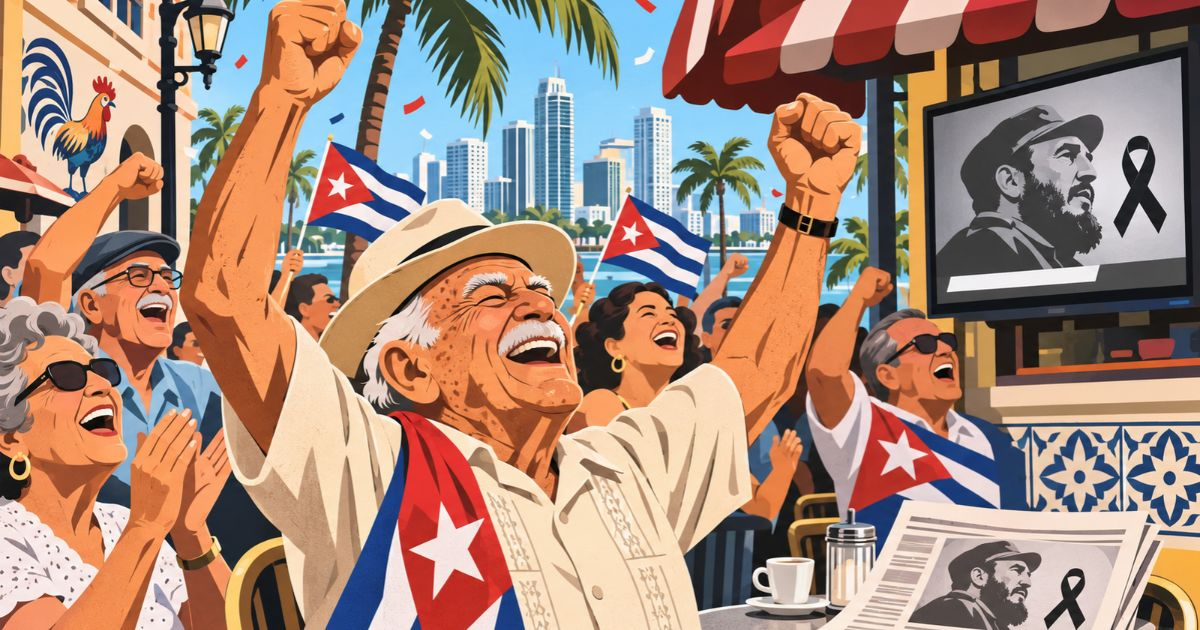
At the age of 88, Fernando Frías took to the streets of Miami to rejoice over the death of Fidel Castro, the leader under whose regime he lost his businesses, endured two years of imprisonment, and ultimately fled Cuba.
A decade after that significant day, his son, Cuban-American journalist Carlos Frías, reflected on one of the most poignant moments he shared with his father.
In a blog post published this Wednesday, Carlos recounted the hours following the announcement of the dictator's demise, recalling the story of a man who had awaited this news for decades.
"Dad, Fidel is dead!" he exclaimed over the phone while driving through Little Havana.
It was 1:09 a.m., and despite his father's advanced age, Carlos knew exactly where to find him: playing dominoes with his siblings, as he did every Friday night.
"What? Really, son?" Fernando responded, incredulous, before sharing the news with his companions.
Carlos remembered his father's nervous laughter, the crack in his voice, and the shouts from those on the other end of the line.
Meanwhile, Little Havana transformed into the backdrop for a massive celebration. Amid champagne bottles, Cuban and American flags, tears, and songs, exiles expressed emotions that had been building for decades.
Carlos Frías himself captured some of the early celebration images in front of the Versailles restaurant, which were broadcast by the press on November 26, 2016.
From Business Owner to Prisoner of the Regime
Fernando Frías was one of 11 siblings from a farming family in the former Oriente province. He made his way to Havana, where he and five of his brothers thrived as café owners.
His life took a drastic turn when Fidel Castro's government nationalized private businesses, confiscating his seven commercial establishments, including stores and grocery shops.
Later, he attempted to escape Cuba on a speedboat but ended up imprisoned for two years.
According to his son's account, during his first night in jail, Fernando heard the execution of 17 men, a number he deduced from the count of gunshots.
Fernando managed to leave Cuba at the age of 42, starting anew in the United States.
"The man I knew wasn't the one left behind," Carlos reflected on the two phases of his father's life.
"I've Waited My Entire Life for This"
The morning after Castro's death was announced, Fernando called his son to join the celebrations in Miami.
From his home in Pembroke Pines, he drove to Carlos's house in Flagami, and the two headed to the Versailles restaurant, where the festivities continued.
The journalist dropped his father off near the venue while he searched for parking. Upon returning, he struggled to find him amid the crowd on Calle Ocho.
Surrounded by flags, dances, and people singing Willy Chirino's songs, Carlos finally spotted his father's red and white cap.
On that day, "Our Day is Coming," the iconic Willy Chirino anthem, echoed through Miami's streets, accompanying the Cuban community's celebrations.
Fernando's reaction mirrored that of other Cubans who had suffered imprisonment under Castro's government. In New Jersey as well, former political prisoners celebrated the dictator's death, hoping for change on the island.
Carlos found his father applauding and singing among the crowd. When Fernando turned, looking skyward with eyes reddened by emotion, the journalist felt he was witnessing the man who existed before leaving Cuba.
"I've waited my entire life for this," Fernando told him.
Understanding the Impact of Fidel Castro's Death on Cuban Exiles
Why was Fidel Castro's death significant to Cuban exiles?
Fidel Castro's death marked the end of an era for many Cuban exiles who had suffered under his regime. It symbolized the possibility of change and the hope for a different future for Cuba.
How did Cuban-Americans in Miami respond to Castro's death?
Cuban-Americans in Miami responded with large-scale celebrations, gathering in areas like Little Havana to express their relief and hope for political change in Cuba.
What was Fernando Frías' experience under Castro's regime?
Fernando Frías lost his businesses when the government nationalized private enterprises and spent two years in prison after a failed escape attempt, before eventually starting a new life in the United States.