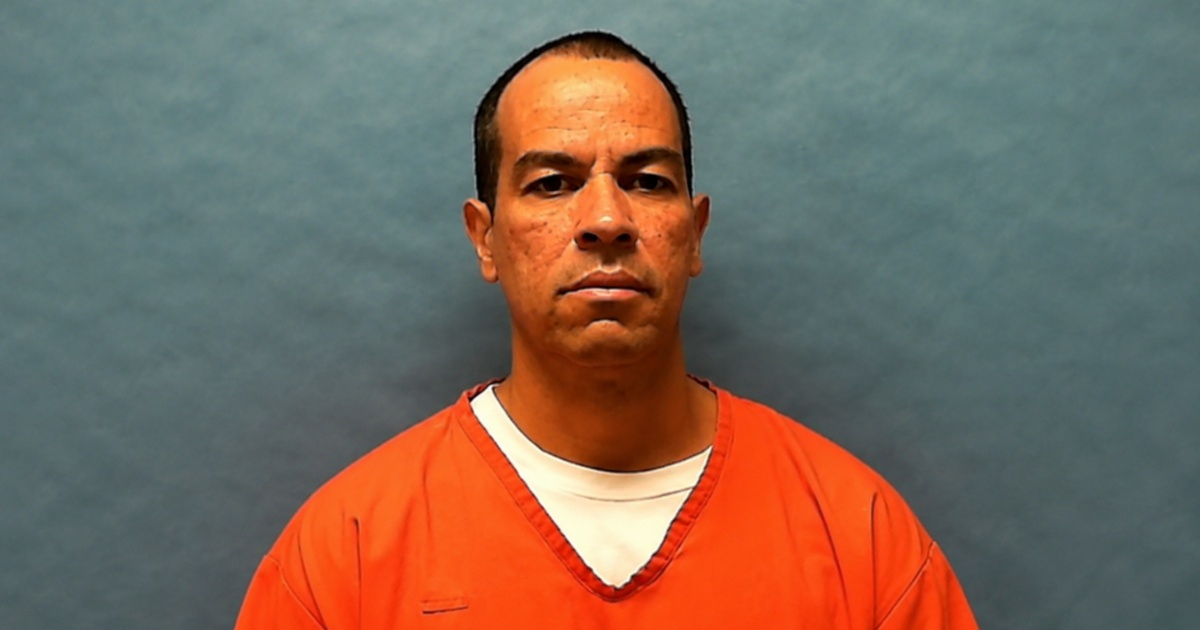
The Florida Supreme Court has closed the final legal avenue for 56-year-old Ricardo González by dismissing all his pending appeals, thereby ordering his execution to proceed without reconsideration.
The lethal injection is scheduled for Tuesday, December 1, at 6:00 p.m. at the Florida State Prison in Starke, according to the Tampa Free Press.
Identified as Cuban in Spanish media reports, González has been on death row for over thirty years for a crime committed on January 3, 1992—a robbery at the Kislak National Bank in North Miami that resulted in the death of 37-year-old officer Steven Bauer, a father of three with twelve years of service with the North Miami Beach police.
Bauer was escorting two employees to the drive-thru windows when González and his accomplices ambushed him.
Investigators concluded that González fired the shot that fatally struck the officer in the chest, although he claimed he aimed downward, thinking he would only wound him in the leg.
The robbers stole approximately $17,000, with González receiving $1,500 as his share of the loot.
Along with accomplices Pablo San Martín, Leonardo Franqui, Fernando Fernández, and Pablo Abreu, also of Cuban origin, González was charged with first-degree murder of a law enforcement officer, armed robbery, aggravated assault, illegal possession of a firearm during the commission of a felony, third-degree grand theft, and burglary.
Legal Battles and Rejected Appeals
The state supreme court rejected nine post-conviction arguments presented by the defense, including claims of intellectual disability and brain damage, the risk of suffering during lethal injection due to drug allergies—deemed "speculative"—and the challenge to the jury's non-unanimous recommendation.
The defense also argued that González was 21 at the time of the crime and had no intent to kill, but the court dismissed this as untimely and procedurally barred.
Regarding his prolonged stay on death row, the court was unequivocal: "We have repeatedly rejected constitutional challenges to executing an individual after a lengthy period on death row."
Governor's Temporary Suspension and Mental Competency Evaluation
In preceding weeks, the defense also raised a challenge to González's mental competence to face execution.
Governor Ron DeSantis temporarily halted the execution on November 17, appointing three psychiatrists to assess him.
The panel concluded, "with a reasonable degree of medical certainty," that González understood the nature of the death penalty and the reasons for its imposition, prompting DeSantis to lift the suspension two days later through Executive Order 26-235.
A hearing on this competency, scheduled for Wednesday in Bradford County, was canceled without explanation in the record.
Historical Context and Judicial Decisions
The case has seen extensive judicial proceedings. González was initially sentenced in May 1994, but the Florida Supreme Court overturned the first death sentence in 1997—when the jury had voted 7-5—and ordered a retrial.
In 1998, a second jury recommended the death penalty by an 8-4 vote, and Judge Robert Scola Jr. issued the sentence that same year.
The U.S. Supreme Court already denied a review of the case in October 2011, leaving the federal court as the last resort for the defense before Tuesday.
Two of his co-defendants, Leonardo Franqui and Pablo San Martín, remain on Florida's death row with no set execution dates.
Two other participants in the robbery had their death sentences commuted to life imprisonment without parole.
If carried out, González's execution would be Florida's 21st in 2026, surpassing the previous record of 20 set on November 19 with the execution of Thomas Overton.
Under DeSantis, the state has overseen more than 40 executions since January 2025, marking the highest rate since the death penalty was reinstated in the United States in 1976.
FAQs on Ricardo González's Case and Execution
Why was Ricardo González sentenced to death?
Ricardo González was sentenced to death for the murder of officer Steven Bauer during a bank robbery in 1992.
What legal avenues are left for González's defense?
The defense's only remaining option is to seek intervention from the U.S. Supreme Court, as the Florida Supreme Court has rejected all appeals.
How many executions have occurred under Governor DeSantis?
Since January 2025, Florida has conducted over 40 executions under Governor Ron DeSantis, the highest number since the reinstatement of the death penalty in 1976.
What was the outcome of González's mental competence evaluation?
A panel of psychiatrists concluded that González is mentally competent, understanding the nature and reason for his execution, leading to the lifting of the temporary suspension.