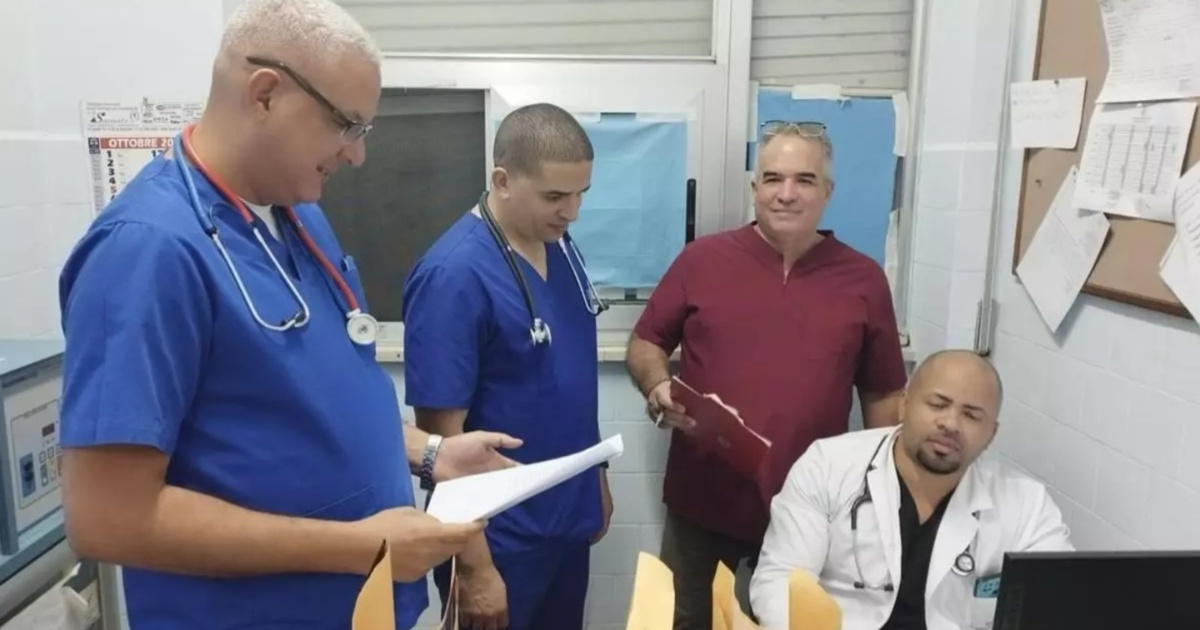
This week, an Italian news outlet inadvertently highlighted the exhausting schedule that Cuban doctors stationed in Calabria endure. On Thursday, after completing a grueling 12-hour session of the official Italian PLIDA exam without any breaks, many Cuban doctors headed straight to hospitals to cover night shifts.
The event unfolded at the "P. Galluppi" High School in Tropea, where the local committee of the Società Dante Alighieri hosted the language certification session. A significant number of the Cuban medical brigade members working in the region attended this session.
Informa Calabria, a local newspaper, portrayed the situation as a story of dedication and commitment. Titti Rando, chairwoman of the Tropea committee of Dante Alighieri, expressed, "Witnessing these Cuban doctors approach the exams with such seriousness is profoundly moving. These individuals have left their homeland to care for ours. Knowing that many returned directly to the hospital to work overnight after such a demanding exam evokes immense gratitude."
While the Italian press celebrates this as an admirable gesture, it essentially depicts a workday that far exceeds any reasonable limits: more than twelve hours of academic testing followed by a night shift, with no rest in between.
This episode is part of a program managed by the Cuban regime through the Cuban Medical Services Trading Corporation (CSMC), a state-owned enterprise that negotiates and collects the fees for overseas missions.
Research by the Cuban Observatory for Human Rights (OCDH) reveals that the agreement stipulates a gross monthly salary of 4,700 euros per professional, of which approximately 3,500 euros—nearly three-quarters—are transferred to the CSMC, leaving around 1,200 euros for the doctor.
In February, Mike Hammer, the United States chargé d'affaires in Havana, traveled to Calabria to urge Governor Roberto Occhiuto to halt the program, citing forced labor and human trafficking concerns. Occhiuto refused, arguing that Cuban doctors are essential for keeping hospitals and emergency services running in one of Italy's poorest regions.
In June, the European Parliament approved a resolution explicitly mentioning Cuban medical brigades as a potential form of human trafficking, and the OCDH requested the European Union to investigate the program in September.
The PLIDA exam these doctors took has an additional dimension not mentioned in the Italian article: obtaining Italian certification is a necessary step to validate their degrees and practice independently in Italy, outside the mission's control.
In 2026, 63 Cuban doctors who had participated in the program applied to join the Calabrian healthcare system individually, allowing them to earn directly without the CSMC's mediation.
The contrast with the situation in Cuba is striking. On Saturday, the Saturnino Lora Hospital in Santiago de Cuba announced a call for 401 vacant positions across 27 job categories—with monthly salaries ranging from 3,885 to 6,435 Cuban pesos—because, according to the institution, "everyone left."
That same day, a resident doctor at the Arnaldo Milián Castro Hospital in Santa Clara reported consecutive shifts of more than 30 hours, months without pay, and a ban on diagnosing hepatitis, leptospirosis, and dengue.
While Calabria applauds the dedication of Cuban doctors, Cuba's hospitals are being depleted of specialists as the regime exports them to earn foreign currency.
Key Facts About Cuban Doctors in Calabria
Why are Cuban doctors working in Calabria?
Cuban doctors are in Calabria as part of a program managed by the Cuban regime through the Cuban Medical Services Trading Corporation to provide medical services and earn foreign currency.
What are the working conditions for Cuban doctors in Calabria?
Cuban doctors often face demanding schedules, such as long exam sessions followed by immediate night shifts, with limited financial compensation due to the majority of their earnings being transferred to the CSMC.
What is the PLIDA exam, and why is it significant?
The PLIDA exam is an official Italian language certification necessary for Cuban doctors to validate their medical degrees and practice independently in Italy, outside the constraints of the Cuban mission.