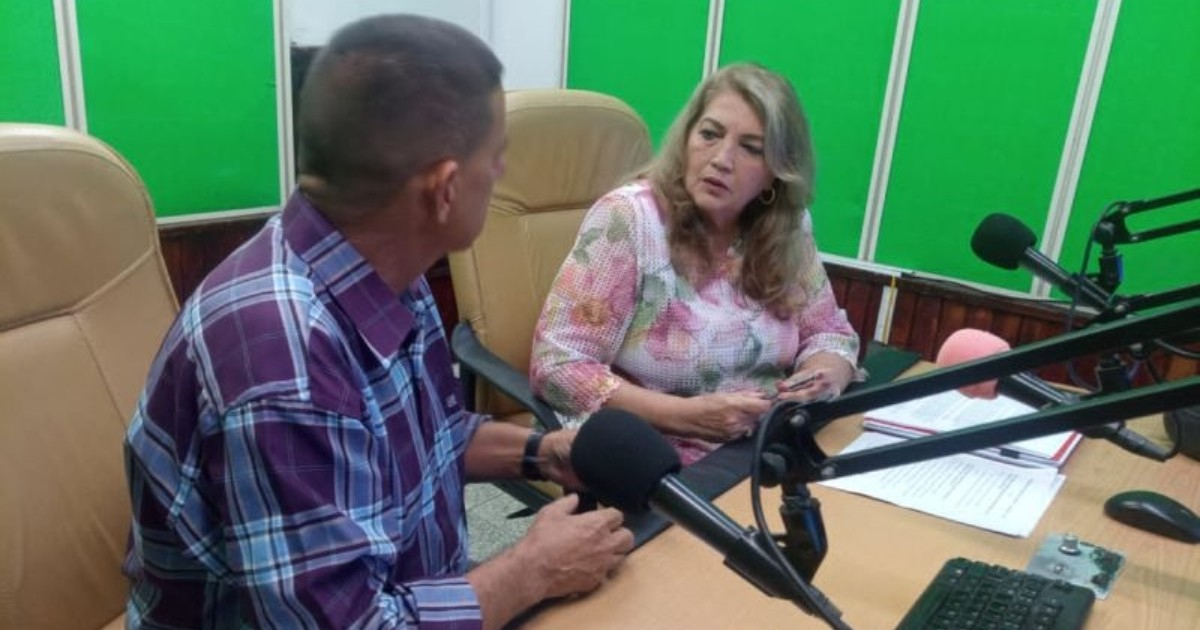
Deivy Pérez Martín, the first secretary of the Communist Party in Sancti Spíritus, openly acknowledged on Wednesday that wages in Cuba are insufficient to meet everyday needs. She made these remarks during the inaugural broadcast of the radio program "Open Microphone" on Radio Sancti Spíritus, a segment focused on evaluating the 176 economic and social transformations being implemented in the area.
"We all find ourselves somewhat vulnerable when daily life is confronted with wages that fall short," stated the Central Committee member as she discussed the situation of families hardest hit by the current crisis, according to the Escambray newspaper.
Pérez Martín revealed that 32,000 families in the province are officially classified as vulnerable. However, she acknowledged that public perception suggests this number is significantly higher due to uncontrolled inflation. The aid provided to those already identified, she admitted, "is still far from meeting people's actual needs."
The statistics reinforce this viewpoint. As of August 2026, the average state salary in Cuba was 7,354 pesos, while the annual inflation rate reached 32.70% in October, with food prices rising by 50.72%.
Addressing the issue of prices, Pérez Martín was candid: "We remain in a severe fuel crisis that hampers essential activities. Consequently, we have been unable to halt the price spiral." The fuel shortage, she added, has worsened urban cleanliness and exacerbated health issues due to the proliferation of micro-dumps.
Sancti Spíritus is also struggling with blackouts lasting up to 50 consecutive hours, water supply issues affecting nearly 58,000 people, and a shortage of over 300 essential medications. By mid-year, almost half of the working-age population was neither employed nor seeking work, with about 2,700 workers classified as inactive due to the energy crisis and lack of resources.
Regarding the 176 transformations, Pérez Martín admitted that "there is still much to be done" and "progress is uneven," though she noted that the territory's eight agro-industrial companies have now shifted to municipal control. "The transformations are not yet the solution to our problems," she conceded.
"Open Microphone" is explicitly modeled after "Shared Criteria," a program led by Díaz-Canel on Radio Rebelde since September 2026. When the new program was announced in mid-November, it was met with ridicule and skepticism on social media: "It's contagious, monkey see monkey do," quipped one user; another questioned whether the answers and questioners had already been prepared.
Communist leader Deivy Pérez Martín stressed that "no matter how challenging the situation we're facing, officials, organizations, and institutions have the responsibility to respond and follow up. Perhaps we don't have the solution, but attention to the issue is imperative."
Insights into Cuba's Economic Challenges
What did Deivy Pérez Martín admit about Cuban salaries?
She admitted that Cuban salaries are insufficient to meet daily needs, leaving many families vulnerable.
How many families in Sancti Spíritus are considered vulnerable?
Officially, 32,000 families are categorized as vulnerable, but public perception suggests the actual number is higher due to inflation.
What are some of the main issues caused by the fuel crisis?
The fuel crisis has led to a spike in prices, worsened urban cleanliness, and increased health issues due to micro-dumps.
What is the public's reaction to the "Open Microphone" program?
The program was met with ridicule and skepticism on social media, with some users mocking its resemblance to another program.