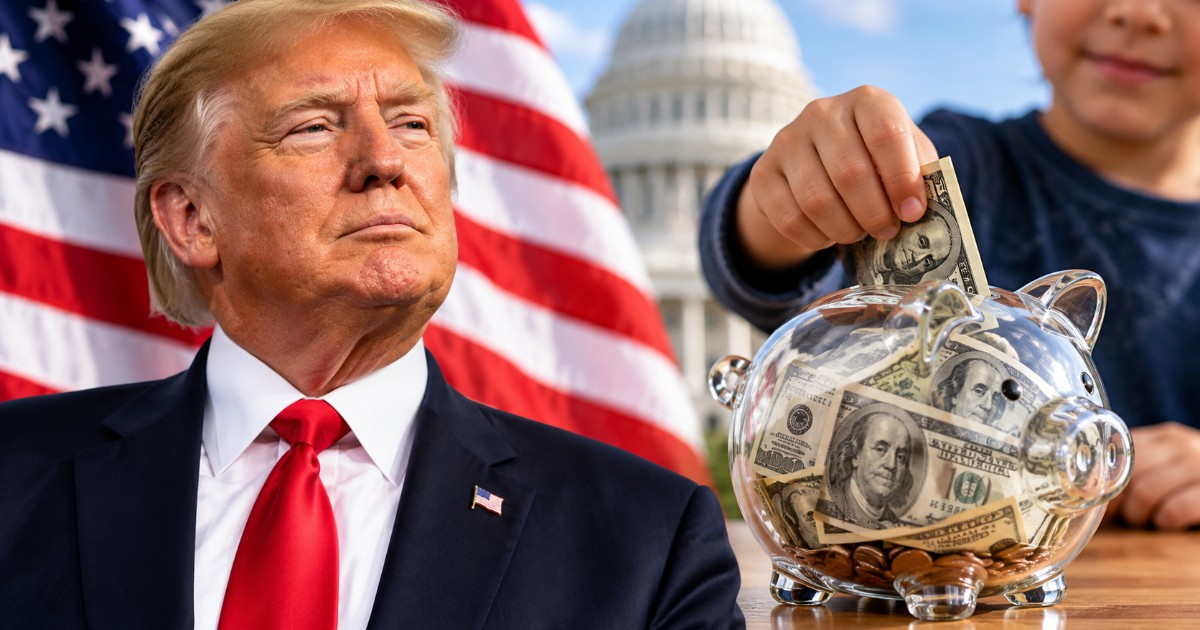
The investment accounts for minors, championed by former U.S. President Donald Trump, have amassed over $1 billion in contributions from relatives and friends. The total amount deposited in the program now exceeds $9 billion.
On Tuesday, Treasury Secretary Scott Bessent celebrated this significant milestone of the program, commonly referred to as Trump Accounts, through a statement on the official Treasury website.
More than three million individuals have made personal contributions, not including large philanthropic donations or initial federal government contributions.
Interestingly, President Trump himself joined the ranks of those personally donating to these accounts this week.
Opportunities for Cuban Immigrant Children
The initiative, launched through a budgetary law signed by Trump in July 2025, started receiving contributions on July 4, 2026. It aims to promote financial asset accumulation from a young age.
Can children of Cuban immigrants take advantage of this program? Absolutely. Children of Cuban immigrants can benefit from Trump Accounts, regardless of their parents' nationality, as long as they meet the program's criteria.
According to the Internal Revenue Service (IRS), to hold one of these accounts, the beneficiary must have a valid Social Security Number (SSN) and be under 18 years old by the end of the year in which the account is established.
While U.S. citizenship is not a general requirement to own a Trump Account, it is necessary to receive the initial $1,000 government contribution.
To qualify for this government deposit, the child must be a U.S. citizen, born between January 1, 2025, and December 31, 2028, and have a valid SSN.
For instance, a child born in Miami in 2026 to Cuban parents could receive the $1,000 if they meet these conditions and an authorized person requests the benefit.
Conversely, a child born in Cuba without U.S. citizenship could hold an account if they meet the age requirements and have a valid SSN for employment, but wouldn't automatically receive the federal contribution.
Children with only an Individual Taxpayer Identification Number (ITIN), without a valid SSN, do not qualify for these accounts.
Claiming the Government's $1,000 Contribution
To resolve queries about eligibility, activation, and account management, families can contact the program's help service via phone at 866-872-4547.
As of October 1, the Treasury Department has been automatically enrolling eligible minors in the program. However, parents or legal guardians must claim the accounts to manage them.
This process can be initiated through the official Trump Accounts app, available for both Android and iPhone devices.
The authorized adult will need to verify their identity, prove their relationship to the minor, review the beneficiary's personal information, and accept the account terms.
To specifically claim the federal $1,000, the IRS requires submitting form 4547 and selecting the option related to the pilot program contribution.
The application can be completed via the official app, the Trump Accounts website, or through the taxpayer's individual account on the IRS website.
It's important to note that the automatic creation of an account does not mean the beneficiary will automatically receive the $1,000.
Family Contributions and Investment Details
The accounts accept contributions from parents, grandparents, other relatives, friends, employers, and philanthropic organizations.
Once the account is claimed, family and friends can contribute directly using a QR code available in the program's app.
The general limit on individual contributions is $5,000 annually per beneficiary. Employers can contribute up to $2,500 a year, typically included within the general limit.
The government's initial contribution and certain qualified philanthropic donations are exempt from this ordinary limit.
The contributions are invested in index-linked funds primarily composed of American companies, aiming to accumulate long-term capital. Returns are not guaranteed and depend on financial market performance.
Accessing the Funds
Trump Accounts are not like traditional bank accounts where parents can withdraw money for their children's everyday expenses.
Withdrawals are generally restricted until the beginning of the calendar year when the beneficiary turns 18.
From that point on, under the program's tax rules, the accounts generally fall under the same provisions applicable to traditional Individual Retirement Accounts (IRAs).
Early withdrawals might be subject to taxes and an additional 10% penalty, although exceptions exist for specific expenses like higher education or a first home purchase.
In recent developments, the Trump administration announced on October 7 that nearly 70 million investment accounts for minors exist in the United States, over 60 million of which were created automatically.
At that time, the White House reported accumulated funds exceeding $4.5 billion, including approximately $1.3 billion in federal contributions, more than $600 million in individual contributions, and another $2.6 billion linked to philanthropic donations.
Frequently Asked Questions About Trump Accounts
Who is eligible to open a Trump Account?
Any minor under 18 with a valid Social Security Number can have a Trump Account, regardless of their parents' nationality.
What are the requirements to receive the $1,000 government contribution?
A child must be a U.S. citizen, born between January 1, 2025, and December 31, 2028, and have a valid Social Security Number to receive the $1,000 federal contribution.
Can contributions exceed $5,000 annually?
The general limit for contributions is $5,000 annually per beneficiary, but government contributions and certain philanthropic donations are exempt from this limit.