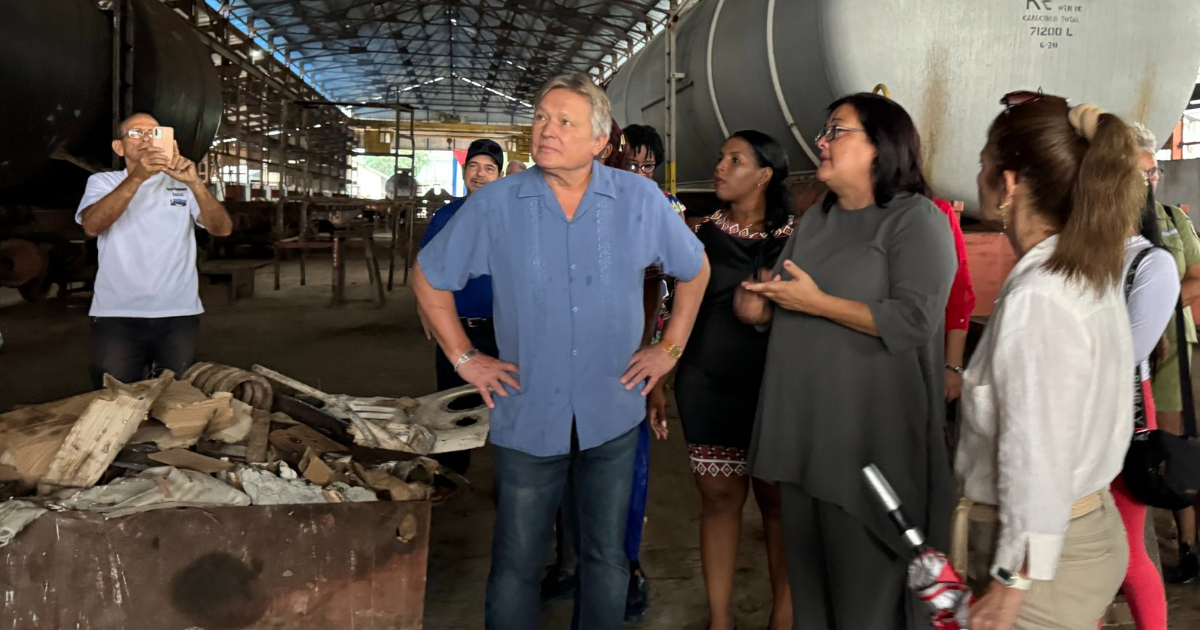
In an interview with the TASS news agency, Victor Koronelli, the Russian Ambassador to Cuba, acknowledged this Tuesday that he cannot ensure Russian companies will implement the new investment proposals put forth by Havana. The interview was also featured by the state-run media outlet, Cubadebate.
"I can't confirm if our companies will take action," Koronelli stated when questioned about whether Russian investors would fill the gaps left by the withdrawal of companies from Spain, Canada, and other nations. According to the ambassador, the ultimate decision rests on market criteria, profitability, and notably, the assessment of risks tied to U.S. secondary sanctions.
This admission is striking given the backdrop of strong cooperative rhetoric between both governments. Back in April 2026, the XXIII Russian-Cuban Intergovernmental Commission announced bilateral investment plans exceeding $1 billion. Additionally, the Cuban regime granted Russian companies permission to run industrial facilities in sectors such as energy, transportation, and food.
Current and Prospective Projects
Koronelli acknowledged that Cuba has submitted new projects to Russia, including tourism proposals, which have received a preliminary review. However, he emphasized that it is now up to Russian investors and the business community to make their decisions.
Regarding ongoing projects, the ambassador affirmed that the main ones are "still underway": the oil cooperation between Zarubezhneft and CUPET at the Boca de Jaruco field—which involves drilling 30 new wells with an investment of 100 million euros—rebuilding the Antillana de Acero steel plant, and a solar power plant of about 10 MW for a water pumping station in Havana. Nevertheless, the latter is awaiting evaluation by the Russian Ministry of Energy, with no construction date announced yet.
Challenges Amidst Official Narratives
The gap between official statements and tangible outcomes is significant. The sole Russian tanker delivering oil to Cuba throughout 2026 was the Anatoly Kolodkin, docking at the Matanzas port in late March with around 100,000 tons of crude. A second tanker altered its course in the South Atlantic in May, never reaching the island. In October, Cuba's ambassador to Moscow admitted that the shipment only mitigated blackouts for about two weeks.
In early November, the Russian Duma's Committee on International Affairs acknowledged that Cuba has been "practically" without fuel imports since August 2026. Russian humanitarian aid has been limited to two shipments of vegetable oil through the World Food Program and a batch of medications planned by the government of Saint Petersburg, with no specified date or volume.
Tourism and Broader Implications
Russian tourism, another cornerstone of the bilateral relationship, has also plummeted. From January to August 2026, only 21,563 Russian tourists visited Cuba, a 73.3% drop compared to the same period last year. Koronelli attributed this decline to the lack of aviation kerosene on the island, which has kept direct flights suspended since February 2026, with no resumption date in sight.
The Russian diplomat's statements inadvertently bolster the argument made by U.S. Secretary of State Marco Rubio at the United Nations in September: "No one will invest in Cuba under its current government model."
Toward the end of the interview, Koronelli used the metaphor of the royal palm to express his belief in Cuban resilience: "This palm doesn't break even under the force of a hurricane: it bends, but it stands back up. And Cubans are a unique nation. They will endure now, just as they did in the 1990s. Simply because no one here gives up."
Key Questions About Russian-Cuban Economic Relations
What factors influence Russian investment decisions in Cuba?
Russian investment decisions in Cuba are influenced by market criteria, profitability, and the evaluation of risks associated with U.S. secondary sanctions.
How has Russian tourism to Cuba been affected recently?
Russian tourism to Cuba has significantly decreased, with only 21,563 Russian visitors from January to August 2026, a 73.3% drop compared to the previous year, largely due to the lack of aviation kerosene and suspended direct flights.
What is the status of Russian humanitarian aid to Cuba?
Russian humanitarian aid to Cuba has been limited to shipments of vegetable oil via the World Food Program and planned medication deliveries by the government of Saint Petersburg, with no confirmed date or volume.