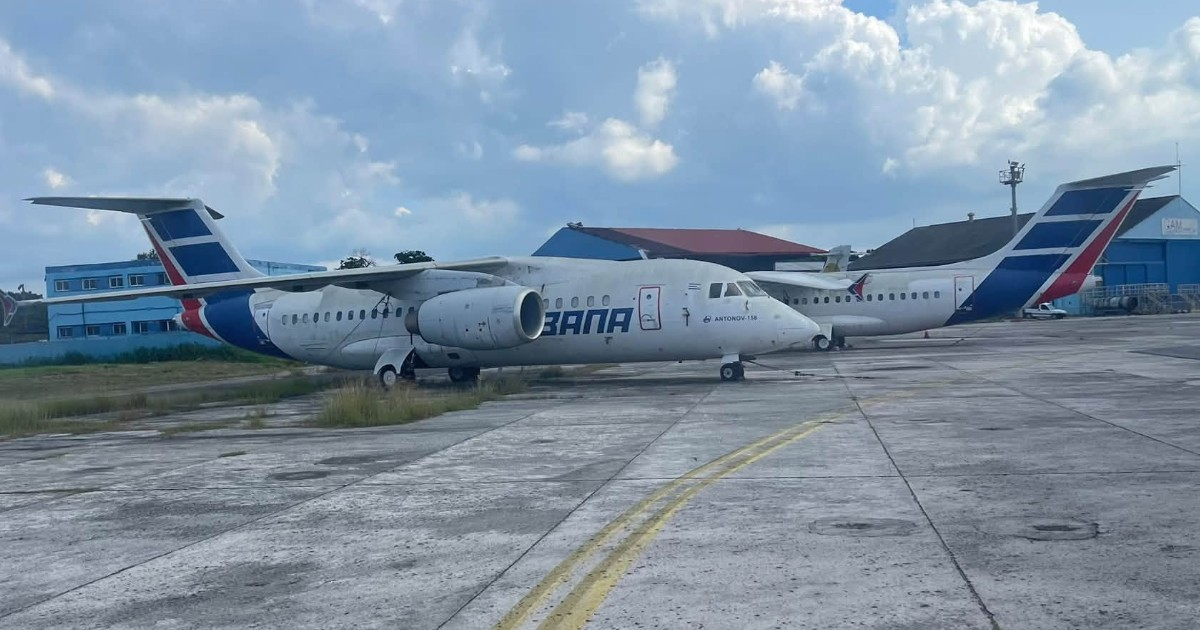
Recent images captured at Havana's José Martí International Airport and shared within the "Fans of Cuban Aviation" Facebook group reveal a troubling sight: multiple Cubana de Aviación aircraft sitting idle, visibly deteriorating, with weeds growing near landing gear and cracked concrete surfaces.
Alberto Pavel Saint-Blancard, who posted the photographs, expressed his dismay: "It pains me to witness firsthand the further decline of these once-proud aircraft that soared through our skies." The post garnered over 1,000 reactions and numerous comments from Cubans, who grimly described the scene as "the only aviation organization in the world with a graveyard right at its airport."
The photos depict at least five planes bearing Cubana's distinctive livery, a Cubana Cargo aircraft, and an Antonov An-158 with its registration numbers erased. "They've erased the Antonov's numbers. What's next?" one user questioned. Another remarked, "And to think the Antonov-158 is the newest of the fleet. What a disaster this country is, my God."
State of Cubana de Aviación's Fleet
The images illustrate the near-total collapse of the airline's fleet. According to Planespotters data as of November 17, 2026, Cubana has eight registered aircraft, with only two operational and six parked. Wikipedia's records from the same month list three active planes — an ATR 42-500 and two ATR 72-200 — averaging 29 years old. One of the ATRs serves as government VIP transport under Aerogaviota, rather than flying regular commercial routes.
The six Antonov An-158s purchased by Cuba since 2013 have been grounded for years. Cuban aviation authorities grounded them in 2018 due to mechanical, hydraulic, electrical, and structural failures. With about 70% of their parts made in Russia, sourcing replacements became nearly impossible. As one commenter put it, "They bought these An-158s, likely the only six made for Cuba, without parts or anything, and with navigation defects. There they are, parked."
Roots of the Decline
The reasons behind this downfall are deep-rooted and decades in the making. One user highlighted that "76% [of airport and international flight revenues] went to GAESA, while ECASA got 24%. That destroyed everything [...] from '98 to 2017." Adding to the woes are multimillion-dollar lawsuits from Russian firm ARK-Technic against Cubana and the Cuban Aviation Corporation (CACSA) for maintenance debts exceeding $6.2 million, with a second lawsuit filed in September 2026 for over 188 million additional rubles.
The Jet A-1 fuel crisis affecting ten Cuban airports since February 2026, with warnings extended to December 1, further exacerbates the operational challenges.
Beyond the Blockade Excuse
Many commenters dismissed the U.S. embargo as the reason for Cubana's collapse. "No one cares. It's poor management and a failure to solve problems. It's not the blockade, since all these planes are Russian-made," wrote one user. Others expanded the critique beyond aviation: "If it were just the planes, but it's everything: roads, buildings, houses, farms, sugar mills, factories, stores, pharmacies, hospitals. The country is in ruins."
Founded in 1929 and nationalized after the 1959 revolution, Cubana de Aviación now receives one out of seven stars in AirlineRatings.com's safety evaluation and is absent from the International Air Transport Association's (IATA) IOSA audit program. As of January 2025, CACSA's president admitted the airline was operating with only two aircraft.
Understanding the Crisis at Cubana de Aviación
What is the current state of Cubana de Aviación's fleet?
As of November 2026, Cubana de Aviación has eight registered aircraft, with only two in service and six parked. The active aircraft include an ATR 42-500 and two ATR 72-200.
Why were the Antonov An-158 aircraft grounded?
The Antonov An-158 aircraft were grounded in 2018 due to mechanical, hydraulic, electrical, and structural failures, compounded by difficulty in sourcing Russian-made replacement parts.
What are the financial challenges facing Cubana de Aviación?
Cubana de Aviación faces significant financial challenges, including lawsuits from ARK-Technic for maintenance debts exceeding $6.2 million, with additional claims filed for over 188 million rubles.