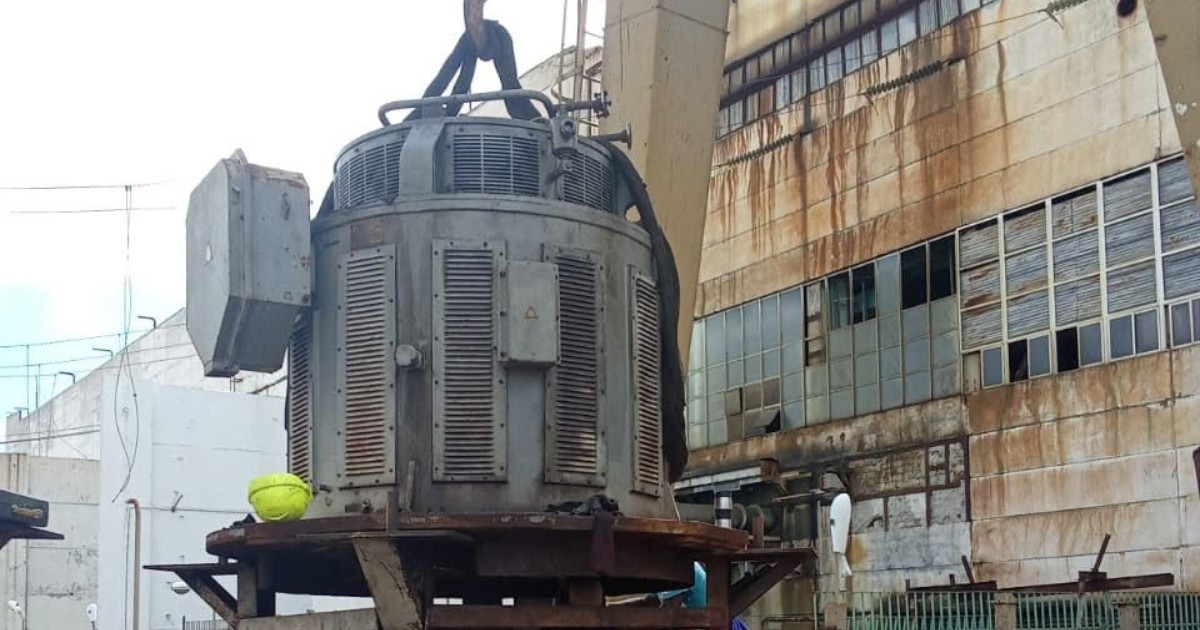
On Monday morning at 9:01 AM, the Electric Union (UNE) announced an emergency shutdown of Unit 3 at the Antonio Maceo Thermoelectric Plant, commonly known as Renté, located in Santiago de Cuba. This incident further exacerbates the already dire state of the National Electric System (SEN).
This latest malfunction occurs amidst a prolonged collapse: according to the official report from UNE and the Ministry of Energy and Mines (MINEM) for this Monday, by 6 AM, SEN's availability stood at a mere 1,105 MW against a demand of 2,135 MW, with 1,039 MW already out of service at that time.
By midday, UNE anticipated an impact of 1,200 MW, though the most concerning scenario is expected to unfold at night.
The state agency projected that during peak demand hours, availability would remain at 1,105 MW against a demand of 2,800 MW, resulting in a shortfall of 1,695 MW and a predicted impact of 1,725 MW—equivalent to over 61% of the maximum projected demand.
Systemic Failures and Maintenance Issues
Alongside units already offline, a series of breakdowns and maintenance works affect several plants across the country: Unit 1 at the Santa Cruz Thermoelectric Plant and Unit 2 at the Felton Thermoelectric Plant are out of operation; under maintenance are Unit 3 of the Santa Cruz Plant, Unit 5 of the Nuevitas Plant, Unit 1 of the Felton Plant, and Unit 5 at Renté itself.
Thermal generation limitations amount to 446 MW.
Solar Power Insufficient to Meet Demand
On Sunday, service was disrupted due to capacity deficits for the entire 24-hour period, with no recovery even during the early hours, as acknowledged by UNE in its statement.
As a partially positive note, photovoltaic solar parks contributed 4,601 MWh on Sunday, providing a maximum power delivery of 715 MW at midday. However, this contribution does not address the nighttime deficit that coincides with peak demand.
Historical Challenges and Future Outlook
The Antonio Maceo Plant has been operating with Soviet-era technology since the mid-1960s and has an installed capacity of 400 MW, representing approximately 12% of the country's necessary thermal generation, according to the Ministry of Energy and Mines. Each failure at this plant has a direct and significant impact on SEN.
Unit 3 of Renté has a history of frequent failures: it was out of service due to instrumentation issues in October 2025, experienced another failure in October 2026, and now faces a new emergency, highlighting the structural deterioration of Cuba's electrical infrastructure.
November 2026 is shaping up to be one of the toughest months for Cubans in terms of energy, with daily peak-hour deficits ranging from 1,695 to 1,922 MW throughout the month, with no signs of short-term recovery.
Understanding Cuba's Energy Crisis
What caused the recent power outage in Cuba?
The recent power outage was caused by an emergency shutdown of Unit 3 at the Antonio Maceo Thermoelectric Plant, exacerbating the existing issues in Cuba's National Electric System.
How significant is the impact of Renté's Unit 3 failure on Cuba's power supply?
The failure of Renté's Unit 3 is significant as it directly impacts the National Electric System's capacity, contributing to a deficit of 1,695 MW during peak demand times.
What role do solar parks play in Cuba's energy mix?
Solar parks contribute to Cuba's energy supply by generating electricity during daylight hours, but they are insufficient to meet the nighttime demand peak.