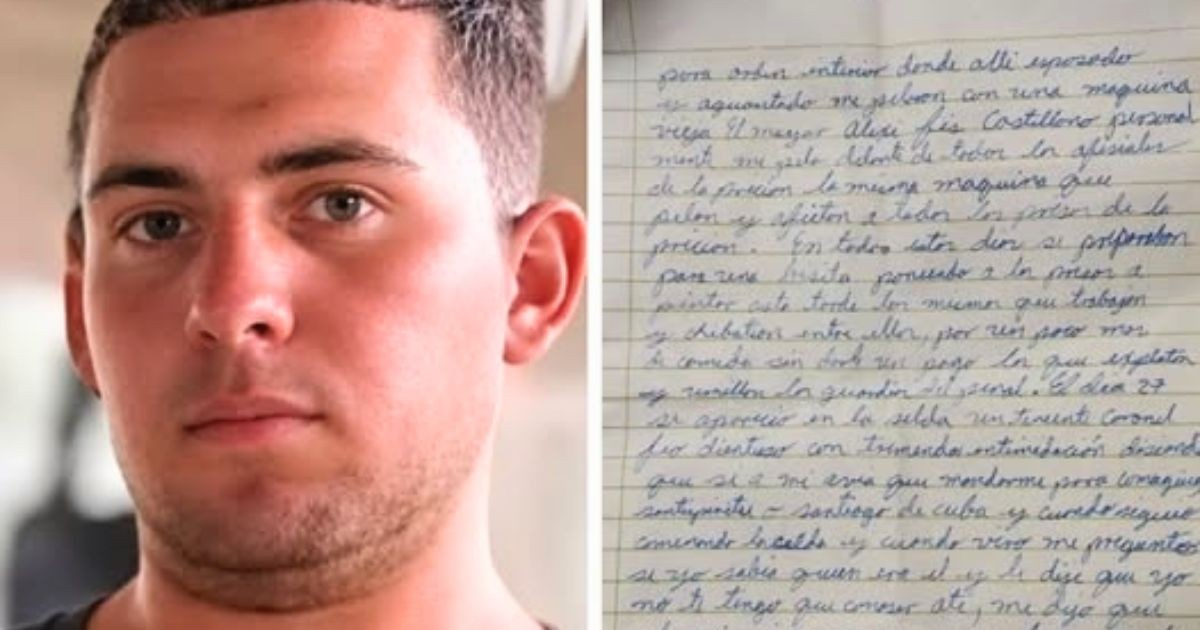
Vladimir Castillo Llanes, a political prisoner known by the nickname "Pichy," has brought to light the harsh conditions he faces in Quivicán prison in Mayabeque through a handwritten letter. Castillo, 32, is currently serving a nine-year sentence for his involvement in the July 11, 2021 protests.
The letter, dated November 8, was shared on Facebook by Marcel Valdes, who urged followers to spread the word about Castillo's situation.
Castillo recounts that since October 14, he has been placed in a punishment cell for refusing to comply with an order from Lieutenant Colonel Alcides Ochoa, the head of the Mayabeque province. "Since October 14, I've been in a cell at Quivicán prison because the provincial chief, Lieutenant Colonel Alcides Ochoa, told me to put my hands behind my back to speak with him. I refused," Castillo wrote.
In retaliation, he was handcuffed and taken to the prison's interior order area, where he was forcibly shaved. "On the 19th, they took me to the interior order area, where, handcuffed and restrained, I was shaved with an old machine. Major Alexis Castellanos personally shaved me in front of all the officers," he described.
Before this incident, Castillo questioned whether the officer intended to torture him, drawing a parallel to the notorious treatment in the former AIDS prison in San José de las Lajas, which was used to detain protestors after the July 11 demonstrations.
Prolonged Solitary Confinement without Explanation
Initially, Castillo was sentenced to 15 days in solitary confinement. However, when that period ended on October 29, he was not released, nor was he given any explanation for his continued detention. "When October 29 came, marking the end of the 15 days, I wasn't let out, and as of today, November 8, no one knows why I'm still here," he wrote, highlighting the lack of communication from the prison authorities.
On October 27, an unidentified lieutenant colonel visited his cell, issuing threats of transferring him to other remote Cuban provinces such as Camagüey, Sancti Spíritus, or Santiago de Cuba.
Inhumane Living Conditions
Castillo describes living conditions in the prison as deplorable. "I don't sleep with a mattress because the ones here, besides being made of batting, are filthy, and I'm afraid of contracting a disease by using them. Darkness, rats, cockroaches, and mosquitoes are part of daily life in these cells," he noted.
He also accused the authorities of exploiting inmates by making them paint the prison in preparation for visits, offering only extra food instead of proper compensation. Castillo views this as a criminal act and a violation of prisoners' rights.
Moreover, Castillo reported that a fellow inmate had been requesting medical assistance since October 26, yet no medical personnel or official had addressed his needs by the time the letter was written.
Castillo holds the prison officials accountable for the deaths occurring inside. "This lack of medical attention and the absence of food and medicine are why we have so many deaths here," he stated, specifically blaming Major Álvaro, head of Quivicán prison, and a lieutenant colonel identified as the head of Health for Mayabeque.
Widespread Neglect in Cuban Prisons
Castillo's revelations are not isolated. According to a report by Cubalex, the Quivicán facility, also known as Aguacate, reported at least eight documented deaths between February 2024 and June 2026. Seven were due to negligence or denial of medical care, while one was allegedly a suicide under custody.
Nationally, Cuba reached a troubling figure of 1,353 political prisoners by October, as reported by Prisoners Defenders. Among them, 464 suffer from severe health issues without proper care, and 236 endure forced malnutrition.
Castillo's mother, Maité Llanes, shared that her son's requests for parole benefits were denied multiple times. After the last denial between January and February 2026, Castillo informed state security agents that he would serve his sentence in full rather than continue to seek parole.
Cubalex has also documented at least 14 political prisoners who, after being released, were re-incarcerated, highlighting that the regime's notion of freedom does not end persecution.
In a rare moment of joy, Nadir Martín Perdomo, another political prisoner from the July 11 protests, was released this past Sunday after serving five and a half years of an unjust sentence at Quivicán. He was warmly welcomed by his community with cries for freedom, tears, and celebration.
Frequently Asked Questions about Conditions in Cuban Prisons
What are the living conditions like in Quivicán prison?
The living conditions in Quivicán prison are described as inhumane, with issues such as lack of clean mattresses, infestations of rats and insects, and inadequate medical attention.
How many political prisoners are currently in Cuba?
As of October, there are 1,353 political prisoners in Cuba, according to Prisoners Defenders. Many of them suffer from severe health issues and malnutrition.
Who is responsible for the conditions in Quivicán prison?
Vladimir Castillo Llanes holds Major Álvaro, the prison head, and a lieutenant colonel responsible for health services in Mayabeque accountable for the dire conditions and deaths within the prison.