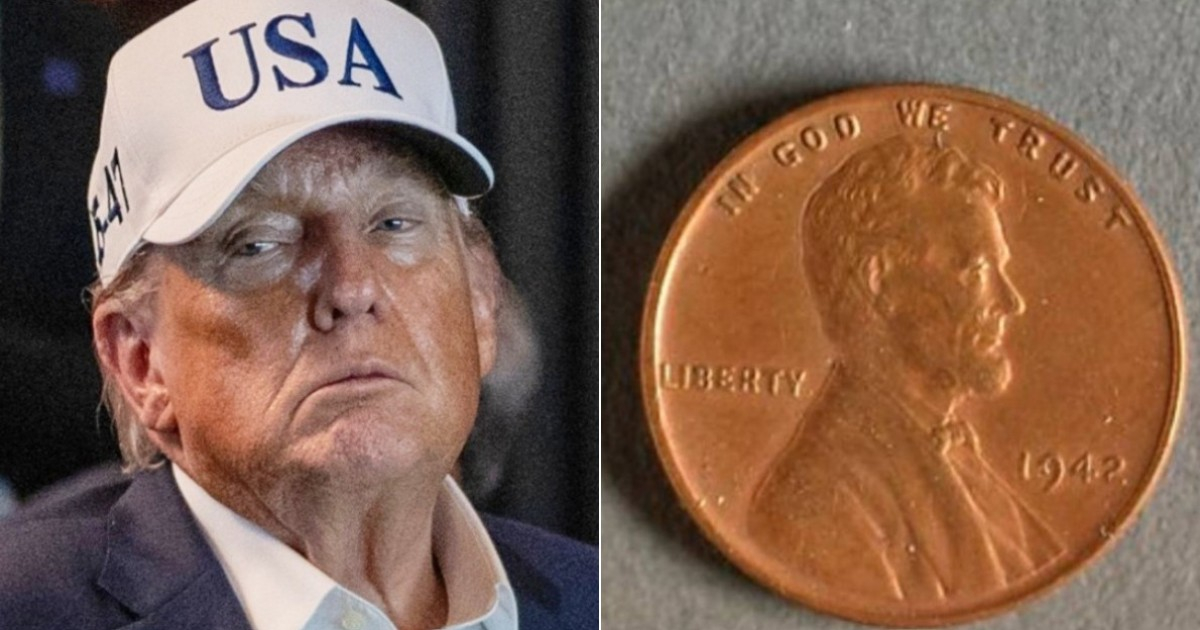
President Donald Trump signed the Common Cents Act (H.R. 10167) into law on Friday, officially ceasing the production of the penny in the United States after nearly 250 years of continuous minting since 1793.
This decision was met with unanimous approval from both the House of Representatives and the Senate, as they supported the measure through voice votes. The bill received broad bipartisan support.
The primary rationale behind the legislation is economic: each penny cost around four cents to produce, resulting in substantial financial losses for the government.
In 2024 alone, minting approximately 3.2 billion pennies led to losses exceeding $85 million.
Republican Representative Lisa McClain from Michigan, who authored the bill, expressed her approval: "This legislation will save $85 million annually by permanently ending penny production; it's just common sense!"
According to the White House, halting penny production is expected to save $56 million annually, based on Treasury Department data.
This law formalizes what had already occurred in practice: the government stopped minting pennies for general circulation in November 2025, nine months after Trump instructed Treasury Secretary Scott Bessent to halt production.
At that time, Trump took to social media to assert: "For too long, America has minted pennies that, quite literally, cost us more than two cents each. This is wasteful!"
Trump's directive to eliminate the penny required legislative backing since the constitutional authority to mint or retire coins rests with Congress, not the Executive Branch.
Despite ending production, the approximately 114 billion pennies already in circulation will remain legal tender for "all debts, public charges, taxes, and dues," according to the law.
The Federal Reserve will continue to recirculate these coins as long as feasible, and the U.S. Mint may still produce limited quantities for collectors.
Impact on Cash Transactions
For cash transactions without exact change, the law introduces a rounding system to the nearest five-cent increment; electronic payments will still be processed to the exact cent.
Future of the Nickel
The law also paves the way for a reform in the composition of the nickel, now the lowest denomination coin in circulation. It authorizes the Treasury to explore using zinc instead of the current copper-nickel alloy to reduce production costs, which exceeded 13 cents per unit in fiscal year 2025.
The penny has a storied history spanning nearly 250 years. The Coinage Act was passed by Congress in 1792, and the Mint began penny production the following year.
The first known design was created by Benjamin Franklin in 1787 and featured a sundial. Over the centuries, the penny has undergone various designs, with Abraham Lincoln's image added in 1909 to commemorate his birth centennial. The most recent design, the Union Shield, was introduced in 2010.
The United States isn't the first nation to take this step; countries like Canada, Australia, and New Zealand eliminated their pennies in 2013, 1992, and 1989, respectively, without significant adverse economic effects.
Penny Elimination: What to Know
Why did the United States stop producing pennies?
The United States ceased penny production because it cost approximately four cents to produce each penny, leading to substantial financial losses for the government.
What happens to the pennies currently in circulation?
Pennies that are already in circulation will remain legal tender for all debts, public charges, taxes, and dues. The Federal Reserve will continue to circulate them as long as possible.
How will cash transactions be affected without pennies?
For cash transactions that cannot be made with exact change, a rounding system to the nearest five-cent increment will be used. Electronic payments will continue to be processed to the exact cent.