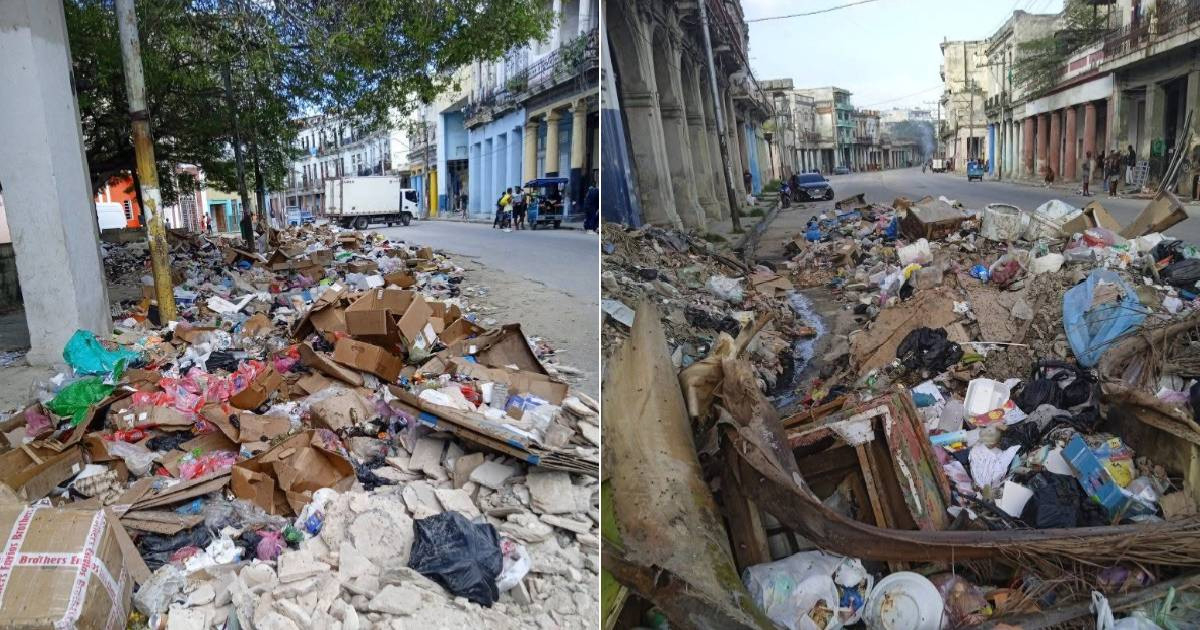
Former audiovisual producer at the Cuban Institute of Radio and Television (ICRT), Cesáreo Navas y Morlanes, boldly called for the resignation of Havana's first secretary of the Communist Party, Liván Izquierdo Alonso, and governor Yanet Hernández López. Navas cited the severe neglect and unsanitary conditions plaguing the city as the reason for his demand.
In a pointed Facebook post, Navas described the dire situation on Monte Street in the Cerro municipality, where he claimed residents have gone weeks without garbage collection services.
"The piles of trash along Montes Avenue are grotesque and overwhelming," he noted. "Heaps of garbage stretch and rise, blocking streets, sidewalks, and even the corners and doorways of buildings." Navas further reported clogged pipes and the overflow of contaminated water mixed with waste at the crossroads of Montes and Castillo.
The retired producer warned that the accumulated garbage is a breeding ground for rats, cockroaches, and mosquitoes, while the stench is unbearable for both locals and passersby.
Navas urged Izquierdo and Hernández to "present their resignations and privileges to the public." He criticized their leadership, accusing them of lacking "initiative, ownership, and empathy to mitigate this serious and hazardous issue affecting the city and its residents."
His critique extended to municipal officials, Prime Minister Manuel Marrero, the Council of Ministers, and leader Miguel Díaz-Canel. Navas also pointed out that the state's use of heavy machinery to collect trash damages sidewalks, columns, and building facades.
Furthermore, Navas criticized the absence of mechanisms for citizens to assess their leaders and the lack of a press capable of holding public officials accountable. "People cannot choose their leaders nor evaluate their performance," he wrote, chastising official journalists for failing to be "a critical and alert eye for society."
Navas fondly remembered historian Eusebio Leal (1942-2020), the mastermind behind the restoration of Old Havana, lamenting the capital's decay. "For years, Havana has ceased to be 'THE WONDER CITY'," he concluded.
This denunciation aligns with discussions on social media during Havana's 507th anniversary on November 16. During this anniversary, Díaz-Canel called for action against "apathy" and "social indiscipline," while the city faces 185,348 deteriorating buildings and approximately 1,000 structural collapses annually.
Earlier this month, residents of Monte and Fernandina in Cerro reported garbage accumulation, stagnant water, and vector infestations after exhausting complaint channels with authorities.
In Centro Habana, weeks ago on Neptuno Street, locals noted the presence of "cat-sized" rodents amidst garbage piles, while in the area of Sitios, between Ayestarán and Infanta, neighbors warned of a rat infestation threatening homes and a food processing center.
In September, authorities introduced 20 Chinese-made trucks and over 240 Ampliroll containers, yet trash continued to pile up.
By October, the official newspaper Trabajadores suggested that Havanans pay 100 pesos for each private garbage collection, a proposal shifting the cost of a public service that the state struggles to provide onto citizens.
Key Questions on Havana's Waste Management Crisis
What prompted Cesáreo Navas to demand the resignation of Havana's leaders?
Cesáreo Navas demanded the resignation due to the severe neglect and unsanitary conditions in Havana, particularly the lack of garbage collection services.
How has the garbage crisis impacted Havana's residents?
The garbage crisis has led to infestations of rats, cockroaches, and mosquitoes, with foul odors affecting both residents and people passing through the area.
What measures were proposed to address the waste problem in Havana?
Authorities suggested using 20 Chinese-made trucks and over 240 Ampliroll containers, while Trabajadores proposed charging citizens 100 pesos for private garbage collection services.