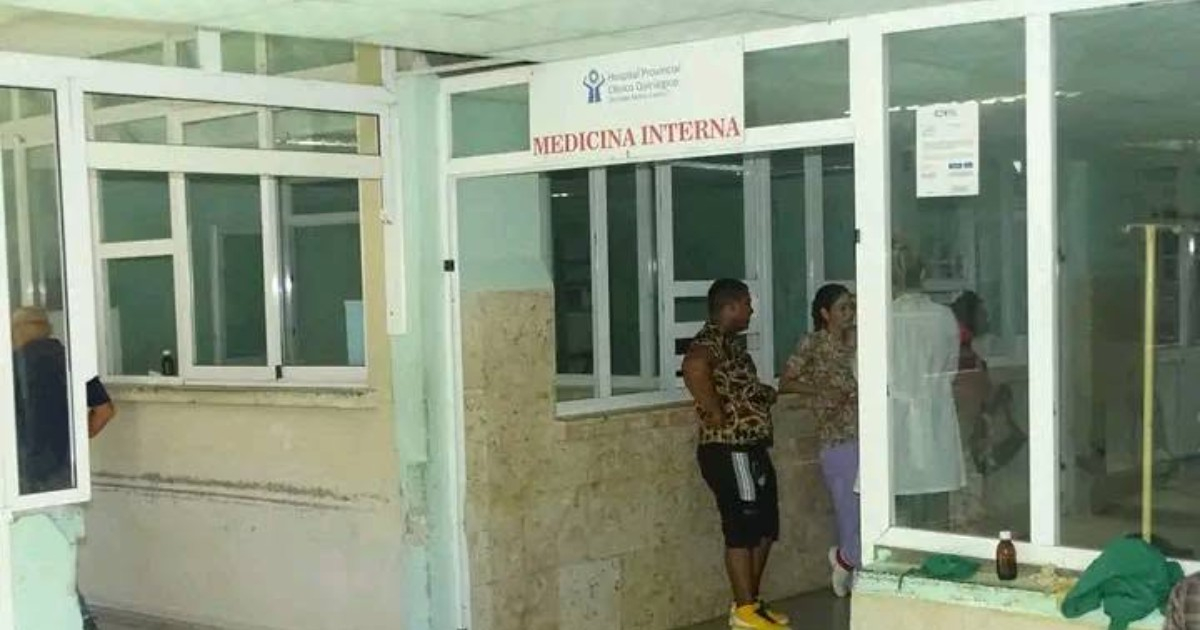
A doctor who formerly worked at the Arnaldo Milián Castro Provincial Hospital in Santa Clara has shared a harrowing account of her experiences working in Cuba's healthcare system. She reached out to CiberCuba under the condition of anonymity to reveal the dire circumstances she faced.
The physician detailed grueling shifts lasting over 30 consecutive hours, extended periods without pay, a ban on diagnosing infectious diseases, and a severe lack of resources that ultimately forced her to leave her position.
She recounted working months in the emergency department without receiving a salary. By the time she was eventually compensated, rampant inflation had significantly eroded the value of the payment.
Her income, she explained, was a mere $12 per month, as the 17/2026 Resolution set the base salary for newly graduated doctors at 7,045 pesos. As of this past Saturday, that amount equals roughly seven dollars on the informal exchange market.
One of the most alarming aspects of her testimony involves orders to falsify diagnoses. "There were times I was forbidden from diagnosing hepatitis, leptospirosis, or dengue. Instead, I had to label them as 'acute febrile syndrome' or 'icteric syndrome'—terms that obviously do not represent actual diseases—all to maintain a false image that 'we have viruses under control in the country,'" she revealed.
This practice is independently corroborated: medical sources confirmed to 14ymedio in August 2024 that there were directives to record dengue cases as "acute febrile syndrome" to avoid inflating figures reported to international organizations.
"Healthcare professionals are battling to uphold the untenable," she wrote, describing a reality that starkly contradicts the official narrative about Cuba's healthcare system.
Seeking Antibiotics on the Streets
The doctor described a "ludicrous" shortage of medications and supplies. "We resorted to treating severe pneumonia cases in hospitalized patients with capsule-form Cephalexin, which is utterly absurd by global standards. Naturally, those patients without thousands of pesos to 'find their antibiotics on the streets' died slowly, suffocating from a potentially curable illness," she recounted.
Cephalexin, an oral first-generation antibiotic, is completely unsuitable for treating severe hospitalized pneumonia cases.
The material conditions she described are consistent with documented crises at the same facility. In June 2026, the Arnaldo Milián Castro hospital went over 72 hours without water, forcing surgeons to wash their hands in buckets.
Its dialysis unit was out of service for nine months due to alleged contamination, requiring 144 patients to travel to Caibarién. In September, a fire damaged the provincial hospital's facilities.
The doctor also reported being required to fill out "false charge sheets" with non-existent patients, being pressured to attend political events, and receiving threats after posting about her situation on Facebook and WhatsApp.
"They even threatened me after I made some posts on Facebook or in my personal WhatsApp statuses about my situation as a doctor in this country," she wrote.
The conditions outside the hospital eventually broke her resolve. "The worst part came six months ago when the blackouts started in my area. The power went out and never came back, along with the water. That was the final straw—coming home after the mental torture at work only to find no light, no food, no water, and no money in my pocket," she recounted.
Her case is part of a documented wave of Cuban doctors who abandoned their medical practice in 2026 due to unsustainable economic and working conditions.
"I had to give up my position, not my profession, because wherever I am, I am still a doctor. But definitely not in the hospital, not in the Cuban healthcare system, not in a totalitarian dictatorship where my rights are violated every day," the doctor concluded. "I cannot compromise my health witnessing the suffering and agony of the Cuban people firsthand as I did until recently."
Understanding the Cuban Healthcare Crisis
Why are Cuban doctors forbidden from diagnosing certain diseases?
Cuban doctors report being instructed to falsify diagnoses to maintain a misleading image of disease control in the country, avoiding negative statistics on infectious diseases like dengue for international reports.
What are the working conditions for Cuban doctors?
Cuban doctors face extremely challenging conditions, including long shifts without rest, delayed salaries that are heavily impacted by inflation, and a severe lack of medical supplies, which forces them to seek alternative solutions.
How has the lack of resources affected patient care in Cuba?
The shortage of medical resources has led to inadequate treatment options, resulting in preventable deaths. Doctors report patients dying from treatable illnesses due to the lack of appropriate medications.