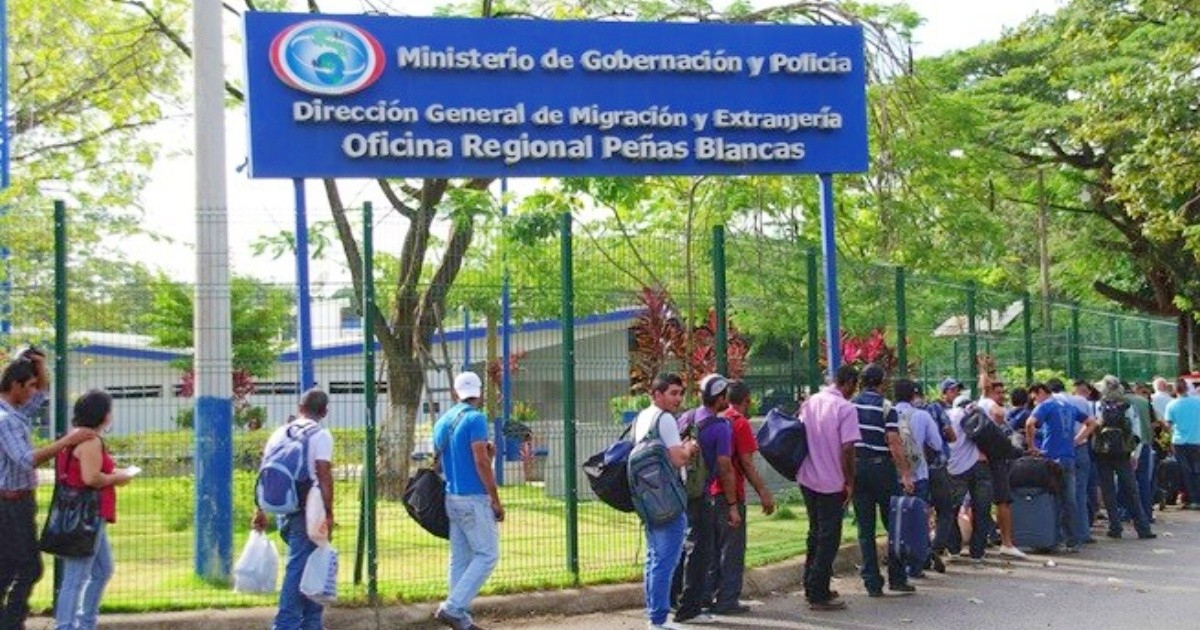
According to a report from the International Organization for Migration (IOM) on regional mobility trends in Latin America and the Caribbean for the first half of 2026, Costa Rica is no longer just a stopover for Cuban migrants but has become a place for extended transit or temporary settlement.
The report, based on data from the Displacement Tracking Matrix (DTM), highlights a significant shift in the Central American migration route since 2025. Irregular northward migration plummeted while longer stays in intermediate countries became more common.
The most striking finding from the IOM's report is that all Cuban migrants interviewed in Costa Rica in February 2026 considered the country their final destination, not just a waypoint en route to the United States.
This trend is further supported by an IOM survey conducted in Costa Rica between January and February 2026, where 94% of Cuban respondents expressed their intent to remain, citing better economic conditions, political stability, and access to international protection.
From September 2025 to February 2026, the IOM recorded 1,541 entries of Cuban nationals from Nicaragua into Costa Rica, accounting for 28% of all migrants in that flow.
In February 2026, the DTM documented approximately 1,200 southbound movements in Costa Rica, with 856 individuals stranded in public spaces and 361 in shelters, translating to 71 cases in public spaces and 30 in shelters per 100 estimated arrivals.
During that month, Cubans constituted 10% of the southward migration flow in Costa Rica, while Venezuelans made up 86%.
This development is part of the collapse of the Darién route, where irregular crossings northward fell by 97% in the first half of 2026 compared to the same period in 2024, dropping from over 200,000 to just 280 recorded crossings.
Faced with the impracticality of reaching the United States via that route, Cubans have redirected their destinations towards Latin America. Brazil and Uruguay have also emerged as new settlement hubs, with around 3,000 Cubans entering Brazil monthly via Guyana between January and May 2026, and 16,982 asylum requests from Cubans during that period.
In Uruguay, the positive migration balance for Cubans reached 5,946 people between January and May 2026.
In response to these dynamics, Costa Rica has introduced a Special Temporary Category to regularize Cubans, Nicaraguans, Venezuelans, and Colombians with pending or rejected asylum requests.
The program, open for applications from September 1, 2026, to September 1, 2027, grants renewable two-year permits allowing work and travel outside the country.
Approximately 10,000 Cubans currently reside in Costa Rica, and from June 2014 to May 2026, the country received 7,292 asylum requests from Cuban citizens, according to figures cited when the measure was announced.
The IOM concludes that mobility systems in Latin America and the Caribbean are becoming increasingly complex, fragmented, and multidirectional, with transit, return, circular migration, and remigration increasingly overlapping on different routes.
Cuban Migration Trends and Policies in Costa Rica
Why are Cuban migrants choosing Costa Rica as their final destination?
Cuban migrants are opting for Costa Rica due to better economic conditions, political stability, and access to international protection, as revealed by a survey conducted by the IOM.
What measures has Costa Rica implemented to address the influx of Cuban migrants?
Costa Rica introduced a Special Temporary Category to regularize Cubans and other nationalities with pending or rejected asylum claims, offering renewable two-year permits for work and travel.
How has the collapse of the Darién route affected Cuban migration?
With a 97% decline in irregular crossings northward, Cuban migrants have redirected their journeys towards Latin America, with countries like Brazil and Uruguay becoming new settlement destinations.