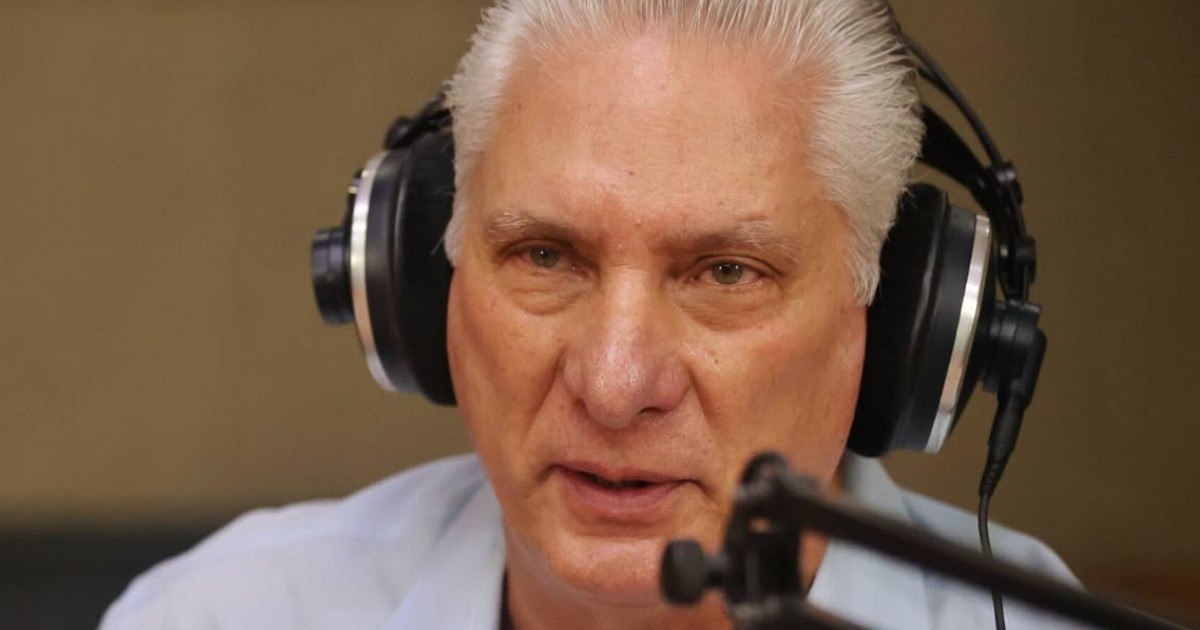
A retired resident from Camagüey, Cesáreo Navas y Morlanes, a former audiovisual producer for the Cuban Institute of Radio and Television (ICRT), sharply criticized Miguel Díaz-Canel during a recent episode of the radio show "Shared Criterion" on Radio Rebelde. The program, aired on November 18, proposed that underperforming officials be called to publicly account for their actions.
With cutting sarcasm, Navas commended the idea before turning the tables on Díaz-Canel: "Bravo, splendid! But it seems the 'presi...' has put the noose around his own neck," he remarked, asserting that Díaz-Canel himself should be the first to answer for his failures, unfulfilled promises, and chaotic management of the country.
Voices of Criticism Against the Regime
Not stopping at mere words, the retired Cuban detailed eight specific charges against the leader. His foremost concern was the descent of countless retired citizens into extreme poverty, a matter deeply personal to him.
Navas' critique is backed by hard facts. As of September 2025, Cuba's minimum pension stands at 4,000 pesos monthly, equating to just over four dollars on the informal market. In stark contrast, economist Javier Pérez Capdevila estimated in May 2026 that an individual needs approximately 96,000 pesos per month to meet basic needs—24 times the pension amount.
Economic Struggles and Societal Issues
Navas also highlighted the government's inability to curb inflation, which, according to the National Office of Statistics and Information, soared to 32.70% year-on-year in October 2026, with food prices skyrocketing by 50.72%. He criticized the ongoing reliance on coal and wood for cooking, persistent power outages, and water shortages.
In 2026 alone, Cuba experienced eight total collapses of the national electrical system, with the Electric Union projecting a 1,805-megawatt shortfall during peak demand this Saturday.
Moreover, Navas pointed to the military monopoly GAESA, accusing it of operating without public audits, and criticized the construction of the K and 25 Hotel, known as Torre K, completed in February 2025 with an investment of 200 million dollars. He argued that these funds could have been better spent on refurbishing obsolete power plants.
Addressing the Nation's Deterioration
Completing his inventory of grievances, Navas mentioned the shortage of medications, hospitals in decline, food scarcity, rising crime, suppression of free speech, and the nation's poor sanitary conditions, characterized by overflowing trash, destroyed streets, and sewage leaks.
Instead of acknowledging any merit in the radio initiative, Navas dismissed it as sheer demagoguery and opportunism, aimed at shirking responsibility and blaming others for the country's woes. He estimated that, given the numerous "blunders," Díaz-Canel would require "more than 10 programs, and even then, that might not be enough to settle the outstanding accounts with the people."
His critique concluded with a jab at the leader's omnipresence in the media: "You already have a radio program, podcasts on TV, multiple interviews; all you need now is a weekly page in the Granma newspaper to dominate every public media outlet."
The "Shared Criterion" show, which began on September 23, 2026, covered 46 cases in its fifth episode—41 complaints and five opinions. Of these, only 20 had been resolved, while 13 remained pending due to resource shortages. In the previous episode, Díaz-Canel admitted that merely 39% of complaints received had been addressed.
Navas has consistently voiced his criticisms on Facebook, demanding "less talk and more food" from Díaz-Canel in October and branding the slogan "leave no one behind" as "opportunistic and demagogic" in November. His voice represents an aging nation with a fraying safety net: 26.7% of the population is 60 or older, with family networks weakened by a mass exodus of youth since 2021.
He concluded his critique with a foreboding political epitaph: "Given the multitude of mistakes... Díaz-Canel, history will not absolve you."
Understanding the Challenges Facing Cuba
What are the main criticisms of Díaz-Canel according to Cesáreo Navas?
Navas criticizes Díaz-Canel for his unfulfilled promises, failures in economic management, and the worsening living conditions for retirees, among other issues.
How does Navas view the "Shared Criterion" radio program?
Navas sees the program as a form of demagoguery and opportunism, believing it is an attempt by Díaz-Canel to deflect responsibility and blame others for the country's problems.
What economic challenges does Cuba face according to Navas' statements?
Cuba faces high inflation, food scarcity, and a reliance on outdated energy sources, among other economic challenges.