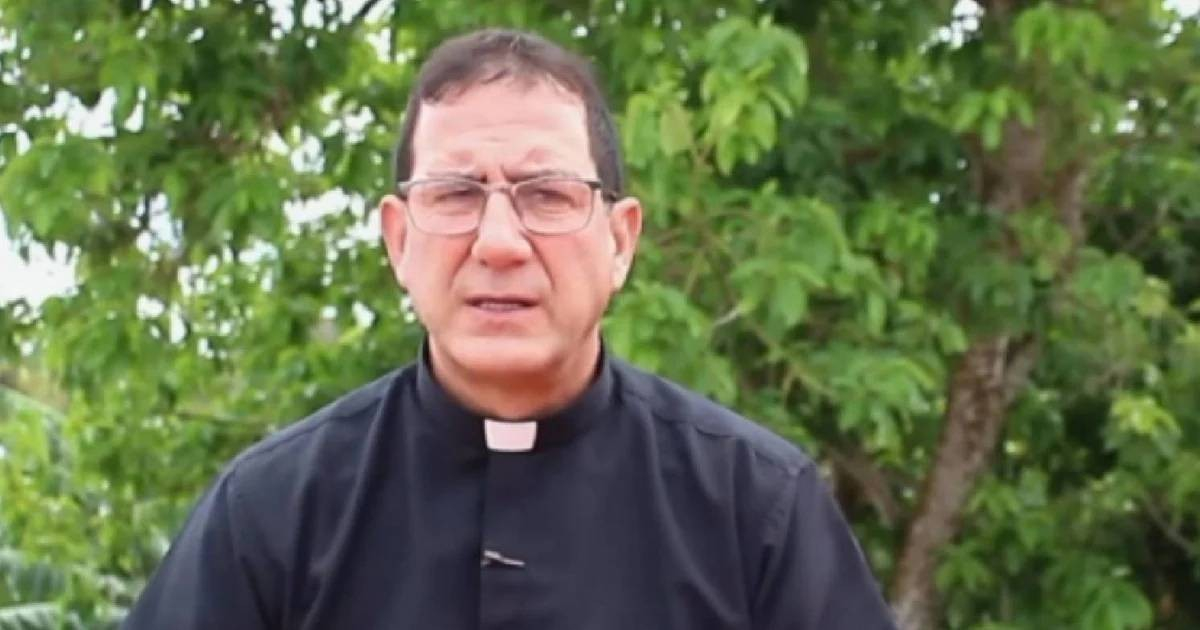
Cuban priest Alberto Reyes Pías shared the 183rd installment of his column "I've Been Thinking" on Facebook this past Saturday. In it, he uses Pope Leo XIV's recent apostolic journey to South America as a lens to highlight Cuba's social and political landscape.
Reyes, who serves as the parish priest in Esmeralda, Camagüey, poses a thought-provoking question: How would Cuba's regime react if the Pope were to repeat in Cuba what he said in Uruguay, Argentina, and Peru during his tour from November 6 to 17?
Comparing Cuba's Political Reality to Uruguay's Democracy
Reyes draws a stark contrast with Uruguay, where Pope Leo XIV celebrated four decades of uninterrupted democracy and the peaceful transition of power through citizen-elected governments. In contrast, Reyes points out that Cuba has been under a dictatorship for nearly 70 years.
"In our country, from the fervent cheers for Fidel Castro, who infamously declared, 'Elections? What for?', to the charade of elections where any political alternative is condemned by the current Constitution, nearly 70 years have passed under the imposition of a single party denying the people the chance to freely express themselves at the polls," Reyes writes.
Freedom of Expression: A Distant Dream in Cuba
Reyes further highlights the Pope's appeal in Buenos Aires for authorities to "recognize the limits of the power entrusted to them" and defend the freedom to dissent and "express one's convictions freely" as essential democratic values.
The Cuban reality, however, is a stark contrast: "There are no democratic mechanisms today in our country that provide real opportunities for our people to change those in power," he remarks.
He also points out the irony of a regime that claims people's loyalty to the revolution but does not allow that loyalty to be demonstrated in multiparty elections, nor does it tolerate any challenge to its authority.
Reyes reminds us of the regime's repression against anyone daring to oppose the official narrative: "In our country, we know that today's dissident is tomorrow's political prisoner."
The Daily Struggles of Cuban Families
The third contrast Reyes draws is from Lima, where the Pope mentioned that for families, peace has a tangible meaning: "to go to work without fear, to care for their children, and to return home with peace of mind."
Reyes contrasts this ideal with the harsh reality in Cuba, where "men and women go out daily, burdened by the struggle to provide food for their children, necessary medications, essential money; and return home to insecurity, eternal fatigue, facing life without electricity, cooking with charcoal."
Reyes, a vocal critic of the regime within the Catholic Church, concludes his reflection by applying Pope Leo XIV's words from November 8 in Buenos Aires to Cuba: "A nation must seriously question where it has failed when its young people must leave their land to achieve their dreams."
Understanding the Impact of Pope Leo XIV's Words on Cuba
Why would Pope Leo XIV's words be uncomfortable for the Cuban regime?
Pope Leo XIV's words highlight democratic principles and freedoms that starkly contrast with Cuba's authoritarian regime, which suppresses political alternatives and dissent.
What comparisons does Alberto Reyes make between Cuba and other South American countries?
Reyes contrasts Cuba's political situation with the democratic landscapes of Uruguay, Argentina, and Peru, where the Pope's speeches emphasized democracy, freedom of expression, and peaceful living.
How does the Cuban regime treat dissenters, according to Reyes?
Reyes indicates that dissenters in Cuba are often repressed, and those who oppose the regime's official discourse risk becoming political prisoners.
What challenges do Cuban families face in their daily lives?
Cuban families endure daily struggles to secure food, medicine, and basic necessities while dealing with insecurity, fatigue, and unreliable utilities like electricity.