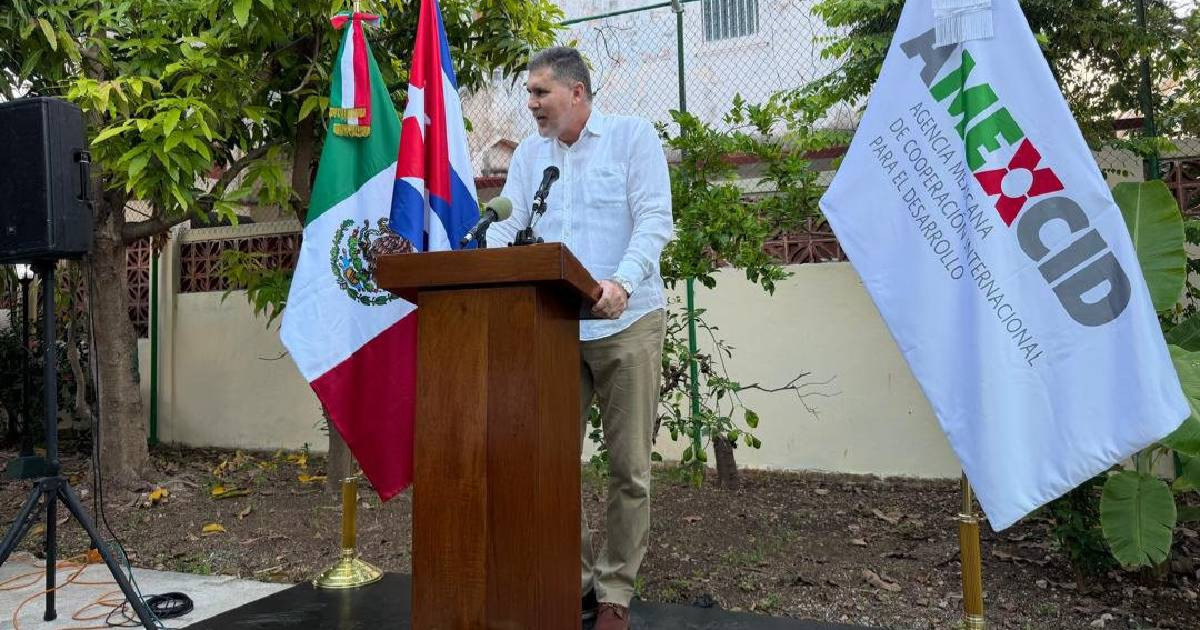
The administration led by President Claudia Sheinbaum inaugurated the very first international branch of the Mexican Agency for International Development Cooperation (Amexcid) in Havana this Friday. This office aims to manage assistance and cooperation initiatives with the Cuban regime.
The event was overseen by Amexcid's Executive Director, Alejandra del Moral Vela, alongside Cuba's Deputy Prime Minister, Óscar Pérez-Oliva Fraga, who is also the Minister of Foreign Trade and Foreign Investment. He praised the bilateral collaboration, citing the presence of Cuban doctors in Mexico as a prime example.
"Today, we open a gateway to dialogue, understanding, knowledge exchange, and joint solutions to our shared challenges, paving the way for mutual prosperity," said Del Moral Vela, according to a report by Mexican news outlet Notigape.
This establishment coincided with the start of the XVIII Mexico-Cuba Interparliamentary Meeting, scheduled for Friday and Saturday in Mexico City, notably without the participation of the Mexican opposition.
The inauguration follows closely on the heels of a meeting between Sheinbaum and former U.S. President Donald Trump in Shenzhen, China, on the sidelines of the Asia-Pacific Economic Cooperation (APEC) Summit held on November 19.
Functions and Controversies of the New Office
The new office is tasked with coordinating humanitarian aid deliveries, overseeing the agricultural program "Sembrando Vida," and facilitating technical exchanges between the two nations.
Nonetheless, these cooperation mechanisms have faced scrutiny. The Cuban doctor program in Mexico, which involves approximately 3,800 professionals across 23 states, was flagged by the Inter-American Commission on Human Rights (IACHR) in April 2026 for significant indications of forced labor and human trafficking.
Accusations claim the Cuban regime withholds between 85% and 95% of the wages paid by Mexico for these services. Reports indicate that while the Mexican government pays around $3,750 per professional, the doctors receive only about $200 monthly.
Additionally, the distribution of humanitarian aid has stirred controversy. The Food Monitor Program reported that some donations from Mexico ended up in state-run stores associated with GAESA, a military-owned conglomerate, where goods were sold in dollars, a currency out of reach for most Cubans.
Financial Commitment and Political Reactions
Mexico's "Sembrando Vida" program is also under scrutiny. Its second phase began in October in Ciego de Ávila, aiming to benefit 1,500 agricultural producers. The initiative was allocated 588 million Mexican pesos, equivalent to over $34 million, in February.
Analyst Mario Di Costanzo criticized this financial commitment, questioning the decision to allocate such resources to Cuba. "While surgeries in Michoacán are suspended due to lack of medical supplies, Sheinbaum donates 588 million to Cuba," he stated.
In 2025, Mexico supplied about 17% of Cuba's fuel needs, shipping around 17,200 barrels daily. However, Petróleos Mexicanos (Pemex) halted these supplies in January following secondary sanctions imposed by the Trump administration.
Since then, Sheinbaum has sought to resume oil shipments through private companies, a move that has raised concerns in Washington. U.S. Secretary of State Marco Rubio warned that these supplies could be a "red line" for U.S.-Mexico relations.
Mexican political figures have also voiced opposition. PRI leader Alejandro Moreno demanded Sheinbaum cancel agreements with the Cuban government, cautioning that the doctor program might jeopardize the United States-Mexico-Canada Agreement (USMCA).
In October, Republican Congresswoman María Elvira Salazar called for the U.S. Trade Representative to investigate the hiring of Cuban doctors for potential violations of the labor chapter of the treaty.
The opening of the Amexcid office formalizes a cooperation relationship that spans economic assistance, agricultural programs, medical services, and humanitarian support, all while the Cuban government grapples with a severe economic crisis, marked by food, fuel, and medicine shortages, and power outages lasting up to 20 hours daily in many areas.
FAQs on Mexico-Cuba Cooperation and Challenges
What is the purpose of Amexcid's new office in Havana?
The office is intended to coordinate assistance and cooperation programs with Cuba, including humanitarian aid, agricultural initiatives, and technical exchanges.
How has the Cuban doctor program been criticized?
The program has faced allegations of forced labor and human trafficking, with claims that the Cuban government retains a large portion of the salaries paid by Mexico.
What controversies surround Mexico's humanitarian aid to Cuba?
There have been reports that some aid ended up in Cuban military-operated stores, where it was sold in a currency inaccessible to many Cubans.