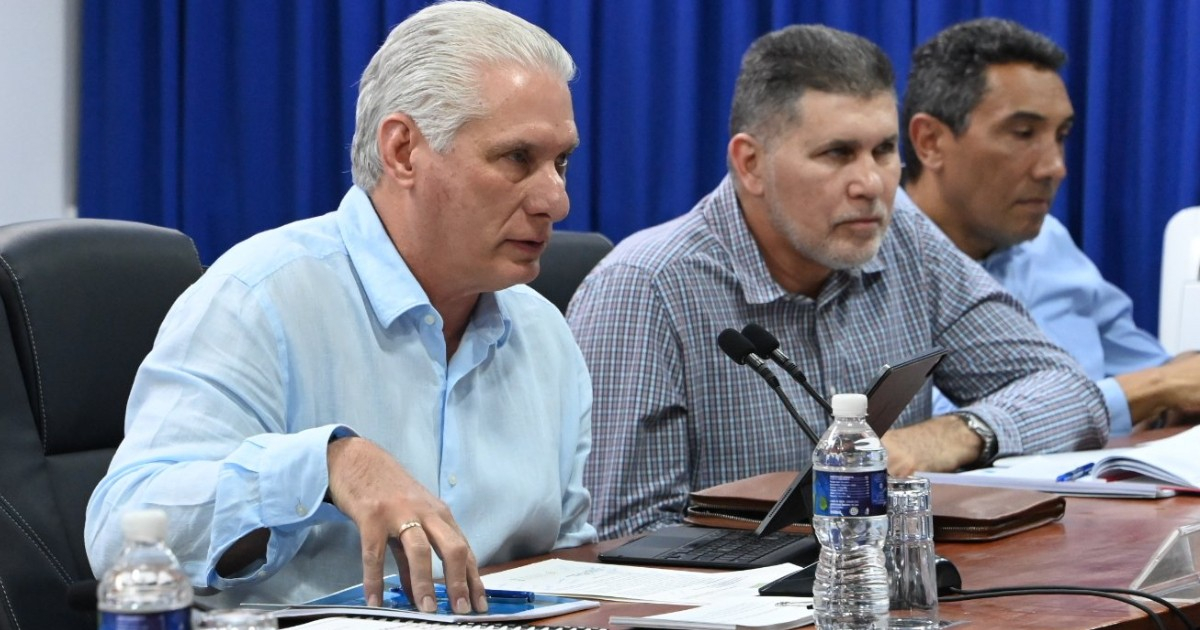
With Cuba's transportation sector hitting rock bottom, Miguel Díaz-Canel once again leaned on his oft-repeated mantra of "creative resistance" this past Friday. This call to action was made during the conclusion of a series of discussions between the Communist Party leadership and workers within the sector, held at the Ministry of Transport.
“We cannot manage scarcity as if it were normalcy. Our response must be a blend of creative resistance and the development of structural alternatives," declared the leader. This marked the seventh visit by the Central Committee to key national agencies in 2026.
Transport Minister Eduardo Rodríguez Dávila acknowledged to Díaz-Canel that the year has been plagued by a decline in both passenger and freight transport, attributed to financial constraints and a lack of spare parts necessary for vehicle maintenance. "President, transportation does not stop," he stated, though the statistics tell a different story.
Interprovincial bus departures from Havana have plummeted from 419 daily in 2025 to a mere 11 in 2026, a drastic 97.4% reduction. Nationwide bus routes have dwindled from over 100 to just 21, and cargo volume is on track to slump from 70 million tons to approximately 20 million by year's end.
The once-bustling interprovincial buses, which transported over 5,000 passengers daily in 2025, now carry fewer than 1,000. Rail services in Las Tunas were halted once more on November 16 due to fuel shortages, just days after operations had resumed.
Díaz-Canel attributed these challenges to the U.S. embargo, describing it as a "policy of deliberate suffocation" that hampers both the population's mobility and the country's logistical operations. He cited the scarcity of diesel, limited fleet availability, and power outages as issues leading to shortages, rising prices, and a declining quality of life.
What Díaz-Canel did not address is that "creative resistance" has been his go-to solution for every crisis, without notable improvements in national metrics. He turned it into a public slogan in October 2022 before delegations from 64 countries; reiterated it during the closing of the National Assembly in December 2023; applied it to blackouts in February 2026; and in March of the same year, he suggested cooking with coal and wood as an embodiment of the concept.
By June 2026, at the Communist Party's Extraordinary Plenum, Díaz-Canel conceded that "resistance alone is not enough." This new stance was short-lived, as by October, he was back to promoting "citizen creativity" as a variation of the same slogan, and by Friday, he had reverted to the original formula in the context of transportation.
The backdrop is an economy in freefall. The Economic Commission for Latin America and the Caribbean (ECLAC) forecasts a 10.3% contraction in Cuba's GDP for 2026, the worst in Latin America and the Caribbean, with a cumulative loss exceeding 23% since 2019. Official inflation surpassed 25% year-on-year in August, with food prices soaring over 36%.
The pattern is all too familiar: a fresh speech, the same slogan, and Cubans left to grapple with the consequences of 67 years of dictatorial governance, which no amount of "creative resistance" has managed to overcome.
Understanding Cuba's Economic and Transport Challenges
What is "creative resistance" according to Díaz-Canel?
"Creative resistance" is a concept promoted by Díaz-Canel that suggests using innovative and resourceful methods to manage ongoing crises and shortages in Cuba, rather than viewing these situations as normal.
How has Cuba's transportation been impacted recently?
Cuba's transportation has seen a severe decline, with interprovincial bus departures from Havana dropping drastically, national bus routes decreasing, and rail services experiencing intermittent suspensions due to fuel shortages.
What factors does Díaz-Canel blame for Cuba's transport crisis?
Díaz-Canel blames the U.S. embargo, a shortage of diesel, fleet unavailability, and power outages for the transport crisis, asserting that these issues lead to shortages, price increases, and a decline in quality of life.