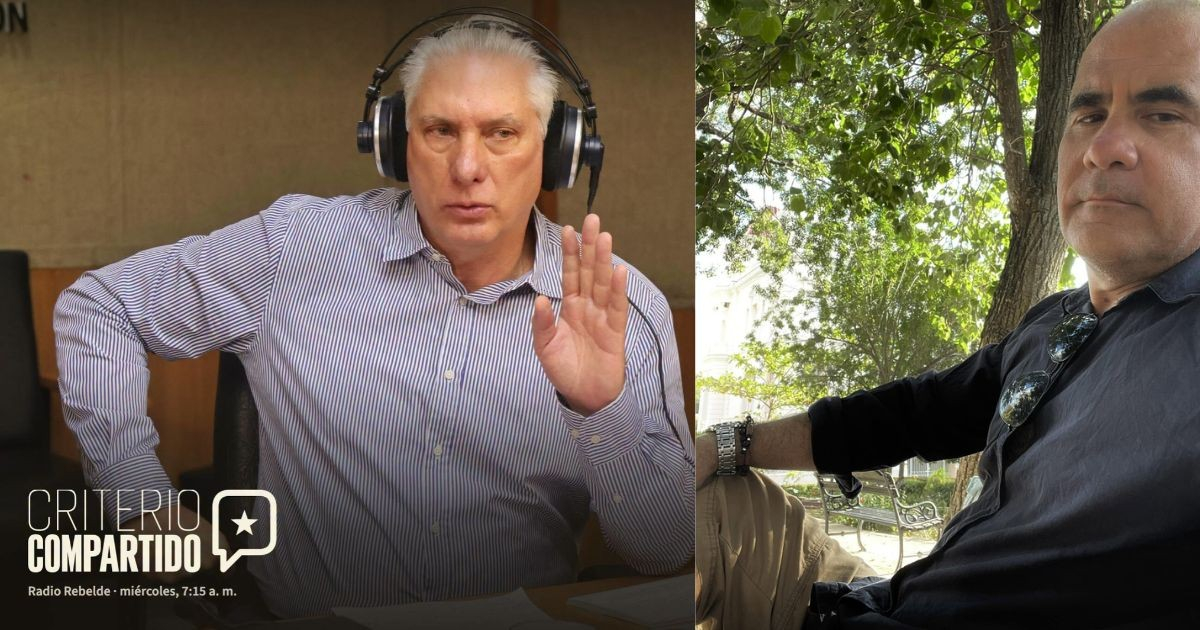
Renowned Cuban legal scholar René Fidel González García took to Facebook on Wednesday to directly challenge President Miguel Díaz-Canel, the Attorney General, and the People's Supreme Court. He accused these authorities of concealing and dismissing a legal complaint he filed against the president and the Attorney General for ignoring a grievance and petition that the Office of the President acknowledged receiving.
The post, laced with irony, came on a day when Díaz-Canel hosted the fifth episode of his biweekly radio program "Shared Criteria" on Radio Rebelde, which was titled, ironically, "No Complaint Left Unanswered."
González García, who holds a doctorate in legal sciences and was once a tenured professor at the University of Oriente until his dismissal in November 2016 for publishing critical articles in independent media, submitted a legal complaint in October 2022. He targeted Díaz-Canel and Attorney General Yamila Peña Ojeda under Law 153/2022, which pertains to constitutional rights protection.
The People's Supreme Court rejected this complaint in December 2022, citing that the issue arose from the administrative revocation of his academic position and did not fall under the appropriate jurisdiction. A subsequent appeal was also dismissed in January 2023.
Legal Appeal and Constitutional Rights
In his outspoken post, the jurist stated unequivocally, "Neither President Miguel Díaz-Canel Bermúdez nor his press team, nor even the Supreme Court can do anything but conceal and dismiss a well-founded complaint directed against him and the Attorney General for failing to respond to a grievance and petition, which the President's Office acknowledged."
González García emphasized that Article 63 of the 2019 Constitution guarantees every individual's right to receive responses to their grievances and petitions, and the failure to respond constituted the rights violation that formed the basis of his complaint. "This precisely constitutes the rights violation for which both are accountable […] The Right of Grievance and Petition is a right."
Political Critique and Public Discontent
He did not mince words in describing the regime's conduct: "In Cuba, there's nothing to do but call this political corruption and abuse of power, or as they see it: doing whatever is necessary. Such is the extent of impunity in Cuba."
The gap between official rhetoric and reality was starkly revealed that same Wednesday. During the fifth installment of "Shared Criteria," of the 46 cases reviewed—comprising 41 complaints and five opinions—only 20 had been resolved, while 13 remained unresolved due to resource shortages. In the previous broadcast on November 4, Díaz-Canel had acknowledged that only 39% of complaints had been addressed, a figure he himself deemed insufficient.
On the same day, Cuban citizen Elizabeth González Aznar published an open letter to Díaz-Canel, questioning, "How and when are we going to change what needs to be changed?" and remarking, "The worst part is that none of this is resolved from a radio booth, yet you persist with this ineffective method of working."
Broader Context of Structural Crisis
González García's challenge—emerging as one of the most critical intellectual voices against the Cuban regime from within the island—occurs amidst a documented structural crisis: the Cuban Observatory of Human Rights estimated in August 2026 that extreme poverty affects 94% of Cubans, while Prisoners Defenders has recorded over 1,370 political prisoners in the country.
The jurist concluded his post with a reflection that transcends his personal struggle: "Courage is not what we need in Cuba; it is decency. One can feel disgust even at the fear felt and those who try to instill it, but what we need is decency, little more than that, to see them naked in power."
Cuban Legal System and Political Challenges
What motivated René Fidel González García to file a complaint against Díaz-Canel?
González García filed a complaint against Díaz-Canel and the Attorney General for ignoring a grievance and petition acknowledged by the Office of the President. He based his complaint on the constitutional right to receive responses to grievances and petitions.
How did the People's Supreme Court respond to González García's complaint?
The People's Supreme Court dismissed the complaint, citing its origin in the administrative revocation of González García's academic position as outside its jurisdiction. An appeal was also rejected.
What does González García see as the core issue with the Cuban regime?
González García criticizes the Cuban regime for political corruption and impunity, emphasizing the need for decency over courage to confront those in power.