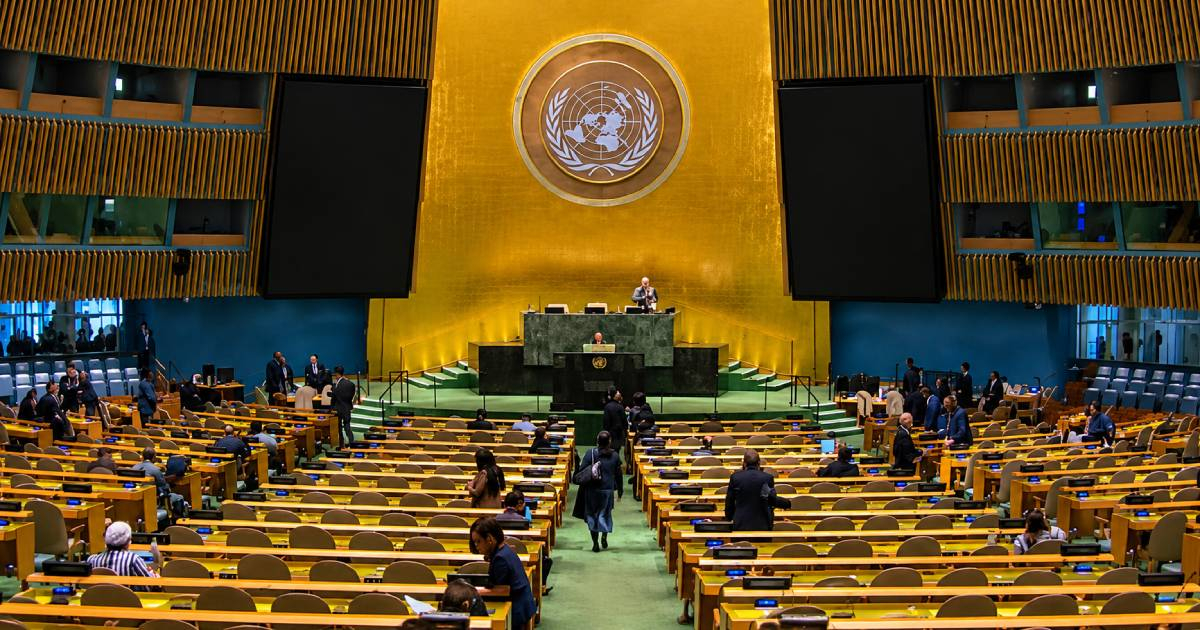
The U.S. delegate to the Third Committee of the UN General Assembly labeled Cuba's resolution on mercenaries as a "performative exercise" and accused the Cuban regime of hypocrisy. He pointed out that thousands of Cuban citizens have joined Russian forces in Ukraine, according to the official UN statement on the November 13 session.
This exchange took place during discussions on the resolution titled "Use of Mercenaries as a Means of Violating Human Rights and Impeding the Exercise of the Right of Peoples to Self-Determination," a resolution Cuba annually presents to denounce foreign interference.
The Cuban representative dismissed these allegations as "baseless," asserting, "Cuba is not part of this conflict in any capacity, nor are we involved there or anywhere else."
To support this stance, the Cuban delegate claimed that the government has conducted 17 internal investigations into the recruitment of Cuban citizens abroad. However, no public results have been shared, and there's no information on whether affected families have been informed.
The documented reality starkly contrasts with this narrative. The Ukrainian project "I Want to Live" identified at least 1,028 Cubans among Russian ranks, with 93 deaths recorded by January 2026. Ukrainian military intelligence confirmed over 1,000 military contracts signed by Cubans with the Russian Armed Forces from 2023 to 2025, estimating the number of recruits could range between 10,000 and 15,000.
Ukraine's representative to the Third Committee reported in October that Cubans are among the four largest foreign national groups recruited by Russia, with more than 1,000 documented contracts.
Amnesty International released a report in September detailing recruitment through deception, false offers of civilian jobs, and coercion, which the organization categorizes as potential human trafficking.
While the regime speaks of investigations, Cuban families have been left without answers for months. Magaly Pernas, mother of Asiel Bacallao—recruited in Camagüey on June 1, 2026—has heard nothing from her son for five months. Vianka Cosme, mother of Jonathan Lázaro González Cosme, missing since May 5, 2026, stated that neither Cuban nor Russian authorities have informed her of his whereabouts.
The diplomatic exchange intensified during the session. Washington additionally accused Havana of corruption and economic mismanagement; the Cuban delegate retaliated by accusing the U.S. of complicity in Palestinian "genocide" and illegal military aggressions.
At the peak of the debate, the Cuban representative described Washington's "obsession" with Cuba as "a clinical, pathological case that medical professionals should examine."
The resolution on mercenaries was approved with 117 votes in favor, 54 against, and seven abstentions, but it still needs to be presented to the General Assembly in December.
During the same session, the Third Committee also approved a resolution on "Human Rights and Unilateral Coercive Measures," co-sponsored by Cuba and Brazil on behalf of the Non-Aligned Movement, with 117 votes in favor and 56 against.
Notably, Chile, Colombia, Honduras, and Peru abstained, signaling weakening Latin American support for the regime as NGO UN Watch warned that the text benefits regimes like Russia, Iran, Belarus, and North Korea.
This episode is part of a broader decline in Cuba's standing at the UN: On October 28, the annual resolution on the U.S. embargo received only 130 votes in favor, compared to 187 in 2024, marking the worst result for Havana since 1992.
Key Questions About Cuban Involvement in the Ukrainian Conflict
How many Cubans are reportedly fighting for Russia in Ukraine?
Ukrainian intelligence and the "I Want to Live" project report that over 1,000 Cubans have signed military contracts with Russia, with estimates suggesting the total number could be between 10,000 and 15,000.
What has been the response of the Cuban government to these allegations?
The Cuban government has denied involvement, claiming 17 internal investigations have been conducted without sharing results or details with affected families.
What are some of the methods used to recruit Cubans for the conflict?
Amnesty International reports that recruitment often involves deception, false job offers, and coercion, which may constitute human trafficking.