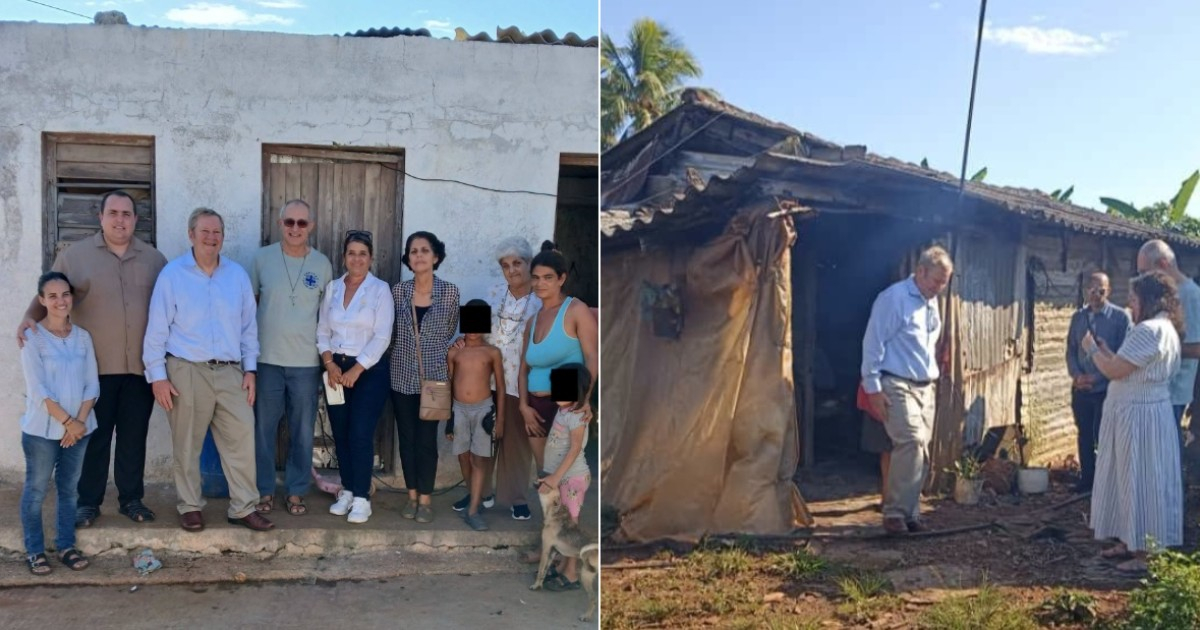
The Church of San Hilarion Abad in Guanajay shared on its Facebook page the account of a visit by Mike Hammer, the Chargé d'Affaires of the U.S. Embassy in Cuba, to families in Artemisa. The parish described the conditions they encountered as "a harsh and painful reality."
Accompanied by representatives from both Diocesan and Parish Caritas, Hammer toured various parts of the town and its outskirts, observing firsthand the living conditions of numerous Cuban families.
Images shared by the parish reveal homes made of rusted zinc sheets and worn-out wood, dirt floors, barefoot children, and families living in extreme poverty.
"During his visit, we toured several areas of the town and its outskirts, where we closely witnessed the harsh and painful reality that many Cuban families face today, marked by daily life challenges and necessities," the parish community noted.
According to the account, the families expressed gratitude for the assistance from the United States government: "The visited individuals expressed profound gratitude for the humanitarian aid provided by the United States Government, a gesture of solidarity that brings relief and hope to many families in our community."
Hammer's stop in Guanajay is part of a broader tour of western provinces this week. In Pinar del Río, he visited artist Arquímedes Lores Echevarría in the provincial capital—where an incident of harassment attributed to State Security took place—and met with Esteban Ajete, a farmer leader and president of the Independent Farmers League of Cuba, in San Diego de los Baños.
The diplomat was joined by Leslie Goodman, head of the embassy's Press and Culture section, and Tim Peltier, political and economic counselor.
Although the aid deliveries in Guanajay were announced by Caritas Pinar del Río, this aligns with the Church's territorial organization: while administratively part of Artemisa, the parish belongs to the Diocese of Pinar del Río. This ecclesiastical jurisdiction also serves other Artemisa communities benefiting from U.S. shipments.
The assistance reaching Guanajay is part of a $100 million humanitarian aid program for Cuba, announced by Secretary of State Marco Rubio on May 8, 2026, following his meeting with Pope Leo XIV in Rome. Out of this total, $60 million is channeled through Catholic Relief Services in coordination with Caritas Cuba and the parish network, ensuring the supplies go directly to families without passing through the Cuban regime.
Artemisa has been among the initial destinations for these diocesan shipments. The first delivery arrived on October 8, with 700 food kits and 700 hygiene modules destined for the Candelaria parish and Quiebra Hacha, a community within the Mariel parish.
The second delivery, received on October 27, included another 700 food kits and 700 hygiene modules for communities and rural areas in Guanajay and Bahía Honda, both municipalities in Artemisa.
In Guanajay, parish volunteers distributed the aid directly to households in Gelabet, La Finca del Americano, Ojo de Agua, Noroña, La Cooperativa, and Reparto de la Granja. At the end of that day, they expressed gratitude to the U.S. government for their support to families in need.
The third shipment, received on November 12, again included 700 food kits and another 700 hygiene kits for Guanajay and Bahía Honda, and incorporated the community of San Martín de Porres in Taco Taco. The quantities represent the total of each delivery, without a detailed breakdown for each locality.
The diocese has already announced a fourth delivery, also with 700 food kits and 700 hygiene kits, destined for Bahía Honda, Taco Taco, and, for the first time, the Pinar del Río municipality of San Juan y Martínez.
The Guanajay parish concluded its post on the visit with a message of solidarity: "Because behind each need there is a face, a family, and a story that deserves our attention and solidarity. Charity compels us to walk alongside the most vulnerable."
Frequently Asked Questions About U.S. Humanitarian Aid to Cuba
What was the purpose of Mike Hammer's visit to Guanajay?
Mike Hammer visited Guanajay to witness firsthand the living conditions of families and to deliver humanitarian aid as part of a broader effort to support Cuban communities.
How is the humanitarian aid to Cuba being distributed?
The aid is distributed through Catholic Relief Services in coordination with Caritas Cuba and local parish networks, ensuring it reaches families directly without passing through the Cuban government.
What does the aid package include?
The aid packages typically include food kits and hygiene modules to support the basic needs of families in affected areas.