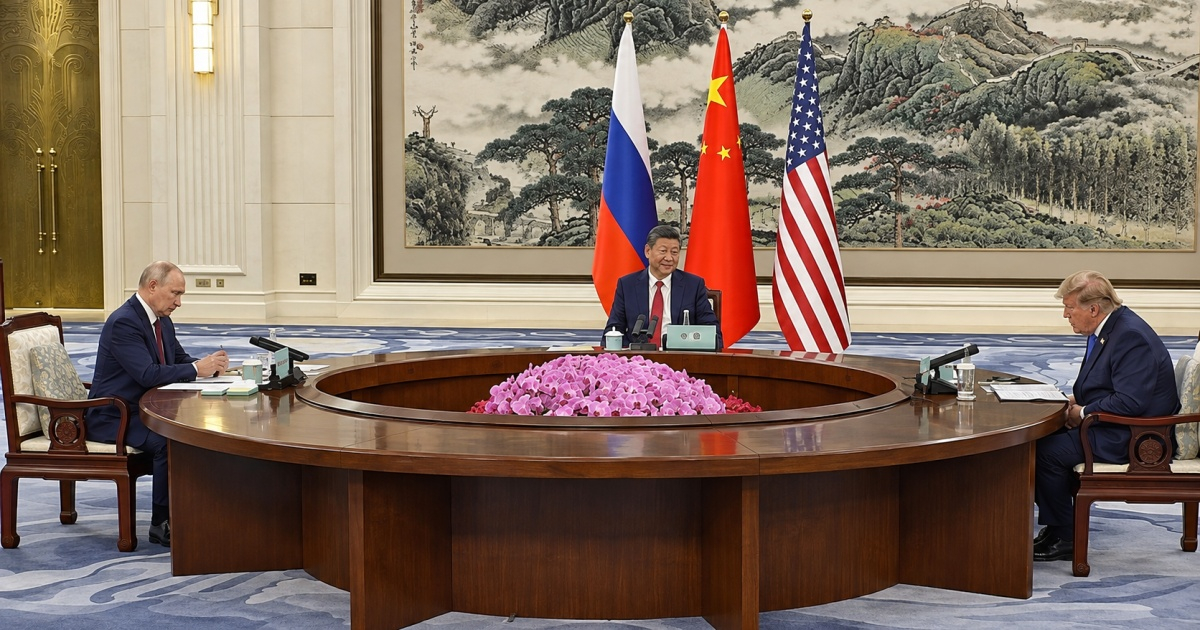
In an unprecedented summit held in Shenzhen, the leaders of the world's three foremost nuclear powers—United States, China, and Russia—came together for the first time to issue a joint declaration. The document, titled "Declaration Toward Peace," was released by China's Ministry of Foreign Affairs.
Donald Trump, Xi Jinping, and Vladimir Putin convened for an 80-minute discussion at the Kylin Villa complex, on the sidelines of the Asia-Pacific Economic Cooperation (APEC) summit.
As reported by EFE, this marked the inaugural gathering of these nations' leaders in such a format. The resulting declaration outlines four specific commitments.
Revamping the UN Framework
As permanent members of the UN Security Council, the three countries pledged to advocate for reforms within the United Nations to enhance its ability to address global challenges efficiently and fulfill its core mission of maintaining international peace and security.
However, the commitment lacks concrete reforms or timelines, leading analysts cited by AP to suggest that the declaration lacks enforceability mechanisms.
Ensuring Energy Stability
The three nations announced plans to "increase production and supply of refined oil products for the benefit of all countries," emphasizing the importance of stable energy flows. This is a direct response to tensions arising from the conflict in Iran affecting the Strait of Hormuz, a critical oil transit route to Asia.
Trump emphasized the shared urgency with Xi to keep this maritime passage open.
Constraints on International Criminal Jurisdiction
The leaders agreed that the International Criminal Court (ICC) and similar bodies "should not abuse their jurisdiction," highlighting the significance of "state consent and respecting state officials' immunity."
This point is seen as a response to the ICC's existing arrest warrant for Putin since 2023 over alleged illegal deportation of Ukrainian minors. Trump, a critic of the court, referred to it as "out of control."
It's noteworthy that neither the United States nor China are signatories to the Rome Statute.
Nuclear Dialogue and Anti-War Stance
The final commitment was explicit: "A nuclear war cannot be won and must never be fought." The countries agreed to "engage in dialogue to reduce nuclear risks and prevent nuclear weapons proliferation."
Xi metaphorically described nuclear arms as "a Sword of Damocles hanging over humanity," while Trump candidly acknowledged the political challenge: "Frankly, as a leader, it’s hard to give up nuclear weapons once you have them," adding firmly about Iran, "They will never have a nuclear weapon."
The backdrop is particularly sensitive with the expiration of the New START treaty on February 5, 2026, leaving the U.S. and Russia without legally-binding limits on their arsenals for the first time since the 1970s.
Lingering Tensions Over Ukraine
The Ukraine conflict lingered over the discussions, yet did not result in any specific commitments. Putin commented on the shared interests in resolving regional conflicts, including Ukraine, while Trump remained reserved, expressing hope for mutual interest in ending the war.
On the same day as the summit, Ukraine launched a third attack in a week on the Crimean Bridge, with negotiations in Abu Dhabi, mediated by the U.S., showing no progress.
Trump opened the meeting by encapsulating his vision: "We are truly making history. Peace has never been forged by missing opportunities for dialogue." Putin concluded by calling the meeting "a page in the history of diplomacy," expressing readiness for future summits.
Key Questions on Historic Summit Commitments
What was the main goal of the historic summit in Shenzhen?
The primary aim of the summit was to foster dialogue and cooperation among the world's leading nuclear powers to address global challenges and enhance international peace and security.
What are the implications of the energy stability commitment?
The commitment to increase oil production aims to stabilize global energy markets, particularly in light of tensions in the Strait of Hormuz, a key route for oil shipments to Asia.
How does the summit address nuclear weapons proliferation?
The leaders committed to engaging in dialogue to reduce nuclear risks and prevent the spread of nuclear weapons, emphasizing that a nuclear war cannot be won and must never be fought.