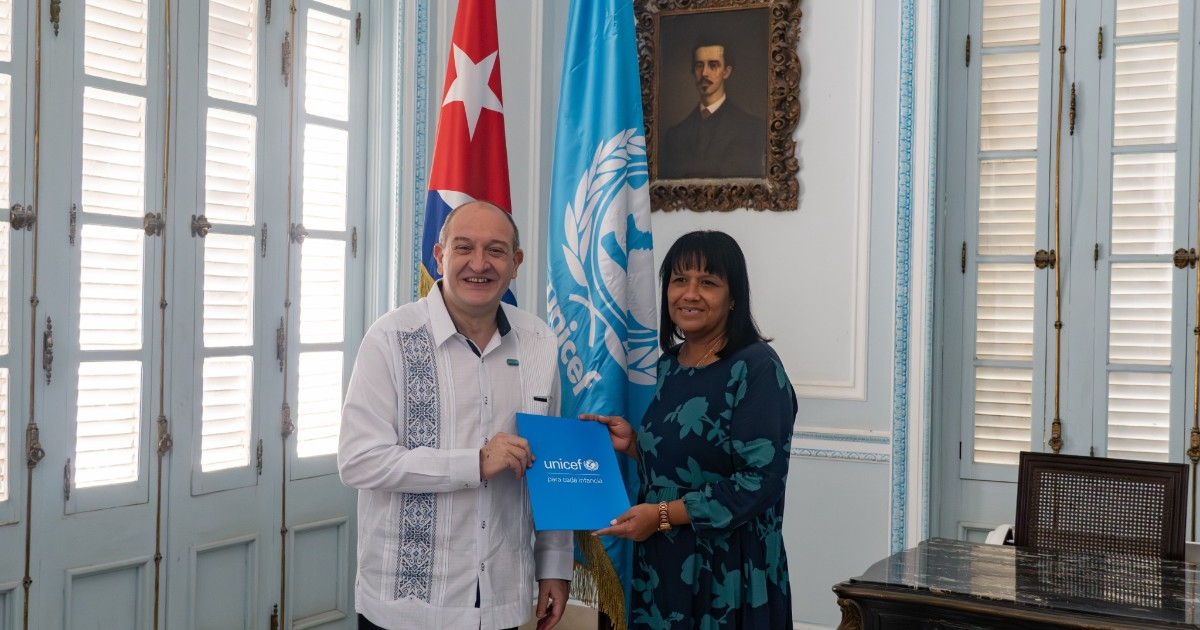
On Wednesday, the Guatemalan diplomat Luis Fernando Carrera Castro officially assumed his role as the new UNICEF Representative in Cuba. During a formal ceremony, he presented his credentials to Anayansi Rodríguez Camejo, Cuba's Deputy Minister of Foreign Affairs.
"I received the credentials of Luis Fernando Carrera Castro as the Representative of the United Nations Children's Fund. We expressed our commitment to continue strengthening the close relationship of cooperation and dialogue with the UNICEF Office in Cuba for the well-being of our children and adolescents," stated the diplomat on social media.
Carrera Castro brings over three decades of experience in public policy, social development, international cooperation, and the advocacy of children's rights, according to a statement by UNICEF Cuba on their social media platforms. Previously, he served as the UNICEF Representative in Mexico starting in 2021, where he led a team of more than 220 professionals focused on social protection, nutrition, education, and humanitarian response programs for migrant children.
Career Highlights and Political Background
His career with the organization dates back to 1994, having held positions in Indonesia, Panama, Cape Verde, Ecuador, Guatemala, and Costa Rica. Outside of UNICEF, Carrera Castro has a political background; he served as Guatemala's Minister of Foreign Affairs from 2013 to 2014, Secretary of Planning of the Presidency from 2011 to 2012, and was Guatemala's Ambassador and Permanent Representative to the United Nations in 2014 and 2015. He also led the Central American Institute for Fiscal Studies (ICEFI) and Soros Guatemala Foundation, offering guidance to governments and UN agencies on governance and human rights.
Academically, he is an economist who graduated from the National University of Costa Rica and holds a Master's degree in Economics and Development Policy from the University of Cambridge in the United Kingdom.
New Program and Challenges Ahead
His appointment comes at a crucial time for bilateral cooperation; in February, the agency's Executive Board approved the Cuba-UNICEF Cooperation Program 2026-2030. This initiative aims to enhance a comprehensive protection system for children's rights, integrated with climate-resilient local development strategies.
UNICEF has highlighted the challenges Cuba faces, with an estimated 1.2 million children exposed annually to two to four severe climatic events. Persistent structural issues, such as low early childhood education coverage, disruptions in access to safe water, and violence in family and community settings, compound the situation.
Within this new cycle, UNICEF has already implemented multiple initiatives on the island: it has donated 100 oxygen concentrators to maternal and child hospitals in seven provinces, distributed over 213,000 bottles of prenatal supplements to around 30,430 pregnant and breastfeeding women, and supported 30 schools in eastern Cuba with water, sanitation, and hygiene projects, benefiting more than 5,000 students.
Cuba's crisis has profoundly impacted children for years. A UNICEF report from 2024 revealed that approximately 9% of children under the age of five suffered from food insecurity. In June of this year, Cuba's Food Industry Minister acknowledged that over 100,000 children were not receiving their daily milk quota.
Upon taking office, Carrera Castro expressed his dedication to "continuing to strengthen collaborative work with national institutions, partners, communities, and young people to ensure the protection of every child's rights in the country."
Understanding UNICEF's Role and Challenges in Cuba
What is Luis Fernando Carrera Castro's background?
Luis Fernando Carrera Castro is a seasoned diplomat with over 30 years of experience in public policy, international cooperation, and children's rights advocacy. He has held positions in various countries and served as Guatemala's Minister of Foreign Affairs.
What are the main goals of the Cuba-UNICEF Cooperation Program 2026-2030?
The program aims to strengthen a comprehensive system for protecting children's rights, integrated with resilient climate development strategies. It addresses issues such as education, safe water access, and reducing violence.
How is UNICEF addressing the challenges faced by Cuban children?
UNICEF has implemented initiatives such as donating oxygen concentrators, distributing prenatal supplements, and supporting schools with water, sanitation, and hygiene projects to improve conditions for children in Cuba.