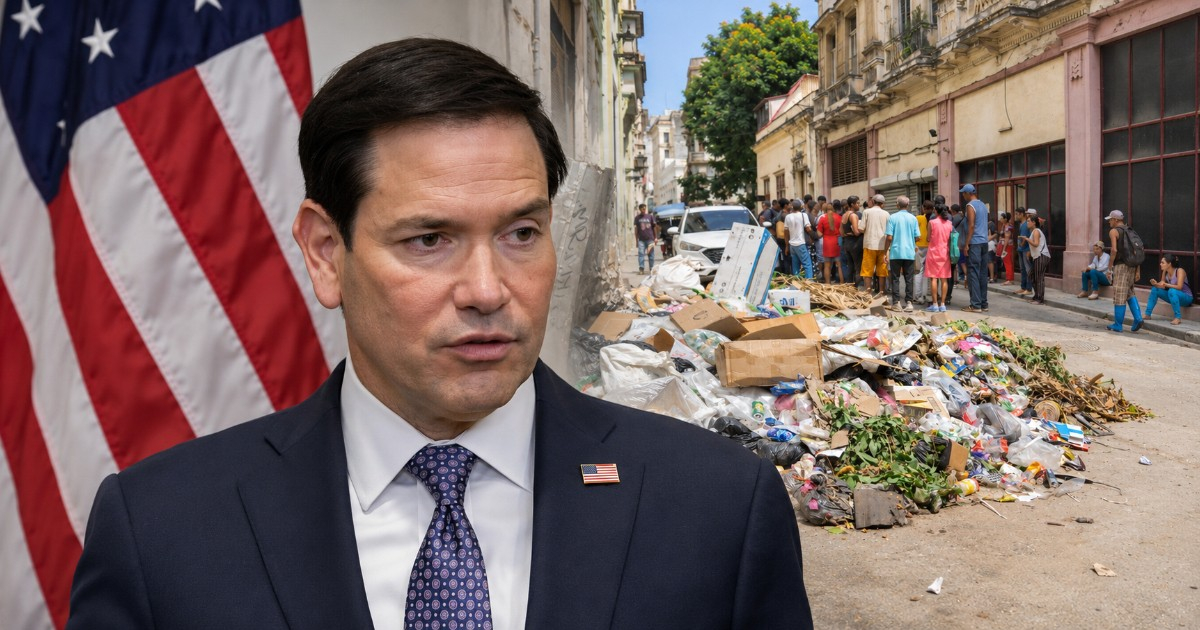
On Wednesday, Colombian newspaper El Tiempo published an analysis by journalist Mauricio Vargas, shedding light on the perspectives from Europe and Latin America regarding the collaborative plan between Marco Rubio and the Cuban opposition to dismantle Havana's regime. The possibility of military intervention has been set aside for the moment, while European diplomats express concern over the lack of clarity in the plan about who would govern Cuba during the transitional period.
According to this analysis, Secretary of State Marco Rubio recently endorsed this transition plan with Cuban opposition representatives. A diplomatic source in Brussels informed El Tiempo that the document "currently puts the military intervention option on hold, though it does not explicitly rule it out."
Both Rubio and the opposition are reportedly banking on an economic collapse to weaken the Castro regime's grip, believing that a mix of military threats and diplomatic efforts will hasten its downfall. However, European diplomats and parliamentarians are worried that the plan falls short in detailing who would form the provisional civil authority—expected to last up to 36 months—and what mechanisms would ensure its legitimacy.
The scenario they caution against mirrors Venezuela's situation: After Nicolás Maduro's capture in January 2026, interim president Delcy Rodríguez, a prominent chavista, has been in power for ten months without scheduling elections.
El Tiempo's analysis places this shift from the White House in a specific political context: the Republican defeat in the November 3 legislative elections, which shifted Congress back to Democratic control, and marked a distancing of the Latino vote from the Republican Party. Thus, Cuba has returned to the forefront of Trump's agenda as a tool to regain this electorate.
Last Thursday, Trump declared on the Salem News Channel his intention to "resolve the Cuba issue" before leaving the White House in January 2029. He praised Rubio, stating, "We have someone very good and capable to handle Cuba, named Marco, Marco Rubio. His parents are from Cuba, and he would love to do it." When asked about military intervention, Trump said he would "consider it."
The plan referred to by El Tiempo is "Cuba on the Threshold," presented by Rosa María Payá in Madrid on November 3 to around 80 diplomats, opposition members, and intellectuals. This document, exceeding 50 pages, stems from the Liberation Agreement signed in Miami in March 2026 by the Assembly of the Cuban Resistance and Pasos de Cambio, backed by over 30 organizations. It outlines four phases—liberation, stabilization, reconstruction, and democratization—and proposes a provisional government with a 51-member Parliament, an Executive with a president and two vice-presidents, and nine technical commissions.
Last week, Payá reiterated her message at the Berlin Freedom Conference, emphasizing that the Cuban dictatorship is "more vulnerable than ever" and urging Europe to abandon its tolerance towards Havana.
El Tiempo's analysis also highlights internal divisions within the opposition. Berta Soler, from the Damas de Blanco, advocates for excluding the Communist Party and establishing tribunals for repressors. Meanwhile, Manuel Cuesta Morúa, from the Council for Democratic Transition, argues that the process could include regime figures willing to embrace political change.
The most severe criticism came from writer José Prats Sariol, who dismissed the project as "pathetic, between ridiculous and grotesque," encapsulating the core debate with the phrase: "launching projects without mambises," referring to the plan's failure to outline how to trigger the regime's fall or identify internal forces capable of challenging it.
The economic backdrop fueling this strategy is dire: ECLAC forecasts a 10.3% contraction of Cuba's GDP in 2026, the worst in Latin America and the Caribbean, while the informal market exchange rate for the dollar hovers around 935 pesos, compared to about 40 pesos in January 2021.
Key Questions About the Cuban Transition Plan
What is the current status of the military intervention in Cuba?
The military intervention option has been put on hold for now, though it remains a possibility that has not been completely ruled out.
Who is involved in the 'Cuba on the Threshold' plan?
The plan involves Marco Rubio, the Cuban opposition, and was presented by Rosa María Payá. It is supported by the Assembly of the Cuban Resistance and Pasos de Cambio, along with over 30 organizations.
What are the concerns about the Cuban transition plan from Europe?
European concerns focus on the lack of a clear outline for who would make up the provisional civil authority and the mechanisms to ensure its legitimacy during the transitional period.