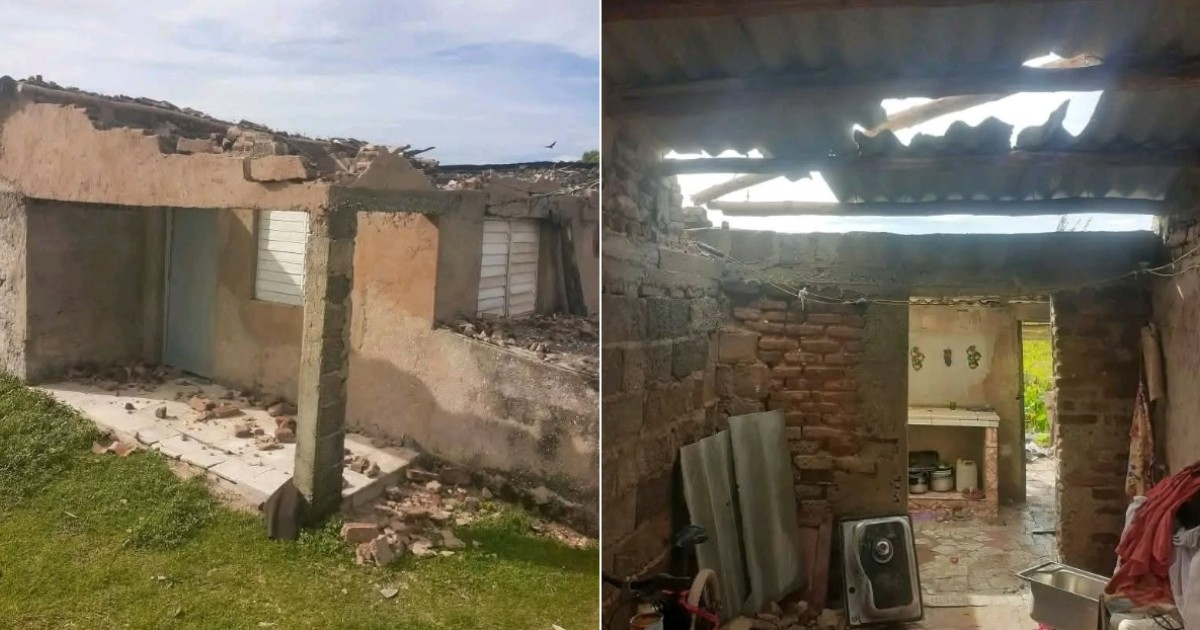
During the early hours of Tuesday, a powerful storm swept through Playa Caletones, a small coastal community northwest of Gibara in Holguín province, causing significant damage to the roofs and structures of multiple homes.
According to a report by Radio Gibara's journalist Daniel Ferrás, the intense weather event struck unexpectedly around 1:30 AM, catching residents of this northern Cuban coastal area off guard.
Images provided by local residents reveal completely collapsed roofs, shattered block walls, and debris scattered both outside and inside the affected homes.
Unpredictable Weather Patterns
Radio Gibara's meteorological analysis indicates that the storm had been brewing for hours over the sea and the northern coastline. "By midnight, a very active storm cloud had formed over land and unleashed heavy rains in the area," Ferrás noted.
The localized and destructive nature of the storm damage suggests the possibility of a waterspout coming inland or even a tornado forming on land. "The type of destruction observed clearly indicates very strong and localized winds," the report stated, though it clarified that the available data does not confirm this.
Wider Impact Across Eastern Cuba
This incident in Caletones is part of a period of intense meteorological instability that has affected eastern Cuba throughout November 2026.
On Wednesday, heavy rainfall in Holguín areas such as Güirabo, Birán, Sagua, Mayarí, and Nipe—ranging from 71 to 98.5 millimeters—caused a bridge support to collapse at the "Italiana" entrance on the road to Los Pinos in Banes municipality, leading to the road's closure.
Recent rains have increased the province's reservoir levels to 85.1% of their capacity.
Challenges Facing Vulnerable Communities
The vulnerability of communities like Caletones is exacerbated by the pre-existing structural deterioration of Cuban homes, which amplifies the impact of any meteorological event, even those of moderate intensity.
Compounding the issue is the fact that the Institute of Meteorology's (INSMET) radar network has been non-operational for months due to a lack of fuel, with only the Pilón radar functional but limited to internal use. This forces the population to rely on the Cayo Hueso radar in Florida for tracking rapidly forming severe weather events.
Independent meteorologist Alejandro Adonis issued a warning on Wednesday about new severe storms in eastern and western Cuba, with intensities reaching up to 98 millimeters per hour. "These storms are not only electrically active; they may bring strong winds, hail, and intense rainfall that could cause flooding," he warned.
Radio Gibara also cautioned that the weather is expected to remain unstable in the coming days: "Conditions remain favorable for continued showers and rains in the central and eastern parts of the country, where they could again be strong in some areas."
FAQs About Severe Weather Events in Cuba
What caused the storm in Playa Caletones?
The storm was a result of a very active storm cloud that formed over land after brewing over the sea and the northern coastline for hours.
Why are Cuban communities particularly vulnerable to storms?
Cuban communities are vulnerable due to the pre-existing structural deterioration of homes, which increases the impact of any meteorological event.
How has the lack of operational radar affected weather monitoring in Cuba?
The lack of operational radar has forced reliance on the Cayo Hueso radar in Florida, limiting the ability to track rapidly forming severe weather events locally.