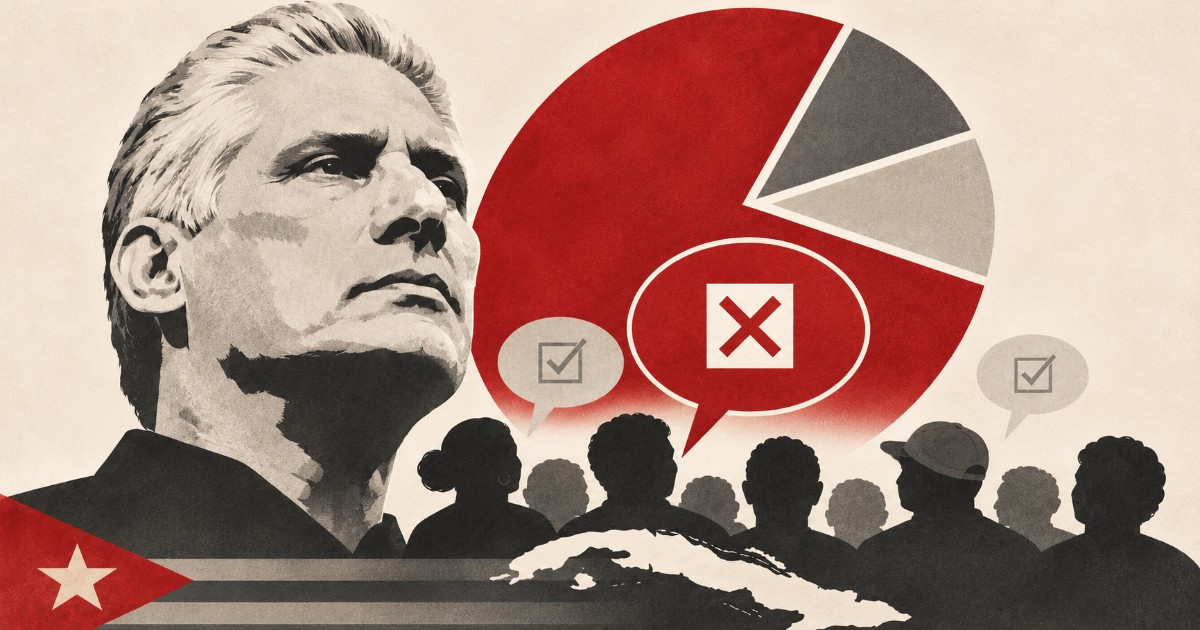
A recent survey conducted with 1,199 participants in Cuba highlights a significant disapproval of Miguel Díaz-Canel and key institutions of the regime.
The findings, published by the International Republican Institute (IRI) and conducted by the National Opinion Research Center (NORC) at the University of Chicago, reveal that a staggering 81% of those surveyed hold an unfavorable opinion of the leader, with a meager 2% viewing him positively.
This study involved face-to-face interviews with Cuban citizens over the age of 18, carried out in their homes from July 22 to September 7, 2026.
Distrust in Political Representation
A notable finding is the overwhelming sentiment regarding political representation: 89% of respondents feel the government does not represent them, while 82% believe that Cuba is governed for the benefit of a select few, rather than the majority of its citizens.
Moreover, 86% of participants expressed that the country is heading in the wrong direction, a sentiment that increased to 90% among those aged 18 to 35 and residents of the eastern provinces.
Negative Perceptions of Díaz-Canel and Regime Institutions
The detailed results paint a grim picture for Díaz-Canel, with 76% of participants describing their view as very unfavorable and another 5% as somewhat unfavorable. Only 1% had a very favorable opinion, and another 1% somewhat favorable, while 12% either didn't know or chose not to answer.
Raúl Castro also faced significant negative feedback, with 76% unfavorable views against 6% favorable. Similarly, Prime Minister Manuel Marrero Cruz was met with 78% unfavorable ratings.
Key political institutions, such as the Communist Party, the National Revolutionary Police, and the Committees for the Defense of the Revolution, each received 83% negative opinions, while the National Assembly of People's Power garnered an 84% negative rating.
Call for Urgent Changes
When asked about political or public figures they trust, a striking 73% of respondents stated they trusted none. Díaz-Canel was barely mentioned, with only 2% expressing any trust in him.
Antonio Garrastazu, IRI's Senior Director for Latin America and the Caribbean, noted the loss of confidence in Cuban authorities, stating, "Trust in the political system and its leaders has plummeted."
The survey also asked what kind of changes are deemed necessary for the country. A significant 78% favored profound and urgent changes, compared to 10% who preferred gradual modifications to maintain the current system, and 7% who believed in protecting the existing order from those seeking change.
Among younger respondents aged 18 to 35, the percentage in favor of urgent and profound changes rose to 85%.
In response to what should remain unchanged in Cuba, 67% of those surveyed answered "nothing."
Economic Struggles and Government Performance
The assessment of the government's performance was overwhelmingly negative. When asked about the administration's greatest achievement, 69% said "nothing." Education was mentioned by 7% and healthcare by 5%.
Economic hardships were evident in the responses, with 76% stating their quality of life had worsened in the past six months, and 44% admitting difficulties in feeding their families and purchasing basic necessities.
The supply of electricity and fuel received a "very poor" rating from 91% of participants, reflecting the same dissatisfaction with the government's handling of food distribution through the ration book.
Comparative Insights from Other Surveys
The IRI study aligns with other research released in 2026 that also recorded critical views of Cuban authorities, albeit with different methodologies. An independent survey in April noted that among 4,324 initial responses, 94% expressed no trust in the government.
During that time, Díaz-Canel received the lowest rating among eight official figures, with 93.7% assigning him the minimum score on a five-point scale.
However, this exercise was conducted through an open digital questionnaire available to Cubans both on and off the island, and its voluntary nature means it cannot be considered representative of the entire Cuban population.
Another study from October by Vanderbilt University's LAPOP Lab found that three out of four participants blamed the Cuban government for the economic crisis. Conducted through a digital panel of 1,095 Cuban residents, it also revealed that 46% identified the Castro family as the real decision-makers, while only 14% pointed to Díaz-Canel.
The authors cautioned that the sample was not statistically representative of the entire adult Cuban population, as it focused on those with internet access and had a larger urban and younger demographic.
Understanding the IRI Survey's Reach
Unlike earlier digital surveys, the IRI study employed face-to-face home interviews and a multi-stage probabilistic sampling method designed to provide a representative sample of the adult population living in Cuba.
According to the methodology, results were weighted by age, gender, region, and urban or rural residence, using population estimates from the United Nations and WorldPop.
The survey reports a maximum margin of error of ±4.2 percentage points for the entire sample, with a 95% confidence level and a 20% response rate.
These aspects allow for interpreting the percentages as statistical estimates about the Cuban adult population, within the design's limits, but do not imply consultation with the entire citizenry.
Additionally, direct comparisons with previous digital surveys are not possible due to differing participant selection and data collection methods.
Insights into Cuban Sentiments and Survey Methodology
What percentage of Cubans have an unfavorable opinion of Díaz-Canel according to the IRI survey?
According to the IRI survey, 81% of Cubans have an unfavorable opinion of Díaz-Canel.
How did the survey assess the Cuban government's performance?
The survey found that 69% of participants believe the government has achieved "nothing," with education and healthcare receiving marginal mentions.
What methodology did the IRI use for the survey?
The IRI used face-to-face home interviews and a multi-stage probabilistic sampling method for a representative sample of the Cuban adult population.