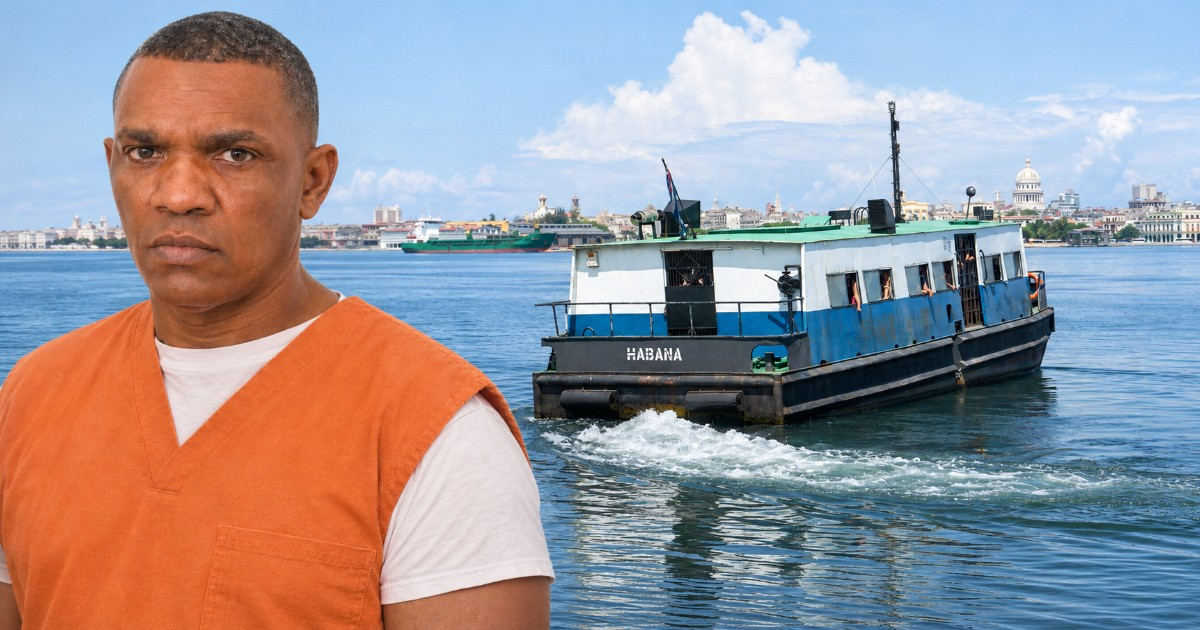
Yohamnys Thomas González has spent over 23 years confined in Guanajay prison, Artemisa, serving a life sentence for his involvement in the 2003 hijacking of the Baraguá ferry. Activist and art historian Anamely Ramos recently highlighted his case on Facebook as part of a series on "lifers"—Cubans serving sentences of 20 years or more without a realistic chance of release.
On April 2, 2003, a group of eleven individuals seized control of the Baraguá ferry, which operated between Regla and Old Havana, in an attempt to reach the United States. The ferry ran out of fuel and was towed back to Cuba. No passengers were harmed during the incident, and several, including foreign nationals, were willing to testify that they were not mistreated. However, their testimonies were disregarded during the legal proceedings.
The summary trial took place from April 5 to 8 that year. Three of the defendants—Lorenzo Enrique Copello Castillo, Bárbaro Leodán Sevilla García, and Jorge Luis Martínez Isaac—received death sentences and were executed on April 11, just nine days after the hijacking and three days following their sentencing.
Their families were denied the chance to say goodbye. Ramos recounted that Lorenzo's mother, Ramona Castillo, was assured by a colonel the previous afternoon that the sentence was not yet final. "At five in the morning the next day, they informed her that her son had been executed and was already buried," the activist wrote.
Yohamnys was among four men sentenced to life imprisonment in the same trial, alongside Maykel Delgado Aramburo, Harold Alcalá Aramburo, and Ramón Henry Grillo. He was 24 when he entered prison and now serves his sentence in the maximum-security area of Guanajay, where Joel Dorta García is also held, whose story Ramos shared last week as the first installment of her series.
Legal Obstacles and Human Rights Concerns
The Inter-American Commission on Human Rights (CIDH) determined that the Cuban state violated the rights to life, justice, and due process for the three executed youths, trying them without proper guarantees. Ramos condemned the trial as "a smokescreen for a predetermined decision, executed swiftly, akin to extrajudicial execution."
All judicial review efforts have been unsuccessful. In 2019, the Prosecutor's Office refused to revisit the case; in June 2020, the Supreme Court denied clemency for Delgado and Alcalá. A mass pardon of 2,010 prisoners announced by the regime in April 2026 specifically excluded those convicted of "crimes against authority," a category often applied to political prisoners.
In October 2026, legal advocacy group Cubalex warned that life imprisonment in Cuba is incompatible with the protection of human rights. Cuban law only allows conditional release consideration for life-sentenced inmates after 30 years, meaning Yohamnys wouldn't be eligible until at least 2033.
Hope and Family
Ramos noted that Yohamnys is about to become a father for the first time, a development that renews his hope for clemency. "Yohamnys's body is not the same, nor his mind, but he still yearns to venture beyond the three or four confined spaces that have surrounded him for over two decades," she wrote.
"For them to return home, embrace their families, and live their remaining years with some peace would mean EVERYTHING to them and much, so much, to the country we still yearn for and cannot stop dreaming of," the activist concluded.
Understanding the Cuban Judicial System and Human Rights Violations
Why was Yohamnys Thomas given a life sentence?
Yohamnys Thomas received a life sentence for his involvement in the 2003 hijacking of the Baraguá ferry, an incident that aimed to reach the U.S. but ended without harm to passengers.
What was the outcome for the other individuals involved in the hijacking?
Three individuals were executed shortly after a summary trial, while Yohamnys and three others received life sentences.
What has the CIDH said about the trial?
The Inter-American Commission on Human Rights concluded that the Cuban state violated the rights to life, justice, and due process of the executed youths, as they were not provided with the necessary legal guarantees.