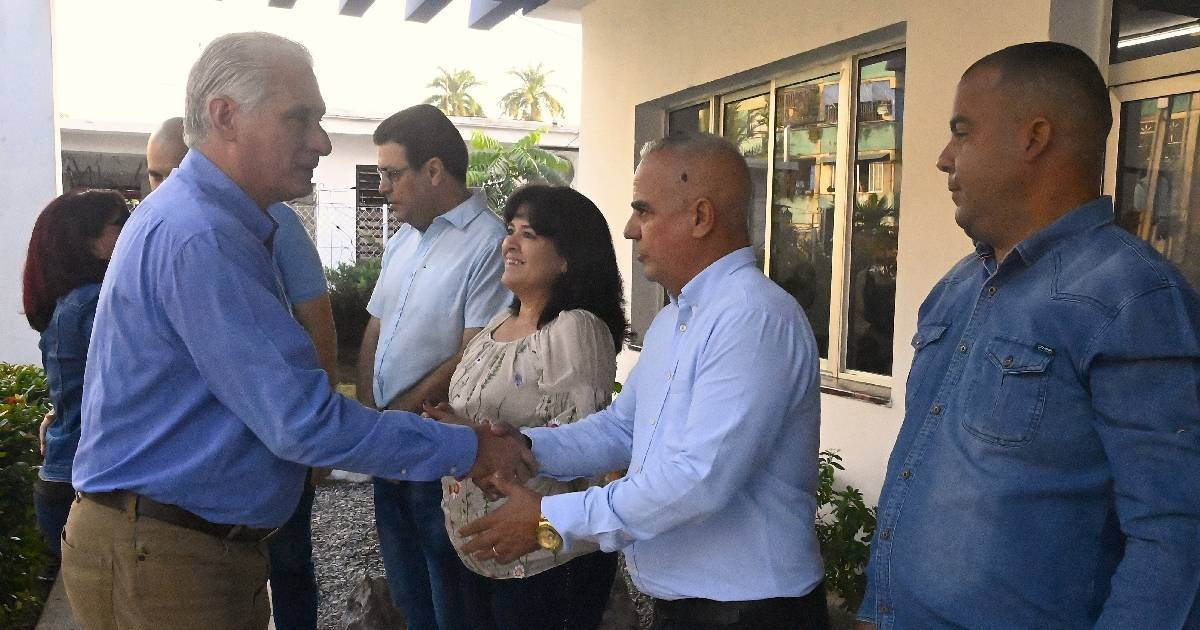
On Tuesday, Miguel Díaz-Canel admitted during a visit to Pinar del Río that the 176 Economic and Social Transformations initiated by the Cuban regime have yet to yield the results expected by the populace. He urged the Cuban people to "go out and fight to defend them."
During his visit, Díaz-Canel met with Communist Party officials and members in the province to assess the progress of the economic reforms, which were approved by the National Assembly in an extraordinary session on June 18-19, 2026. These reforms have been presented as the most significant structural changes since the Special Period.
“We are already implementing these transformations. This process, of course, needs to move faster, become more coherent, and most importantly, start producing tangible results that the population anticipates,” Díaz-Canel stated to those present.
Rather than announcing specific progress, the leader acknowledged that doubts and uncertainties persist in several sectors. He instructed Party cadres to revisit these areas: “We need to go where there is more doubt and uncertainty,” in sectors with less understanding, “to explain again, to call upon them once more.”
The most striking appeal was directed at the citizens: “We need the majority of the population to understand the Transformations, to be willing to participate, and to go out and fight to defend them.”
Díaz-Canel pointed out that the main concerns among Cubans revolve around whether this process will preserve the system's social services, to which he responded with a slogan: “The transformation seeks to build socialism amidst our current situation.”
He also emphasized that change will not occur spontaneously: “Transformations are not solved through inertia, bureaucracy, or decrees; they are resolved by working, innovating, and through popular participation and control.”
The visit to Pinar del Río comes amid a severe crisis. In October, Prime Minister Manuel Marrero Cruz acknowledged that the reforms had not improved the population's quality of life and projected that noticeable effects would not occur until 2027.
The province visited has over 36,000 hectares of idle agricultural land and another 17,000 poorly exploited, out of a total of 416,000 hectares, according to mid-November data.
Nationally, the situation is equally dire: as of October 2026, 96.91% of the Cuban population did not have adequate access to food, according to the Food Monitor Program, and 33.9% of households reported at least one member going to bed hungry the previous month. Official inflation reached 25.19% in August 2026, with maximum electrical impact reaching 1,816 MW at the beginning of this month.
Díaz-Canel himself admitted in a radio program days ago that Cubans expect “fewer blackouts and more food,” noting that only nine out of 23 complaints from the previous broadcast had been resolved.
Roberto Morales Ojeda, member of the Political Bureau and Secretary of Organization of the PCC Central Committee, also attended Tuesday’s meeting, emphasizing unity around the Party as essential for progress. Meanwhile, Pinar del Río's provincial first secretary, Yamilé Ramos Cordero, provided a detailed account of the progress and shortcomings of the province in implementing the measures.
Out of the 176 approved transformations, 172 had policies and procedures approved, with 231 legal norms produced, though the gap between the legal framework and tangible results remains the main political vulnerability for the regime.
Understanding Cuba's Economic Reforms
What are the 176 Economic and Social Transformations?
These are a series of reforms approved by the Cuban government aimed at significant structural changes to the economy and society.
Why is there doubt and uncertainty about the reforms?
Many sectors remain skeptical due to a lack of visible progress and concerns about the preservation of social services within the existing system.
When are the reforms expected to show results?
Prime Minister Manuel Marrero Cruz projected that noticeable effects of the reforms would not be seen until 2027.