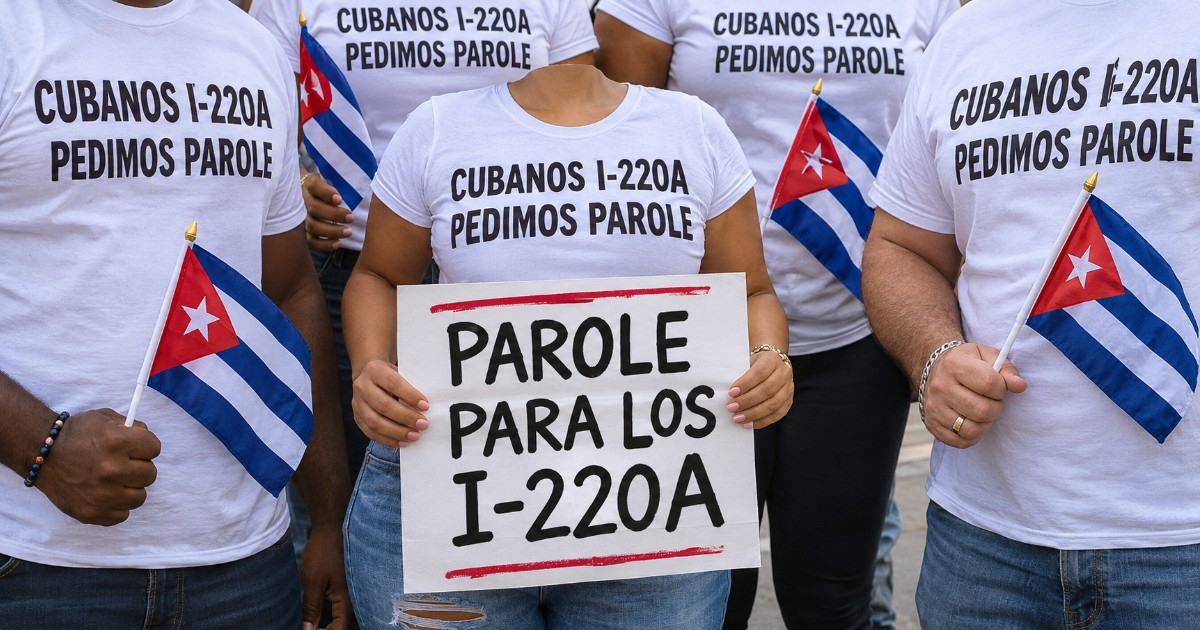
A U.S. Court of Appeals for the Eleventh Circuit ruling has delivered a significant setback to Cuban immigrants who had hoped to equate the I-220A form with a parole status. According to Telemundo 51 journalist Alexis Boentes, the court decided that this document alone does not qualify as a valid parole under the Cuban Adjustment Act.
The decision, detailed in a 16-page opinion in the case Aguiar-Fernandez v. U.S. Attorney General (case number 24-12318), originated from a petition by a Cuban family—Yoan Aguiar-Fernandez, his wife Yenisley Gonzalez-Sanabria, and their daughter—who crossed the Mexican border in 2021, were detained by Border Patrol, and subsequently released with an I-220A.
Court's Distinction on Parole and Release
The judges determined that release under section 1226 of the Immigration and Nationality Act is legally different from the humanitarian parole specified in section 212(d)(5)(A), which is required by the Cuban Adjustment Act to apply for permanent residency.
This ruling on the I-220A and the Cuban Adjustment Act could significantly impact the immigration future of countless Cuban nationals in the U.S. Stay informed on these and other developments in our U.S. Immigration section.
Legal Implications and Federal Precedent
As a published opinion, the decision sets a binding precedent for all federal courts in Florida, Georgia, and Alabama regarding the legal issues it addresses.
The I-220A is a release order under supervision issued by Immigration and Customs Enforcement (ICE) that allows migrants to remain free while their immigration process is ongoing, but it does not confer immigration status nor does it independently open the door to residency through the Cuban Adjustment Act.
Impact on Collective Legal Actions
This new precedent appears at a crucial time for the class action lawsuit Bello-Rubio v. Noem, being processed by federal judge Jacqueline Becerra in the Southern District of Florida, filed by 992 Cubans.
The lawsuit seeks to have the circumstances under which many Cubans were processed and released at the border legally recognized as a parole, thereby allowing them to apply for residency through the Cuban Adjustment Act. Advocates believe a favorable decision could benefit between 500,000 and 600,000 Cubans in similar situations.
However, the ruling does not automatically dismiss this class action nor imply that all Cubans with an I-220A have a deportation order. The real impact of the precedent on the litigation will depend on pending arguments and the decisions made by Judge Becerra.
In September, Judge Becerra had already denied the federal government's first attempt to dismiss the case, asserting jurisdiction to review the core issues of the litigation. In October, the government filed a second motion to dismiss, to which the plaintiffs responded on the 23rd of that month.
Previous Legal Context and Trends
This decision isn't the first to draw such a distinction. The Board of Immigration Appeals had established in September 2023, in the Matter of Cabrera-Fernandez case, that release under section 236 of immigration law is "legally distinct" from humanitarian parole, a stance it reaffirmed in June 2025. What changes now is the Eleventh Circuit making it a binding precedent.
The backdrop is particularly sensitive: Cuban immigration arrests increased by 463% during the first year of Trump's second term, reaching an average of 1,008 per month, as analyzed by the Cato Institute.
Attorney Mark Prada, representing the plaintiffs in Bello-Rubio, had previously noted that even a legal victory wouldn't automatically shield all affected individuals from deportation nor grant them residency outright.
Understanding the I-220A and Cuban Adjustment Act Ruling
What is the significance of the Eleventh Circuit's ruling on the I-220A?
The ruling clarifies that the I-220A form does not qualify as a valid parole under the Cuban Adjustment Act, affecting many Cubans' ability to apply for permanent residency.
How does this decision impact the class action lawsuit Bello-Rubio v. Noem?
While the decision sets a legal precedent, it does not automatically dismiss the lawsuit. The outcome will depend on future legal arguments and decisions by Judge Becerra.
Why is the I-220A form important for Cuban immigrants?
The I-220A form allows Cuban immigrants to be released under supervision while their immigration process continues, but it does not grant them legal status or a pathway to residency.