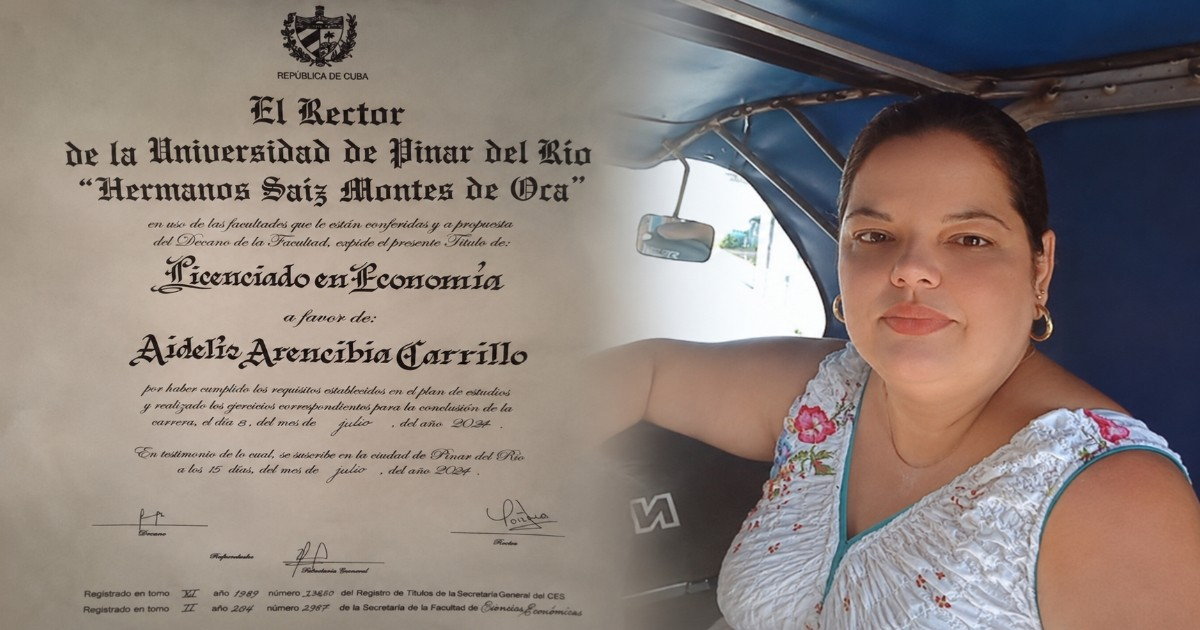
Aidelis Arencibia, an Economics graduate from the University of Pinar del Río "Hermanos Saíz Montes de Oca" and mother of three autistic children, recently posted a message on Facebook that captured widespread attention. She showcased her university degree tucked away in a closet, describing it as "perfectly authenticated and extraordinarily useless."
Amidst clothing, Arencibia discovered the document and shared a photo of it beside a text dripping with irony and sorrow. Addressing José Martí symbolically, she wrote, "You said that to be cultured was the only way to be free; today, more than ever, we are prisoners of an island that starves us."
Arencibia makes her presence known, stating, "I say this: a neurodivergent mother of three autistic children, a juggler of the impossible. And while the world applauds my resilience, here we survive on rhetoric and silence."
The Collective Outcry
She called upon fellow Cubans to join her cause: "If you also have a degree gathering dust, give a 'like' and share. Share it, lest someone forget that thinking is still free."
The response was immediate. Yordanka Battle Moré shared her own experience, admitting her degree languishes "in a closet corner." She lamented, "It hurts! Deeply. What a disgrace for a country!" Further, she declared, "Cuba is already a Jurassic Park. Filled with professionals whose greatest academic achievements have become mere relics stored away."
Battle Moré pointed out that the issue isn't a lack of capability or willingness: "Sometimes not due to a lack of talent, preparation, or willingness to work, but because a system has failed to offer opportunities to develop talents and live with dignity from one's efforts." She concluded with a poignant statement: "Cuba is missing Cuba, because it lacks a nation where talent can thrive."
A Wider Context of Disillusionment
Arencibia's protest is not isolated. Cuban professionals earn state salaries ranging from 4,000 to 9,400 pesos monthly—equivalent to merely four to ten dollars on the informal exchange—while basic needs require an estimated 96,000 pesos.
This "degree in the closet" phenomenon isn't new. In May 2026, Professor Austin Llerandi was barred from teaching after posting a photo of his diploma inside a pot as a symbolic protest. By July, an official journalist questioned "what good is a degree?" acknowledging the youth's disillusionment with higher education.
Known on Cuban social media in 2026, Arencibia also condemned the inadequate medical diet provisions for her three autistic children. "Giving a mother a list of foods for a sick child that are only written down is humiliating, disrespectful, and shows cardboard empathy," she stated.
Her viral post echoes a question silently pondered by many Cubans. As Battle Moré expressed, "Behind every rolled-up and stored degree, there are years of study, family sacrifices, deferred dreams, and immense frustration."
Arencibia concluded her message with a powerful sentiment: "Maybe someday a degree will once again mean a future. For now, it stays in the closet, perfectly authenticated and extraordinarily useless."
Understanding the Plight of Cuban Graduates
Why are Cuban degrees considered "useless" by some?
Many Cuban graduates find their degrees "useless" due to the lack of opportunities and low salaries that do not reflect their education or expertise.
What is the significance of the "degree in the closet" phenomenon?
The "degree in the closet" symbolizes the disillusionment and frustration of Cuban professionals who cannot utilize their education for personal or societal advancement.
How has the Cuban government responded to these protests?
The Cuban government's response to these protests has been largely inadequate, with systemic changes needed to provide real opportunities and adequate compensation for professionals.