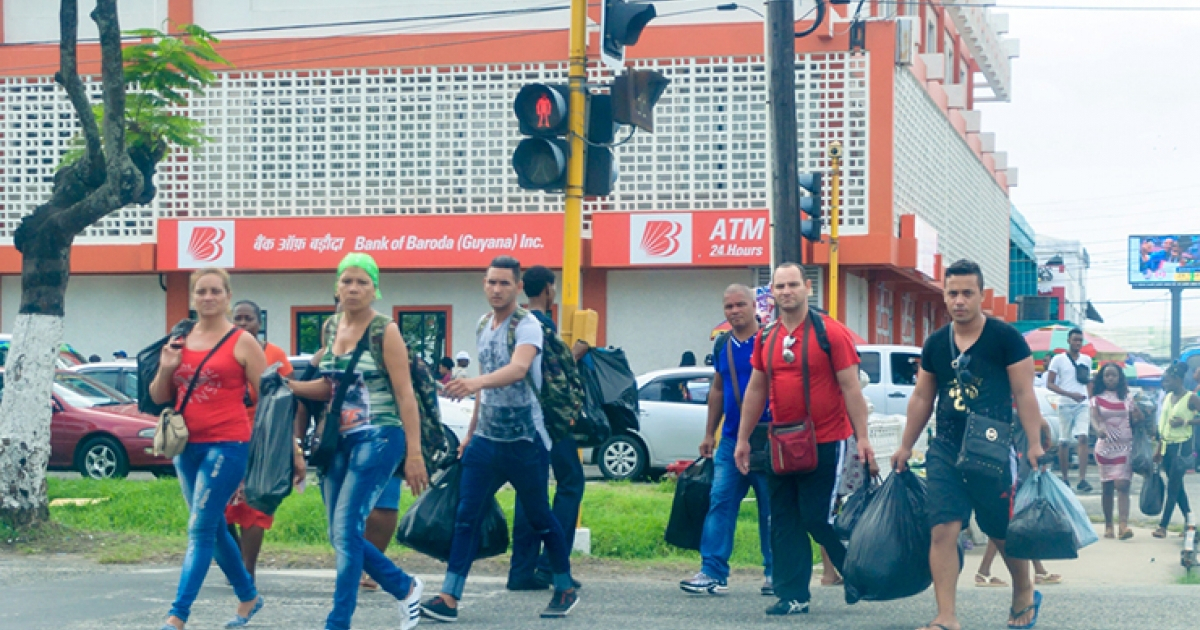
The issue of Cuban immigrants has once again taken center stage in Guyana's political arena. Opposition parliamentarian Terrence Campbell has raised questions about the immigration policies of President Mohamed Irfaan Ali's administration, highlighting differences in how nationals from Cuba, Venezuela, and Haiti enter the country.
As reported by the Guyanese news outlet Guyana Standard, Campbell, a member of the opposition coalition A Partnership for National Unity (APNU), accused the government of failing to update its immigration and labor policies. He argued that this oversight has left the nation vulnerable to infiltration by foreign criminal organizations.
Campbell pointed out that Venezuelan citizens were entering Guyana without proper documentation, whereas Cubans were arriving through documented channels. He also criticized the restrictions imposed on Haitians, despite Haiti being a member of the Caribbean Community (CARICOM).
Discrimination Allegations and Security Concerns
Campbell accused the government of discriminatory practices against Haitians, citing unequal treatment among immigrant groups. His criticisms followed a national security address by President Ali on November 12, where Ali warned of intelligence reports on potential activities by the Venezuelan criminal group Tren de Aragua, including plans to target individuals and strategic facilities in Guyana.
The President also mentioned an attack on a substation of the Guyana Power and Light company on November 10, involving incendiary devices. While authorities were investigating whether this incident was part of a broader conspiracy, no public link to Tren de Aragua had been confirmed, according to News Room Guyana.
Calls for Policy Overhaul
Campbell argued that the government couldn't issue warnings about foreign criminal entities without addressing what he sees as deficiencies in border security and immigration employment regulation.
This controversy arises as Guyana seeks to align its immigration policies with the demands of a rapidly growing economy, primarily fueled by the burgeoning oil industry and large infrastructure projects.
In September, President Ali announced plans for a new immigration policy to cater to the increasing need for foreign workers. He emphasized the necessity for a more flexible and modern framework, projecting that by 2030, approximately three million people could be involved in the country's economy for work, trade, and tourism.
Cuban Presence and Legal Status
Cubans are part of this migratory wave. In August, President Ali stressed that those wishing to work in Guyana should enter legally and comply with the same labor conditions as local workers. Data cited by Bloomberg indicated that around 135,000 Cubans gained legal status in Guyana by 2025, a significant increase from just over 800 in 2020, highlighting the growing presence of Cuban nationals in the South American nation.
The immigration debate extends to Cubans relocated from the United States. In September, four Cuban citizens arrived in Guyana alongside two Afghans under a bilateral agreement to receive certain deportees from third countries. Campbell criticized this mechanism, demanding greater transparency regarding the identity of the transferred individuals and the terms of the agreement.
Beyond the political discourse, Cubans in Guyana face security challenges and exploitation risks. In early November, Guyanese authorities placed 14 Cuban women under protection during an operation against potential human trafficking in the mining town of Bartica. A Cuban national was arrested as investigations into the case continued.
Key Questions About Guyana's Immigration Policies
What are the main criticisms against Guyana's immigration policies?
The main criticisms include outdated immigration and labor policies, alleged discriminatory practices against Haitian immigrants, and insufficient border security and employment regulation for immigrants.
How has President Ali responded to immigration challenges?
President Ali announced plans for a new immigration policy to meet the needs of a growing economy and emphasized legal entry and compliance with local labor conditions for foreign workers.
What is the significance of Cuban immigrants in Guyana?
Cuban immigrants have significantly increased in Guyana, with legal status numbers rising from just over 800 in 2020 to around 135,000 by 2025, reflecting their growing presence and impact on the country's economy.