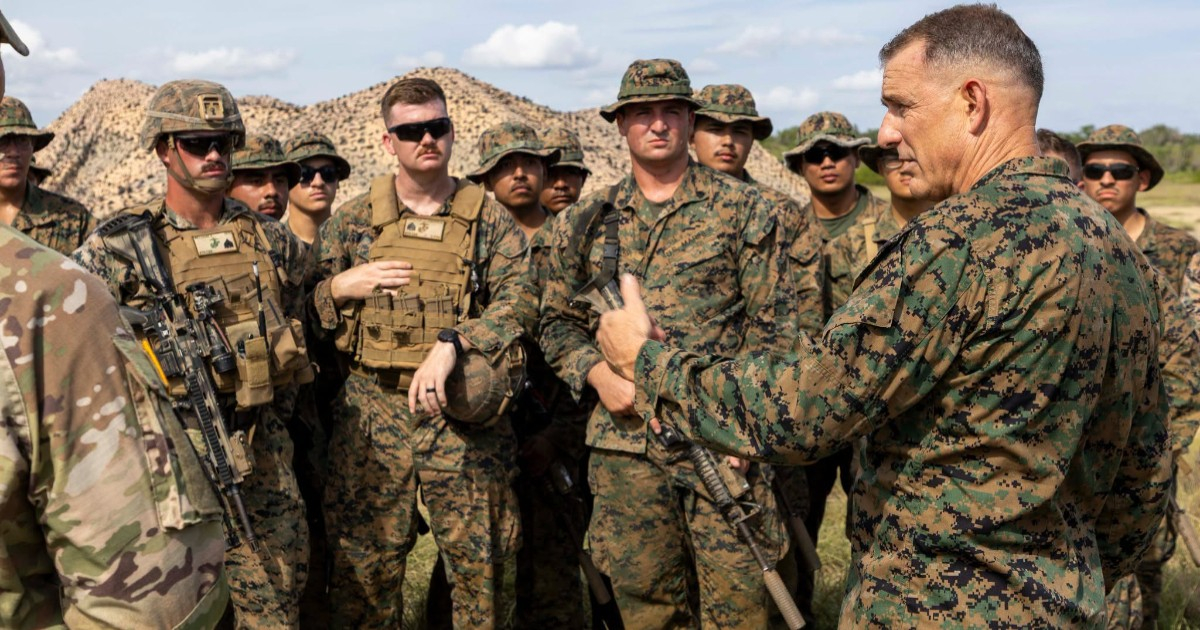
The United States Southern Command recently shared on its official X account new images featuring General Francis L. Donovan participating in live-fire drills with Marines from Task Force Secure at the Guantanamo Naval Base, conducted on November 12.
The photos depict members of the Marine Corps in combat stances, equipped with long-range weaponry, including rifles with scopes and grenade launchers, against the backdrop of Guantanamo's low-vegetation terrain.
An official statement from SOUTHCOM highlighted the exercise's aim to "maintain operational readiness and support mission requirements in Guantanamo Bay." The statement also acknowledged the collaboration with Marine Forces South (MARFORSOUTH) and the United States Marine Corps (USMC), emphasizing high-level institutional coordination.
Emphasizing a "readiness from above" concept, the publication underscored Donovan's personal involvement. As SOUTHCOM commander since February 5, 2026, Donovan brings nearly 37 years of service in the Marine Corps, specializing in infantry and special operations.
The U.S. Embassy in Cuba had already shared the same statement in Spanish, widening its reach to the Spanish-speaking audience on the island by tagging the Department of Defense and MARFORSOUTH.
The November 12 exercise is the latest in a series of military activities at the base throughout 2026. Just nine days earlier, Task Force Secure, consisting of over 140 Marines within the Joint Task Force–Southern Guard, executed the "No Fly Zone" anti-drone exercise, involving JIATF-401, Southern Command Naval Forces, the Fourth Fleet, and the Army's Combat Capabilities Development Command.
On November 6, the littoral combat ship USS Minneapolis-Saint Paul made a port call at the base. In October, SOUTHCOM announced that Guantanamo would host the first regional center for the Autonomous Warfare Command (SAWC), established by Donovan in April to integrate drones and autonomous systems.
The political-military climate is increasingly tense. On the same day Donovan observed the live-fire exercises, Raúl Castro sent a letter to the Border Brigade—tasked with guarding the land perimeter of the base—denouncing the U.S. presence as "usurpation" and vowing that Cuba would "achieve victory."
Cuba has declared 2026 the "Year of Defense Preparation" and responded with the strategic exercise Moncada 2026, held from November 4 to 6. During this event, General Roberto Legrá Sotolongo, Chief of the General Staff of the Cuban Revolutionary Armed Forces, warned that Cuba would defend "house by house, neighborhood by neighborhood, area by area."
Cuban representative to the United Nations, Ernesto Soberón, told Russian media that Havana takes "very seriously the possibility of a U.S. military operation." Meanwhile, a CBS News investigation in September revealed that the U.S. Army Reserve was considering deploying medical, logistical, engineering, and military police units to SOUTHCOM within 90 to 120 days, in a plan that officials directly linked to Cuba.
Understanding the Rising Tensions at Guantanamo Bay
What was the purpose of the live-fire exercise in Guantanamo?
The live-fire exercise aimed to maintain operational readiness and support mission requirements in Guantanamo Bay.
Who participated in the "No Fly Zone" anti-drone exercise?
The "No Fly Zone" anti-drone exercise involved Task Force Secure, JIATF-401, Southern Command Naval Forces, the Fourth Fleet, and the Army's Combat Capabilities Development Command.
How has Cuba responded to U.S. military activities at Guantanamo?
Cuba declared 2026 as the "Year of Defense Preparation" and conducted the strategic exercise Moncada 2026, emphasizing a robust defense strategy.