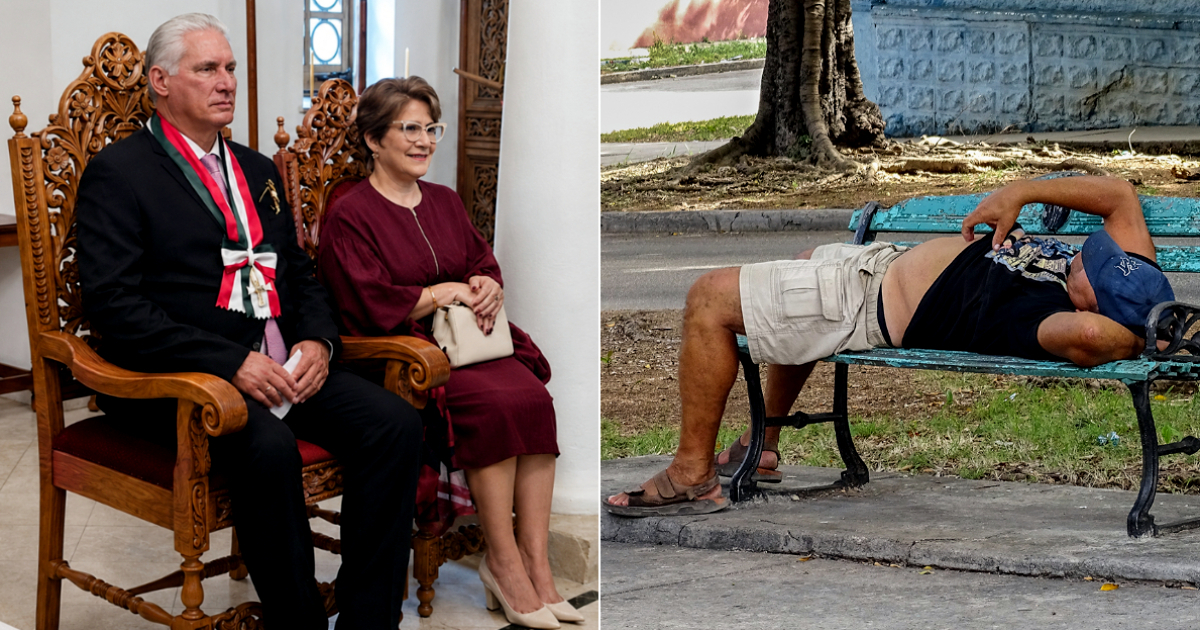
During Havana's 507th anniversary, Miguel Díaz-Canel used the occasion to chastise the city's residents for their "apathy" and "social indiscipline." This comes in a city plagued by endless power outages, water shortages, heaps of garbage, and crumbling buildings that daily endanger its inhabitants.
"Havana's birthday reminds us of what we owe this city as its residents, within the limits of possibility and beyond, to free it from the painful impacts of the blockade, but also from apathy and social indiscipline. The Capital of all Cubans deserves this," the leader posted Monday on his X account.
This statement repeats two common themes of the official discourse: the U.S. embargo, referred to by the regime as a "blockade," and the behavior of the populace. However, the issues leading to Havana's current state of decay far exceed the individual responsibility of its residents and involve the public services that the State is supposed to manage.
Havana's Struggle with Basic Services
For years, Díaz-Canel has resorted to blaming citizens for the capital's squalor. In October 2025, during a meeting monitoring a sanitation campaign, he criticized neighborhoods where residents did not participate in garbage collection. "There are neighborhoods where no one showed up," he lamented, citing areas like Diez de Octubre, Playa, and La Lisa.
The leader demanded public participation in a task that the Communal Services system should regularly ensure. Even his own government admitted it lacked a sustainable solution and that extraordinary efforts were insufficient to keep the city clean.
Months earlier, in August 2025, the provincial director of Communal Services, Mariano Suárez del Villar Farrés, blamed the population for the disappearance of containers, claiming some citizens used them to make containers and even "clothesline sticks." He also admitted that the city needed far more bins than the state industry could produce.
In August 2026, a leader from the Rampa Popular Council described social indiscipline as "a cancer slowly consuming us." He did so while acknowledging a waste collection project using electric tricycles had failed to function as intended, partly due to difficulties charging the vehicles.
Energy and Water Crisis Amplifying Hardships
Havana marks its anniversary amid a worsening energy crisis that has made power outages a daily torment. Once relatively shielded from the blackouts afflicting the rest of the country, the capital now suffers increasingly prolonged interruptions, with neighborhoods spending entire days without electricity.
The lack of power prevents food preservation, complicates cooking and resting, halts economic activities, and exacerbates other essential services. Last Saturday, residents of Calabazar and Las Cañas in Boyeros protested after more than a week without electricity. Reports indicate the Las Cañas bridge was set on fire during these demonstrations.
The water crisis adds another layer to the torment of Havana's residents. Aguas de La Habana has admitted that approximately 87% of its hydraulic system depends on electricity. By early November, more than 536,000 residents were facing supply disruptions, with some neighborhoods going weeks or even months without running water.
A recent electrical failure at the Cuenca Sur supply source worsened conditions in multiple municipalities, highlighting how the degradation of one service drags others down with it.
Garbage Collection and Urban Decay
Garbage collection provides another example of the breakdown. By early 2026, only 44 of Havana's 106 garbage trucks were operational, merely 41.5% of the fleet, due to fuel shortages and mechanical failures. Meanwhile, the city generates between 24,000 and 30,000 cubic meters of waste daily, far exceeding the available collection capacity.
The outcome is makeshift dumps that linger for weeks in the streets, leading to infestations of rodents, mosquitoes, foul odors, and health risks. Waste accumulates even near hospitals and schools, while extraordinary cleaning operations provide only temporary relief.
Adding to this grim picture is the deterioration of architectural and housing heritage. Official reports cite around 1,000 building collapses annually in Havana. By the end of 2025, more than 185,000 buildings were in disrepair, and the September 2026 rains caused 26 total and 122 partial collapses.
The contrast extends to investment priorities. While thousands of families live in homes threatened by collapse, the military conglomerate GAESA has allocated substantial resources to tourist facilities, including the Iberostar Selection Havana hotel, situated in the Torre K, popularly known as "López-Calleja," in Vedado.
Hotel investment continues to be questioned amid low tourist occupancy and the deterioration of basic services.
Shifting Blame in the Face of Public Unrest
This Monday's reprimand also contrasts with Díaz-Canel's statements on November 4, during the radio program Criterio Compartido, where he acknowledged that the embargo did not justify the negligence and indifference of officials responsible for serving the population.
"Where there's neglect, where there's indifference, where there's a public servant who doesn't serve the people, there's no blockade that matters," he declared, referring specifically to the water supply crisis.
However, that acknowledgment did not include questioning the decisions of the Communist Party leadership and the government he leads, which are responsible for organizing, funding, and overseeing public services.
The deflection of responsibility has also been evident in response to protests. In July, when asked about demonstrations against power outages, Díaz-Canel suggested that Cubans direct their protests at their "northern neighbors," referring to the United States, instead of holding national authorities accountable.
Even years earlier, in October 2022, Díaz-Canel's then-Communications Chief, Leticia Martínez Hernández, criticized residents of Havana who protested power cuts and other shortages, describing the capital as a city that "has everything and wants more."
The anniversary message revives this tone of demand towards those suffering the consequences of the crisis.
Dr. Miguel Díaz-Canel calls on Havana's residents for efforts "beyond the impossible" to save their city but omits from his congratulatory message the political decisions, resources, and institutional responsibilities that have allowed its deterioration over decades.
Understanding Havana's Ongoing Crisis
What did Díaz-Canel say during Havana's anniversary?
During Havana's 507th anniversary, Díaz-Canel criticized the city's residents for their "apathy" and "social indiscipline," while also blaming the U.S. embargo for the city's issues.
What are the main issues facing Havana today?
Havana is dealing with severe power outages, water shortages, garbage collection problems, and deteriorating buildings, all exacerbating the city's living conditions.
How has the government responded to public grievances?
The government has often deflected blame onto residents and external factors like the U.S. embargo, without addressing the institutional failures responsible for the city's decline.