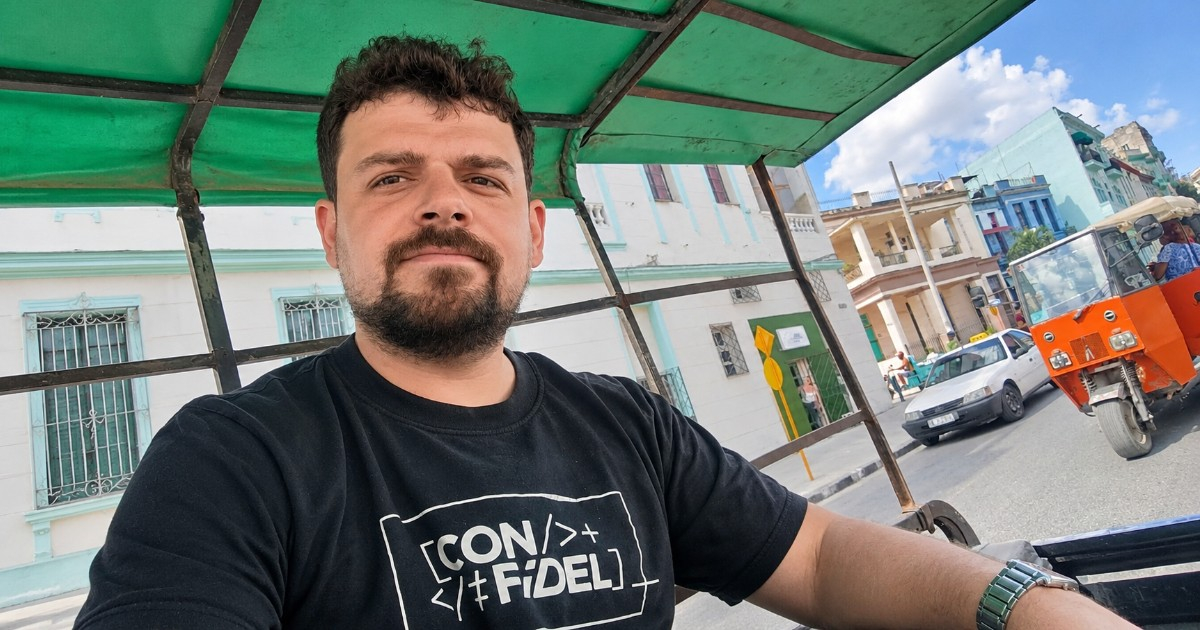
Michel Torres Corona, the host of the pro-government show "Con Filo" and director of the Nuevo Milenio Editorial Group, recently took to Facebook to share a lengthy personal reflection underscoring his commitment to communism. His words echo the longstanding doctrine of Cuba's regime: "I became a communist to fight for a world without millionaires or kings, a world free from the filthy reign of capital."
In his post, Torres describes himself as "a poor and honest man" devoid of political power or wealth, armed only with his ideas and enriched solely by his culture: "In essence, I'm just another grain of sand. A poor and honest man, trying to remain the latter without succumbing to the former."
The regime's spokesperson finds it "immoral that there are rich people while others (including children) die from hunger or curable diseases," asserting that he embraced communism "to have nothing to lose but chains."
However, Torres' declaration starkly contrasts with a reality he chooses to ignore: it's the very private companies and entrepreneurs—the "millionaires" he resents—who generate jobs, invest capital, innovate, and create wealth. Economic history shows that economies targeting private accumulation do not foster widespread prosperity but rather the poverty Torres claims to fight against.
The regime Torres supports has spent over six decades implementing this same ideology in Cuba, resulting in documented outcomes: chronic shortages, mass exodus, and a populace scraping by on wages equivalent to mere dollars monthly.
Meanwhile, the leadership preaching this equality lives in luxury, both inside and outside Cuba, unaffected by the hardships and shortages they demand the populace endure without protest.
The military conglomerate GAESA, which controls between 40% and 70% of Cuba's formal economy, is alleged to have amassed over $18 billion in foreign bank accounts, according to accusations made before an international body.
Even Miguel Díaz-Canel criticized in July the "obscene wealth" of the U.S. power elites—a statement many noted as perfectly reflecting Cuba's own reality. The irony was not lost on observers.
Torres himself has been involved in incidents highlighting the contradictions of the system he champions. In April, the regime censored a "Con Filo" segment where he criticized Sandro Castro—Fidel's grandson—for declaring himself pro-capitalist from a privileged hereditary position. Torres had to post the segment on his personal Facebook page as the aired program completely ignored the topic.
This episode laid bare the double standards Torres professes to despise: "I am irritated by those who pose as proletarians while living as bourgeois, disconnected from the destitute they claim to 'care so much about,'" he wrote in a recent post, seemingly unaware that this description perfectly fits the very nomenclature he serves.
Since its launch in August 2021, shortly after the July 11 protests that year, "Con Filo," hosted by Torres, has operated as a tool to attack opposition, independent journalists, and government critics. Funded by the state and aired on Cubavisión, the program saw Torres labeling those who protested in Morón, Ciego de Ávila, as "beasts" this March.
The U.S. ambassador to the UN, Michael Waltz, succinctly captured the contradiction Torres seems blind to: "Fuel and resources should be reaching the people and farmers, not the yachts, private kitchens, or aircraft of the ruling elite."
Understanding the Contradictions in Cuba's Economic Policies
Why does Michel Torres Corona support communism?
Michel Torres Corona identifies as a communist to advocate for a world devoid of millionaires and royalty, aiming to eliminate the influence of capital he views as corrupting.
What are the criticisms of Torres' stance on wealth?
Critics argue that Torres overlooks the role of private businesses and entrepreneurs in creating jobs and wealth, and highlight the contradictions in his stance given the luxury enjoyed by Cuba's leaders.
How has the Cuban government implemented its economic policies?
For over six decades, Cuba's government has applied policies aimed at curbing private accumulation, resulting in chronic shortages, mass emigration, and low wages for its citizens.