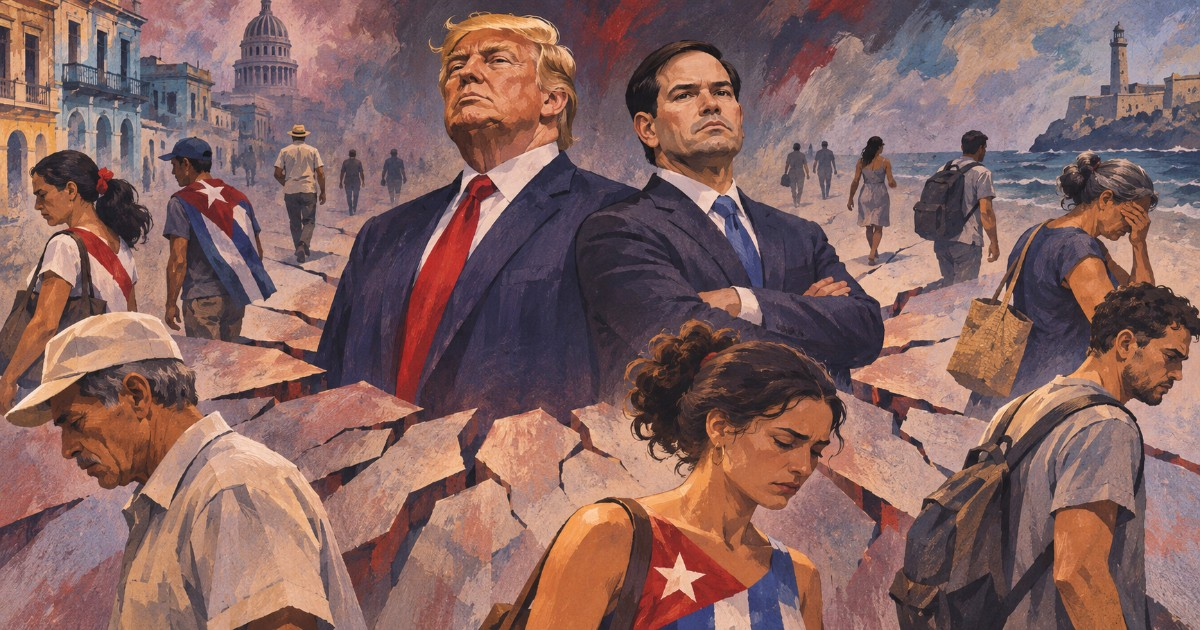
The trust that some Cubans placed in Donald Trump and Marco Rubio to drive political change in Cuba has waned in recent months, according to American academic Theodore Henken. He asserts that the expectation for transformation has turned into disillusionment due to the lack of results and the worsening crisis on the island.
"The Trump-Rubio brand has eroded," said the Baruch College Sociology and Anthropology professor during an interview with WSLR. Henken explained that by late spring, many Cubans he was in contact with, both on the island and in exile, believed a political change was imminent, even if it required U.S. military intervention.
However, those expectations began to fade rapidly as months passed without the anticipated change, while living conditions continued to deteriorate. To illustrate the disillusionment, Henken shared sentiments expressed by some of his contacts: "Well, if they were going to invade, they should have done it a month ago. The moment has passed. This suffering seems endless."
Shift in Cuban-American Perspectives
Henken believes that the passage of time since the summer without decisive events, coupled with the ongoing conflict with Iran and Trump's political weakening, has diminished hopes for a U.S.-driven solution. Among some Cuban Americans, there is a growing sense that their expectations were pinned on the wrong strategy, particularly after the Republican defeats in the November 3 midterm elections.
Henken also mentioned reports suggesting the Trump administration might attempt to implement a strategy in Cuba similar to the one in Venezuela, which focuses on economic gains and resource control, with democracy and human rights being secondary concerns.
Economic and Political Realities in Cuba
The academic warned that the worsening Cuban economy does not necessarily mean the regime is on the brink of collapse. On the contrary, he believes the regime's chances of survival have increased since the summer, after considering a political outcome more likely in the first half of 2026.
"The Cuban government has become adept at weathering storms, waiting for the Americans," Henken explained, noting that Havana's authorities rely on an eventual shift in U.S. political circumstances or party leadership.
His comments align with a Sunday analysis about the Cuban dictatorship's ability to endure the remaining two years of Trump's term. In a Newsweek report, Henken suggested that the Republican defeat could bolster Havana's confidence in retaining power.
Impact of U.S. Policies and Cuban Governance
Henken criticized U.S. restrictions on oil supplies, arguing that their impact extends beyond government structures to affect the entire population, particularly the poorest and most vulnerable. However, he also blamed the Cuban regime for refusing to reform its state-controlled economic system and allowing the military and GAESA conglomerate to dominate lucrative activities.
According to the researcher, the authorities fear that economic openness would enable other sectors to gain resources and power, thus perpetuating poverty through their current model.
Henken, who is familiar with the Cuban situation through his research on the private sector and independent journalism, noted that while the Havana government declared him persona non grata and he hasn't returned since 2018, he maintains connections with Cuban entrepreneurs and journalists via digital platforms.
Demographic Consequences and Cuban Emigration
During the interview, Henken also highlighted the demographic impact of emigration. He described the exodus of Cubans over the past five years as biblical in scale, pointing out that many young individuals who had started personal or professional projects on the island have left the country.
The academic estimated that over a million people have emigrated during this period, warning that Cuba has lost a significant portion of its human capital, while the population continues to age. This situation also affects Florida, particularly the southern region, home to a substantial Cuban community and many recent emigrants from the island.
Understanding Cuban Political Dynamics and Emigration
Why have Cuban hopes for political change faded?
Hopes have diminished due to the lack of expected political change and worsening living conditions, along with the realization that U.S. intervention might not occur.
What impact has the Cuban emigration had?
The emigration has led to a significant loss of human capital for Cuba and an aging population, while also affecting regions like southern Florida with a growing Cuban community.
How has the Trump administration's policy affected Cuba?
The policy, particularly oil restrictions, has negatively impacted the entire Cuban population, not just the government, exacerbating poverty and hardship.