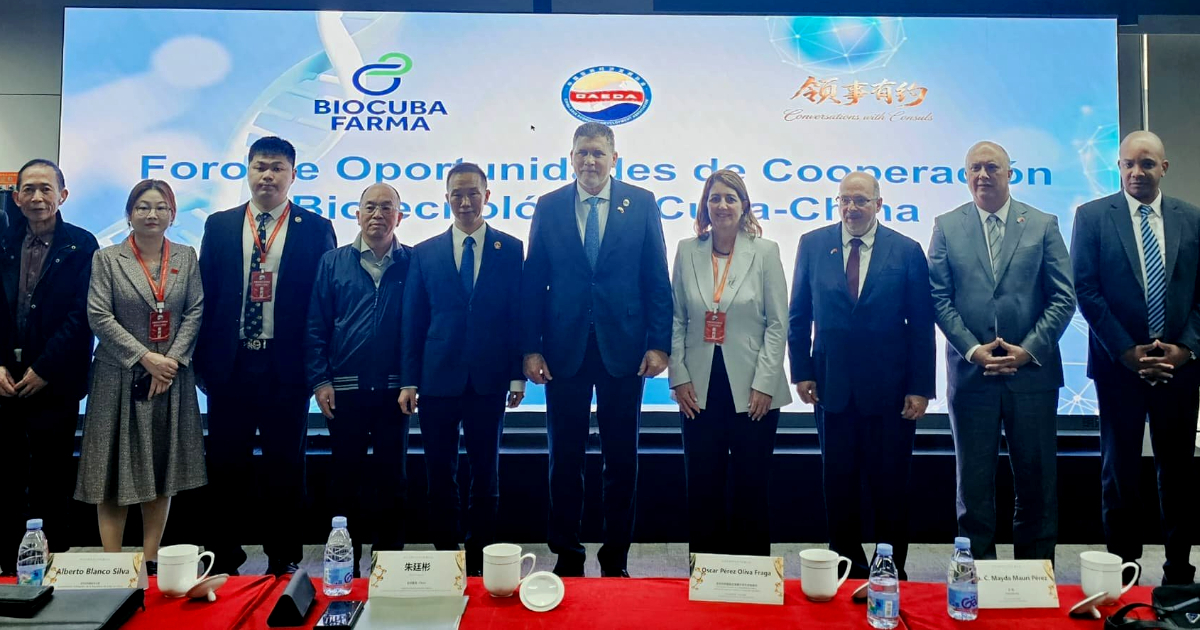
In a bid to attract foreign investment, Cuba's Deputy Prime Minister Óscar Pérez-Oliva Fraga pitched the alleged "economic and social transformation" of the Cuban regime to Chinese business leaders during a trade and investment forum held on Thursday, November 12, in Beijing. This event was part of a tour that began earlier in Shanghai. However, the meeting concluded without any new investment commitments or financial figures being announced.
Dubbed the China-Cuba Trade and Investment Cooperation Forum, the event was jointly organized by the China Council for the Promotion of International Trade (CCPIT)—a Chinese state entity—and the Cuban embassy in China. According to an official CCPIT statement, over 170 companies from both nations participated, with a total attendance exceeding 200 individuals.
Bruno Rodríguez Parrilla, Cuba's Foreign Minister, who traveled to China as a special envoy of the Communist Party and the Cuban government, was also present. Pérez-Oliva highlighted various "business opportunities" that the regime claims are available in sectors such as agriculture, logistics, tourism, renewable energies, and biomedicine.
CCPIT President Ren Hongbin took the opportunity to invite Cuba to join the 5th International Supply Chain Expo and the 19th China-Latin America Business Summit, although neither invitation was accompanied by economic commitments.
The stark contrast between what the regime promotes in Beijing and the actual situation on the island is hard to overlook. Tourism, one of the sectors touted as attractive to investors, is in dire straits. In July, Prime Minister Manuel Marrero Cruz admitted that 73% of Cuban hotels were closed, leaving around 25,000 workers in "availability" status. By the end of October, Cuba had reached only 28.8% of its annual tourism target, with just 506,074 visitors out of a goal of 1,757,480.
Major hotel chains like Meliá, Iberostar, and Barceló ceased their operations in Cuba between June and July 2026. Canadian airlines also suspended flights to the island since February due to a shortage of Jet A-1 fuel, resulting in a 75.6% drop in Canadian tourism from January to August.
The energy sector, another area highlighted at the forum, faces severe challenges. This past Sunday, the Electric Union reported an availability of only 970 MW against a demand of 2,800 MW, creating a deficit of 1,830 MW. Power outages have exceeded 20 hours daily in several provinces, and the grid has collapsed at least eight times this year.
The forum took place shortly after Washington imposed sanctions on two Chinese companies—CEIEC and Beijing H&C Technologies—for supplying surveillance technology and military components to Cuban Armed Forces. Beijing condemned the sanctions and promised "all necessary measures," reflecting the cautious manner in which China manages its support for Havana: concrete aid so far includes $80 million in emergency funds, 60,000 tons of rice, and 49 photovoltaic parks with a combined capacity of 120 MW.
China has not committed to supplying oil or renegotiating bilateral debt.
Pérez-Oliva's tour also featured the signing of three biopharmaceutical cooperation agreements in Shanghai between BioCubaFarma and unnamed Chinese partners, with no disclosed amounts or timelines. The regime also announced plans to open an eleventh joint research and development center, again without a confirmed date.
Investment and Economic Challenges in Cuba
What sectors did Cuba promote for investment during the Beijing forum?
Cuba highlighted opportunities in agriculture, logistics, tourism, renewable energies, and biomedicine during the forum.
How is the tourism sector performing in Cuba?
The tourism sector in Cuba is struggling, with only 28.8% of the annual visitor target met by the end of October, and many hotels closed.
What are the current challenges in Cuba's energy sector?
Cuba's energy sector faces significant deficits, with power outages lasting over 20 hours daily in some areas and a major shortfall in electricity supply.