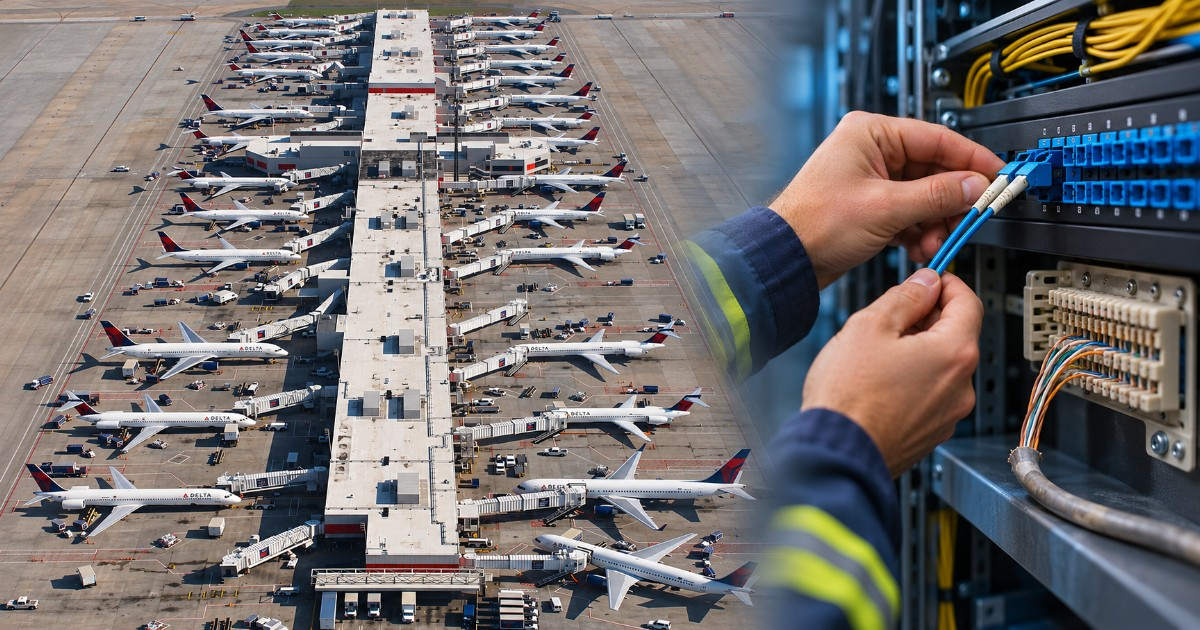
Aging copper cables and a router slated for replacement have become the focal points of an investigation into the abrupt halt of U.S. air travel on Friday, November 13. This incident marked only the third nationwide airspace closure in modern American history.
The Federal Aviation Administration (FAA) issued a complete suspension of outbound flights at 3:54 p.m. Eastern Time after observing that radio frequencies and radar systems were "failing and recovering" across several control centers simultaneously. The instability began approximately 18 minutes earlier and eventually impacted 17 out of the country's 22 regional centers, lasting more than four and a half hours.
Transportation Secretary Sean Duffy identified contractor L3Harris Technologies as the central focus of the inquiry. The company, during routine maintenance at a remote facility in El Dorado, Arkansas, was replacing outdated copper lines with fiber optics. During this process, a router began bombarding the network with over 1,000 connection attempts every four to five seconds, overwhelming equipment that included Cisco routers manufactured between 2001 and 2006.
"What did L3Harris do? Did they make mistakes? They're the owners of this network. They're our primary contractor. There's no other company to turn to. They're responsible. Or was it a defective router? We're going to find out. And frankly, we're going to hold people accountable," Duffy stated to the press.
Duffy also mentioned a second facility in Amarillo, Texas, where similar work had been completed weeks prior, and its potential connection to the Friday collapse is under investigation. Both the FAA and FBI are on-site with L3Harris to determine the root cause.
FAA's Response and Broader Implications
FAA Director Bryan Bedford elaborated on the decision to halt all departures: "If it had been a single facility, we would have worked to resolve it. But when we saw the issue spread to two, three, 10, and 17 facilities, we realized something much larger was occurring."
Authorities have explicitly ruled out a cyberattack. Bedford assured that "we see no evidence of malicious activity or any indication of artificial intelligence involvement."
The aviation chaos stretched into the weekend, with Saturday ending with 6,695 cancellations and 9,011 delays nationwide. By early Sunday, FlightAware reported 1,454 flights canceled and 2,258 delayed. Among those disrupted were flights to Cuba: American Airlines flight AA2705 to Havana was canceled on Saturday and rescheduled with a delay of over three hours, while World Atlantic's connections to Havana and Camagüey experienced delays of two to two and a half hours.
Infrastructure Concerns and Future Outlook
The incident reignited the debate over the obsolescence of the U.S. air infrastructure. A Government Accountability Office report from September highlighted that over 75% of the 138 FAA systems evaluated were unsustainable or potentially so, with technology reliant on floppy disks and 1980s interfaces.
Duffy acknowledged that about 30% of the network's copper cables have yet to be replaced by fiber optics and called for a $50 billion investment from Congress to modernize the system. "More incidents like this will happen. There will be more disruptions unless the American people and Congress tell us to build the new system," he warned.
In a Sunday interview on "Face the Nation," Duffy anticipated that airspace operations would return to full capacity by the end of the day or Monday, just in time for Thanksgiving week, one of the busiest travel periods of the year in the U.S.
Understanding the Impact of the U.S. Flight Shutdown
What was the main cause of the U.S. flight shutdown?
The shutdown was primarily caused by a router, in the process of being replaced, which flooded the network with excessive connection attempts. This was compounded by outdated copper cables, leading to system overloads.
Who is responsible for the incident?
L3Harris Technologies, the primary contractor responsible for network maintenance, is at the center of the investigation to determine any potential errors or equipment failures.
How did the FAA respond to the system failures?
The FAA responded by ordering a complete suspension of all outbound flights to prevent further complications as the issue affected multiple regional control centers.