On November 12, Donald Trump stated he might consider a short military operation against the Cuban regime.
The following day, Miguel Díaz-Canel defended the decision to "activate wartime structures to work in peacetime."
Amidst threats and preparations lies a populace whose lives are at risk, lacking any effective democratic means to alter their government's course.
The gravity of the situation stems from this vulnerability. The regime claims citizens are ready to bear the consequences of a confrontation, but in reality, it is a subjugated population unable to freely replace those in power.
The totalitarian regime uses supposed popular support and loyalty to the "revolution" as unassailable arguments to defend sovereignty, while keeping political competition closed off.
The possibility of using force has a recent precedent. The U.S. operation on January 3 ended with the capture of Nicolás Maduro and resulted in the death of 32 Cubans, acknowledged by Havana. While Venezuela's situation doesn't dictate Cuba's fate, it underlines the seriousness of threats from an administration with a history of military action in the region.
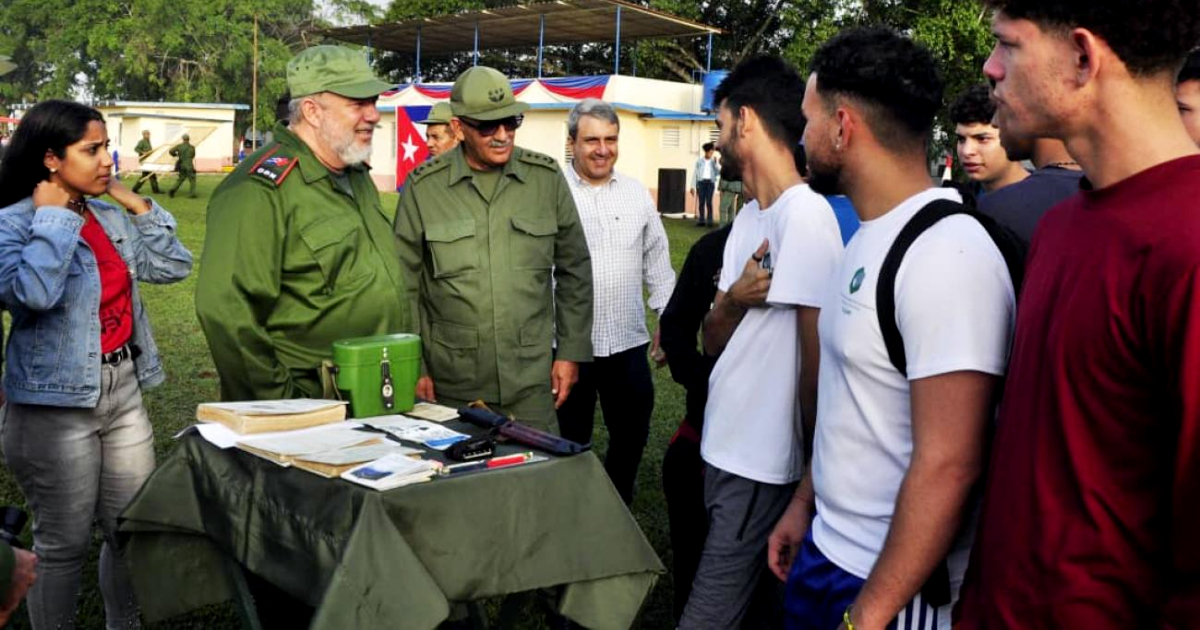
During the Moncada exercise on November 4 and 5, Roberto Legrá Sotolongo, the Chief of General Staff, announced a defense strategy of "house by house, neighborhood by neighborhood, area by area." The doctrine of the War of All the People includes militias, reservists, and civilian structures, with official propaganda calling for resistance "to the last drop of blood."
A Nation Exhausted by Resistance
The country summoned to this resistance is already weary. In a 2026 survey by the Cuban Observatory of Human Rights (OCDH), eight out of ten respondents reported having skipped meals due to lack of money or food.
The study involved 1,318 interviews across 79 municipalities between June and July. This deprivation means choosing which meal to skip and how to distribute the remaining food.
In October, an official report noted by EFE revealed a shortage of 300 out of 395 domestically produced medicines from the essential list. It also recorded a decline in survival rates for children and young cancer patients from 85% to 65%. The healthcare deterioration is now measured in lost survival opportunities.
The authorities blame these shortages on the U.S. embargo. However, the debate over external restrictions does not absolve those governing the country from responsibility.
Cubans lack the freedom to scrutinize the power's priorities—take the example of GAESA—and to replace officials based on their performance. The rulers remain shielded while the living conditions of the governed continue to decline.
The Reality of Repression
This protection includes tangible instruments. Prisoners Defenders documented 1,353 political prisoners as of late October. The OCDH noted at least 387 repressive actions during the same month, including arbitrary detentions, police blockades, threats, and harassment.
The repression of protest limits society's ability to demand solutions and discuss the country's direction.
Lessons from Russia
Russia exemplifies the extreme separation between decision-makers and those who bear the consequences.
The invasion of Ukraine, ordered by Vladimir Putin, has inflicted immense suffering on the attacked nation and caused a devastating loss of life among Russians themselves.
By November 15, the Ukrainian General Staff estimated over 1.62 million Russian casualties, a figure that includes both the dead and wounded. In October alone, they calculated 54,400. These are estimates from a warring party, not an independent count of the deceased.
Separately, a November 13 analysis by the Financial Times, based on leaked Rosstat records, estimated at least 450,000 Russians dead due to the war by summer, mostly military personnel. The Institute for the Study of War (ISW) had noted these initial leak calculations, cautioning that they couldn't be verified.
The Financial Times investigation highlights that the burden has disproportionately fallen on poorer regions and ethnic minorities. The Kremlin's decisions cost lives in households losing members and communities forced to live with deaths, injuries, and absences.
Amidst such a tragedy, Putin maintains power after elections deemed illegitimate and undemocratic by the European Parliament.
Russia is the aggressor power. In Cuba, the danger is that defending the regime becomes a national duty against an external threat. The link between both cases lies in the authoritarian leadership's ability to risk lives without subjecting its continuation to free citizen choice.
Excluding the People from Decision-Making
Havana expresses its willingness to dialogue with Washington. However, it has set a boundary: "The Cuban political system is not subject to negotiation," asserted Deputy Minister Carlos Fernández de Cossío on March 20, also excluding the presidency and other governmental positions.
Nonetheless, the structure that declares itself untouchable to outsiders also isn't open to free political competition within the country. The Cuban regime believes it has the right to sacrifice its citizens for its grip on power, the same power that denies them civil and political liberties, and participation mechanisms that could threaten the macabre system they've built.
This order's challenge has already appeared in a recent multilateral statement. The G7 called on November 11 for political and economic reforms, a multiparty democratic government, and freedoms of the press, expression, and association. They also demanded the release of arbitrarily detained individuals and the promotion of inclusive dialogue to emerge from the crisis.
The crucial issue is that Cubans can participate in that future. Talking about sovereignty while denying them the chance to organize and change the government empties the word of meaning. The nation becomes identified with the regime, and defending it means preserving its leaders.
A confrontation would add destruction to a society already struggling for food and medical care. For a family without reserves, a hospital without medicine, or a community without stable services, even a so-called brief operation could leave lasting impacts. The duration envisioned by a strategist doesn't measure the time a population needs to recover.
The lives of Cubans are not a resource available to prolong the regime's existence. Those who speak for the entire people must accept that the people can withdraw their power. Before demanding a willingness to die, they should allow them to decide how they wish to live.
Understanding the Political Situation in Cuba
What did Donald Trump propose regarding Cuba?
Donald Trump suggested he might consider a short military campaign against the Cuban regime.
How does the Cuban regime respond to external threats?
The Cuban regime claims the populace is ready to face confrontation consequences and activates wartime structures in defense.
What are the current living conditions in Cuba?
Cubans face shortages in food and medicine, with a significant portion of the population skipping meals due to lack of resources.
How does the Cuban regime view political competition?
The Cuban regime does not allow free political competition within the country, maintaining a tight grip on power.