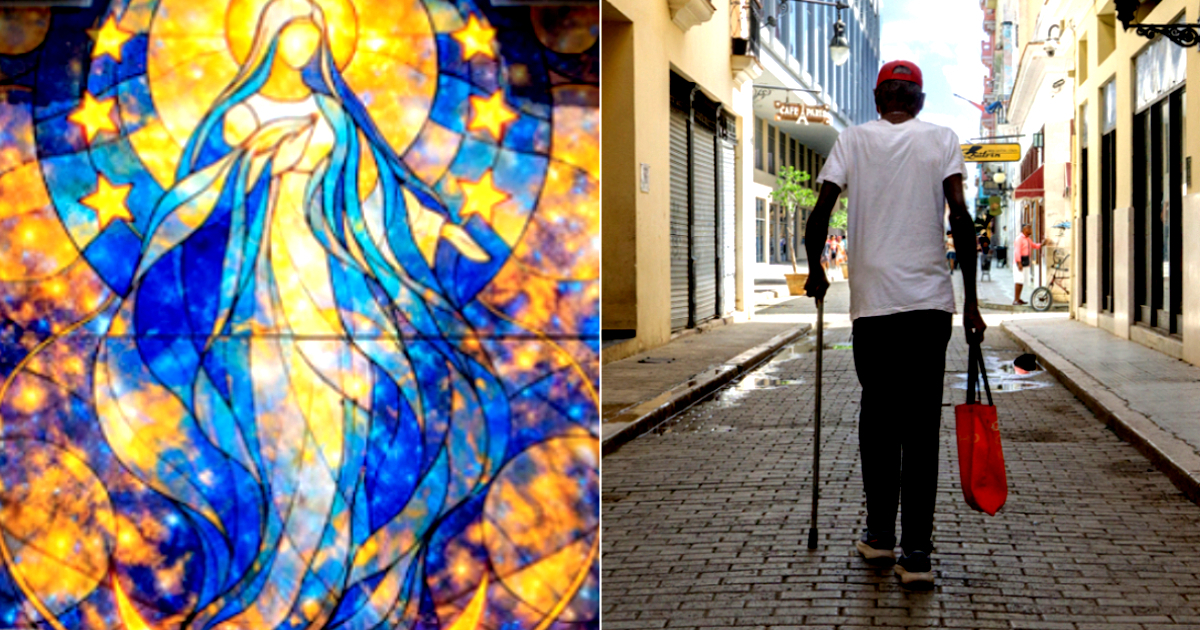
The crumbling public services, extreme poverty, neglected elderly, and increasing influence of churches paint a vivid picture of Cuba as presented by Robert F. Worth in his detailed report for The Atlantic, titled "The Collapse of Cuba."
Released in late October, the piece gains heightened relevance following Miguel Díaz-Canel's recent gratitude to a delegation of U.S. bishops for the Church's role in facilitating humanitarian aid from abroad.
This acknowledgment comes at a time when religious and humanitarian organizations are stepping up to fill the void left by insufficient state welfare, which fails to meet the needs of countless Cubans.
Just before this, Cáritas Cuba announced the arrival of a third shipment from the United States to Matanzas, consisting of 700 food parcels and an equal number of hygiene kits for vulnerable families. This initiative is part of a U.S.-funded aid program executed through humanitarian organizations with significant involvement from the Catholic Church.
Failing Public Services
For nine days in August, Worth traversed the island with photographer Moises Saman. They encountered deteriorating roads, communities nearly immobilized by power outages, resource-starved hospitals, and a population resorting to increasingly desperate survival tactics.
On the Malecón in Santiago de Cuba, they met a 76-year-old woman and her daughter, who survived by begging and collecting plastic bottles. Their primary breadwinner had died of cancer, and they reported receiving no state assistance. In their home, they slept on metal frames covered with cardboard instead of mattresses.
The dire state of healthcare is exemplified by the story of a nurse from Cayo Granma, tasked with caring for 870 residents of the small island and patients from nearby communities. The absence of doctors, medications, and potable water had overwhelmed her capacity to provide care. Water supply had been disrupted for three months, leading to an increase in bacterial and skin infections.
"We have to perform miracles here," she told the journalist, expressing her intention not to retire as there was no one to replace her.
Churches Step In
A central finding of the report is the growing role of religious organizations in a society where public institutions have lost their ability to meet basic needs. At the church of Los Escolapios in Havana, Worth observed makeshift classrooms, children receiving religious education, and volunteers distributing meals of rice and beans.
Father Iván Guerra Álvarez, his guide, recounted how, after 1959, the regime took over religious facilities and set up surveillance mechanisms. Now, the Church was attempting to reclaim some of those spaces.
"We are the largest institution in Cuba outside the government," the priest explained, believing that the Church could play a significant role in a potential political transition.
In Baracoa, the journalist met Pentecostal pastor Raúl de Jesús Muñoz Munder, whose congregation, with around 1,100 regular members, frequently organizes food and medicine distributions to those in need, even outside their religious community. According to the pastor, the Assemblies of God expanded from two to 40 churches in the region over the past three decades. Worth sees this growth as part of a broader social transformation, though acknowledges the lack of independent statistics to measure evangelical expansion throughout Cuba.
Dismantling Revolutionary Ideals
The report also highlights the disillusionment of former revolution supporters with the system they once defended.
In a retirement home managed by the Catholic Church, Worth spoke to a veteran of the Angolan War who had tattooed Che Guevara on his arm at 18. Having served two years in Africa, he bore combat scars. His response, filled with expletives and hostility toward current Cuban leaders, reflected the disenchantment of someone who had dedicated part of his life to the Revolution and ended up reliant on religious aid.
Worth also notes the impact of tightened U.S. oil sanctions, yet emphasizes that none of his interviewees directly blamed Washington for their plight. Many attributed the decisive deterioration to the pandemic and the accumulated shortcomings of Cuba's economic model.
The journalist refrains from predicting the timing or nature of a political shift, instead illustrating the paradox of a regime maintaining its control structures while losing its ability to provide the services that once formed a core part of the so-called "revolution's" legitimacy.
The final scene of the report unfolds at the Santa Ifigenia Cemetery in Santiago de Cuba. After touring impoverished neighborhoods, under-resourced hospitals, and trash-strewn streets, Worth finds a meticulously maintained site: perfectly trimmed grass, clean paths, and uniformed soldiers performing a precise military ceremony at José Martí's mausoleum, adjacent to Fidel Castro's grave.
The contrast becomes even more striking as a gust of wind carries the smell of burning trash from nearby streets into the cemetery.
Understanding Cuba's Current Challenges
What is the current role of churches in Cuba?
Churches in Cuba are increasingly stepping in to provide humanitarian aid and support to the population, filling gaps left by the failing state services. They are involved in distributing food, offering education, and supporting vulnerable communities.
How are public services failing in Cuba?
Public services in Cuba are deteriorating, with power outages, lack of medical resources, and inadequate water supply becoming widespread issues. The state is struggling to provide essential services, leading to increased reliance on community and international aid.
What impact have U.S. sanctions had on Cuba?
While U.S. sanctions, particularly on oil, have had an impact, many Cubans attribute the current crisis more to the pandemic and long-standing economic deficiencies within Cuba itself, rather than external pressures.