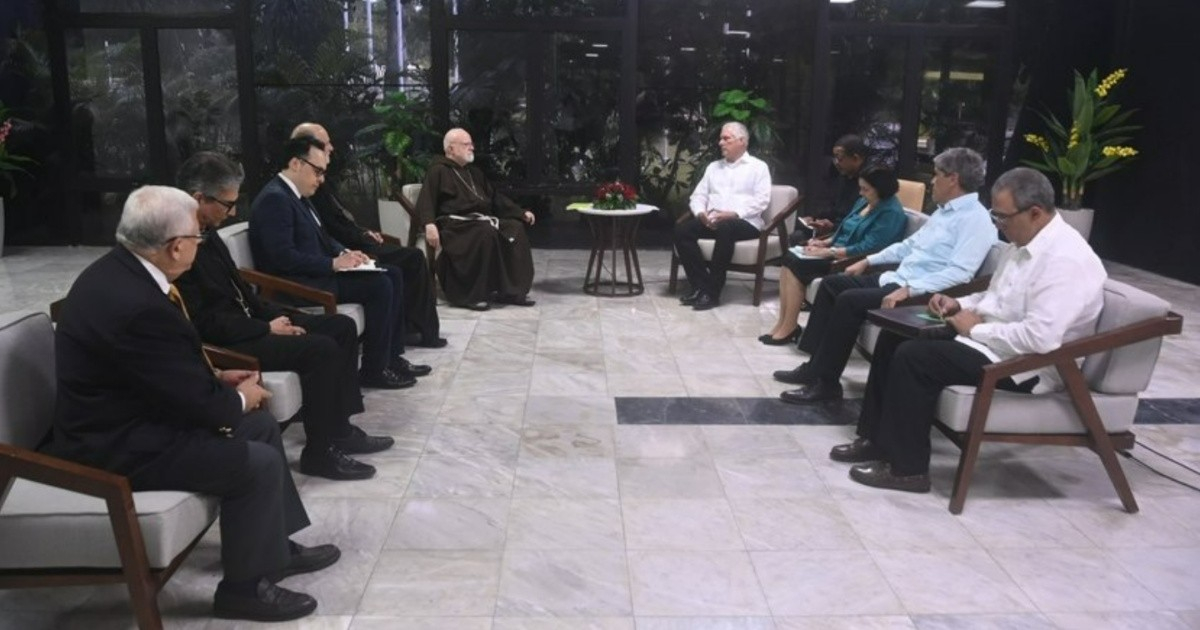
On Saturday afternoon, Miguel Díaz-Canel welcomed a delegation from the United States Conference of Catholic Bishops (USCCB) at Havana's Convention Palace. The meeting primarily focused on the humanitarian aid being facilitated by the Catholic Church to assist Cuba.
Leading the delegation was Cardinal Sean Patrick O'Malley, Archbishop of Boston. He was accompanied by Archbishop Borys Gudziak, head of the USCCB's Commission on Justice and Peace; Christopher Ljungquist, Director of the International Justice and Peace Office; and Mario Jesús Paredes, CEO of the medical organization SOMOS Community Care.
Díaz-Canel shared news of the meeting on his social media account, stating, "We discussed the national realities of both countries and the international landscape."
The official Cuban presidential site reported that during the discussion, the Cuban leader expressed gratitude for "the role of the Church and its organizations in facilitating humanitarian aid from various countries." This is a direct nod to the program managed by Catholic Relief Services (CRS)—an international agency of the USCCB—and Caritas Cuba since May 2026.
This initiative, backed by $60 million from the U.S. Department of State as part of a $100 million package, aims to provide food and hygiene supplies to nearly 200,000 households—impacting over 500,000 people nationwide. Notably, this aid bypasses the Cuban government and GAESA, with CRS procuring the necessary supplies in the U.S., and Caritas Cuba distributing them directly through parishes and home visits.
The gathering also included the newly appointed Archbishop of Santiago de Cuba, Monsignor Juan Gabriel Díaz Ruíz, who recently transitioned from the Matanzas diocese after his appointment by Pope Leo XIV on November 7. His participation marked one of his initial public engagements in his new role.
Representing Cuba were Caridad Diego Bello, a member of the Communist Party's Central Committee and head of the Office of Religious Affairs, along with Carlos Fernández de Cossío, Deputy Minister of Foreign Affairs.
The Cuban government promoted the visit as a testament to the "respectful ties" it maintains with the Catholic Church and its representatives in the United States, yet conspicuously omitted any mention of the island's political prisoners.
This was not Cardinal O'Malley's first encounter with Díaz-Canel. Back in September 2021, amid a severe crackdown following the July 11 protests, O'Malley visited Havana and requested clemency for the detained. At that time, Foreign Minister Bruno Rodríguez expressed gratitude for the USCCB's favorable stance on improving bilateral relations.
In April 2023, after Díaz-Canel met with Cuban Catholic bishops, Ariel Suárez, the Secretary of the Episcopal Conference, informed Reuters that discussions included the political prisoners' situation. He noted the dialogue was "open and frank," with an indication of potential amnesty—a promise the regime never fulfilled.
Insights on U.S.-Cuba Humanitarian Initiatives
What is the role of the USCCB in Cuba's humanitarian aid?
The USCCB, through Catholic Relief Services, is actively involved in providing humanitarian aid to Cuba, facilitating the delivery of essential supplies like food and hygiene products to Cuban households without the involvement of the Cuban government.
How does the humanitarian aid program operate in Cuba?
The program, funded by the U.S. Department of State, operates by purchasing supplies in the United States, which are then distributed directly in Cuba through Caritas Cuba and local parishes, effectively bypassing state control.
Who are the key figures involved in the U.S. Catholic delegation to Cuba?
The key figures include Cardinal Sean Patrick O'Malley, Archbishop Borys Gudziak, Christopher Ljungquist, and Mario Jesús Paredes, representing various facets of the USCCB's humanitarian and peace initiatives.