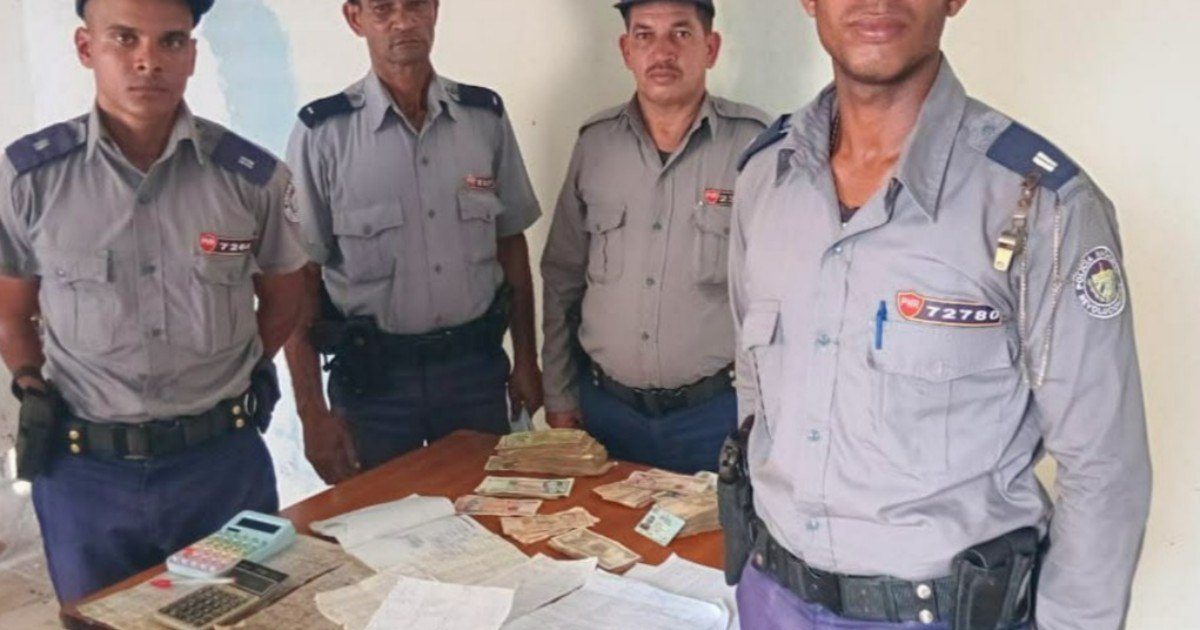
A recent operation conducted by the Revolutionary National Police (PNR) in the town of El Caney, located in Santiago de Cuba, successfully dismantled an illegal lottery operation, known locally as a "bolita bank." Authorities seized cash, calculators, notebooks, and other items associated with this illicit activity.
This crackdown, highlighted on the Facebook page "Héroes del Moncada"—a channel linked to the Ministry of the Interior (MININT) in Santiago de Cuba—was initiated following a tip-off from a local resident. The police executed a search warrant in the area based on this information.
Photos from the operation reveal four uniformed PNR officers standing beside a table stacked with a significant amount of cash, documents, and a calculator, showcasing the formal presentation of the seized evidence.
According to the official report, the operation specifically targeted a "bank," which is the highest tier in the bolita hierarchy. This structure includes players, list-makers, collectors, and at the top, the bankers, who provide the capital, pay out winnings, and manage the network from the shadows.
"It's no secret that these illegal games often lead to other crimes such as theft, fraud, and public disturbances, and thus are strictly countered by the authorities to uphold the law," stated the MININT communication from Santiago.
The bolita, also referred to as the Cuban charade, is an underground lottery that has been banned in Cuba since 1959. Its illegality was reinforced by the current Penal Code, Law 151 of 2022.
Article 281.1 of this code stipulates penalties for bankers, collectors, list-makers, or promoters of illegal games, ranging from one to three years in prison and fines up to 300,000 pesos. If the crime involves two or more individuals, the punishment can increase to three to eight years of imprisonment.
Despite being outlawed for over sixty years, the practice remains widespread across the country and has seen a resurgence linked to the ongoing economic crisis. This resurgence is facilitated by mobile apps that allow betting without relying on foreign radio broadcasts.
The El Caney incident adds to a series of similar operations in 2026: in October, police arrested nine individuals in the La Marina neighborhood of Matanzas for running an illegal gambling house, and just days prior to this case, authorities in Cárdenas confiscated 82 counterfeit $100 bills along with gaming equipment.
A more distant precedent showcases the scale of this activity: in August 2020, police in Camagüey confiscated over a million Cuban pesos from an alleged bolita banker.
Understanding Cuba's Illegal Lottery Crackdown
What triggered the police operation in El Caney?
The operation was initiated following a citizen's tip-off, leading authorities to conduct a search in the area.
What is a "bolita bank"?
A "bolita bank" is the top level in the hierarchy of the illegal lottery network, involving bankers who provide capital and manage the operation.
How are illegal lotteries penalized under Cuban law?
Under Article 281.1 of the Penal Code, individuals involved in illegal lotteries face one to three years in prison and fines up to 300,000 pesos, with harsher penalties if multiple people are involved.