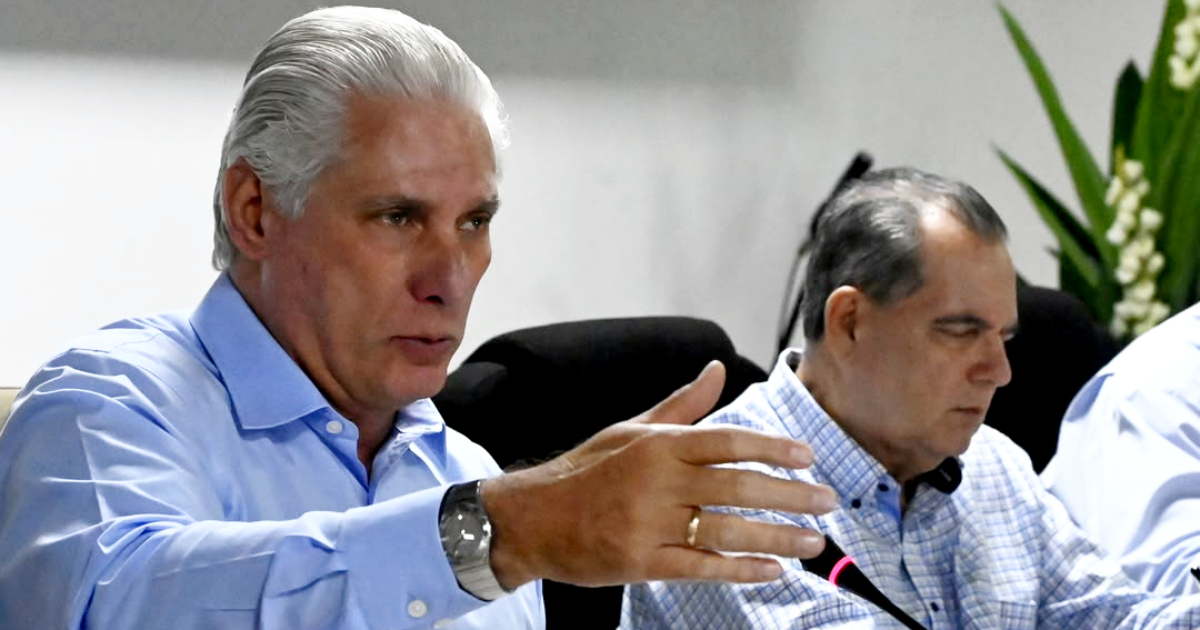
In the face of a dramatic decline in sugar production, Miguel Díaz-Canel has asserted that Cuba's sugar industry is undergoing a "transformation" rather than being abandoned.
Appointed by Raúl Castro in 2018, the Cuban leader suggested the operation of sugar mills to generate electricity, even if they are not processing sugarcane, as part of a series of measures aimed at revitalizing the sector.
Exploring Energy Generation in Sugar Mills
During a meeting held Thursday at the Palace of Conventions in Havana, focused on implementing 176 economic and social changes, Díaz-Canel acknowledged the industry's decline and low planting levels. Nevertheless, he emphasized that the future of the sugar sector relies on diversifying its activities.
"The challenge is not to produce sugar at any cost but to repurpose the industrial facilities of the mills, utilizing their capabilities for electricity generation, molasses production, and other sugarcane derivatives," he said, according to the Cuban Presidency.
As the First Secretary of the Communist Party, he went further, stating, "We need to get as many mills running as possible, even if they're not grinding for the sugar harvest. The priority should be energy generation."
Challenges and Contradictions in the Proposed Plan
This plan aims to leverage industrial facilities to produce electricity, primarily through cogeneration from sugarcane bagasse. However, the official report did not specify which mills might be included, the potential energy output, or how fuel would be secured for operation without grinding, given that bagasse is a byproduct of sugarcane processing.
The proposed transformation comes after decades of declining production. The 2024-2025 harvest produced less than 150,000 tons of sugar, according to estimates from the EFE agency based on partial official reports—the worst outcome in over a century. Back in 1989, Cuba produced about eight million tons annually.
Addressing Internal and External Obstacles
The 2025-2026 campaign was also marred by an energy crisis. In March, the Melanio Hernández mill in Sancti Spíritus had to halt operations due to a fuel shortage, despite being the only functioning mill in the country. No comprehensive national overview of that harvest has been released.
In light of this situation, Díaz-Canel admitted, "Without planting, there is no harvest, and without a harvest, there is no industry," and emphasized, "It's not about normalizing unacceptable figures but using them as a starting point for an honest analysis."
Although he attributed significant challenges to the U.S. embargo and the so-called energy blockade, the leader also acknowledged internal shortcomings. "It's unacceptable to blame everything on the blockade and macroeconomics without assessing internal management," he stated, adding that "the blockade is not an excuse."
His criticisms directly targeted sector leaders. "Bureaucracy and administrative passivity should be sanctioned as serious offenses," he warned, demanding the replacement of those showing "incapacity, bureaucratism, or resistance."
He also acknowledged issues with payments to producers and workers: "Debts to producers and unpaid wages have names and responsible parties." However, the official report did not detail the amounts owed or identify those accountable for the failures.
Measuring Success Through Tangible Results
Regarding the 176 economic and social transformations, Díaz-Canel insisted they be clearly communicated to enterprises and cooperatives, with defined responsibilities and deadlines for each agreement. "Transformation is measured in results, not documents," he asserted.
This demand comes at a time when, according to recent official assessments, 172 of the 176 measures have approved policies, and 231 legal norms have been generated, without yet showing a demonstrable recovery in sugar production.
Summarizing his new priorities, Díaz-Canel set another criterion for evaluating Azcuba's activities: "The sugar sector will be measured by the energy it generates, the molasses it produces, the debts it pays, and the wages it delivers."
Understanding Cuba's Sugar Industry Transformation
What is the current state of Cuba's sugar industry?
Cuba's sugar industry is facing a significant decline, with recent harvests producing historically low quantities of sugar, marking the worst performance in over a century.
What strategies are being proposed to revitalize the sugar sector?
Díaz-Canel has proposed transforming sugar mills to generate electricity and diversify production to include molasses and other sugarcane derivatives, as part of a broader effort to revitalize the industry.
How does the U.S. embargo impact Cuba's sugar industry?
The U.S. embargo is cited as a significant challenge, contributing to economic difficulties. However, internal management issues are also acknowledged as factors affecting the industry's decline.