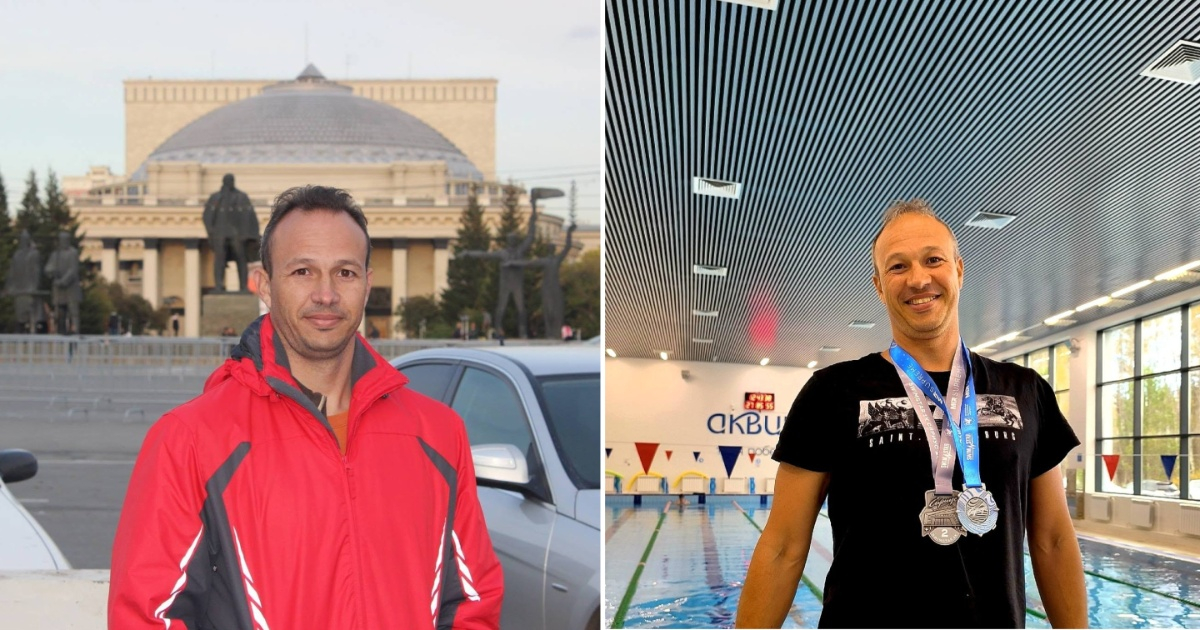
A Cuban man born in Novosibirsk who was separated from his Russian mother for over three decades made headlines in a November 11 report by the regional Russian website NGS.ru. His story traverses the challenging journey between two different worlds and the cultural contrasts he faced upon returning to Russia after spending years in Cuba.
Alexander Luisovich Paneque-Meshchenkov was born in 1983 in the Pervomaisky district of Novosibirsk, to a Russian mother and a Cuban father who met while studying engineering at what was then the Novosibirsk Electrotechnical Institute, now known as the Technical University (NGTU).
In 1985, when Alexander was just two and a half, his father took him to Cuba, while his mother remained in Russia.
"I was very young, so I hardly remember Novosibirsk. I grew up in Cuba, studied there, and played sports. My mom stayed in Russia, and I lived with my dad," Alexander shared in the report.
While in Cuba, he graduated as a computer engineer and became a competitive swimmer. At the age of eight, he won municipal competitions and was selected for a specialized sports school, eventually earning two bronze medals at the Cuban national championship.
In 2017, Alexander reunited with his mother at the age of 34. He described the process of obtaining the necessary documents to leave Cuba as complex. Additionally, he had to relearn Russian from scratch, as he hadn't spoken the language since he was a toddler.
"I always wanted to see my mom and the city where I was born. The meeting was significant for both of us. I knew my mom through photos and phone calls, and suddenly we were together. It was a huge shock for both of us," he recalled.
He humorously summed up his adaptation to the Siberian cold: "You need to dress warmer." However, the real surprise was culinary.
"I tried sour cream for the first time here; dairy products in general were new to me. In Cuba, the variety of products isn't as large, and in Russia, I discovered many new things. The sausages too: there's a vast variety here, things I hadn't seen before," he explained.
In Novosibirsk, Alexander has become a versatile professional. He works as a lifeguard at the Koltsovo Sports Facilities Center, trains children in swimming, and leads the "Koltsovo Sports Veterans" team, comprised of older women whose technique reportedly inspires envy among younger swimmers.
He also teaches computer science to schoolchildren and spent a year teaching Spanish at a local university.
Continuing his sports career, he placed second in his age group (40-49 years) in a one-kilometer race at the SWIMSTAR-2026 event in October, held in Sirius, Sochi. In 2021, he swam across the Obi River—a distance of approximately 3.6 km—at the "Siberian Wave" festival.
"This isn't ours," said Tamara Lisitsyna, leader of the veteran group, as she hung the team's trophies around their coach's neck. "It's his achievement."
Alexander's family is spread across three countries: his father and two siblings remain in Cuba, while a sister resides in the United States. He expresses a sentiment of having "two roots," stating that while he loves Cuba, his life is now in Russia.
Alexander's story is part of a broader, less-documented generational phenomenon: the children of Cuban-Soviet mixed marriages born during the era when between 100,000 and 300,000 Cubans studied in the USSR on university scholarships, many of whom were separated from a parent following the Soviet collapse in 1991.
Exploring the Impact of Cuban-Soviet Mixed Marriages
What challenges did Alexander face when returning to Russia?
Alexander had to navigate complex bureaucratic processes to leave Cuba and relearn the Russian language, which he had not spoken since he was two years old.
How did Alexander adjust to life in Siberia?
He adapted to the cold climate by dressing warmly and discovered a new range of culinary delights, including sour cream and a variety of sausages, which were not available in Cuba.
What is the significance of Alexander's story?
Alexander's journey highlights the experiences of children from Cuban-Soviet mixed marriages who were separated from a parent due to geopolitical changes, illustrating the enduring impact of these historical events.