The Antonio Guiteras thermoelectric plant has faced 28 shutdowns from the National Electric System (NES) in 2026, while still awaiting a major overhaul that would require approximately six months.
Despite this, authorities continue to rely on partial repairs to quickly reintegrate it into power generation. Recently, it was announced that Cuba will produce its economizer, a crucial yet heavily deteriorated component of the boiler.
This information, shared on social media by journalist José Miguel Solís from Matanzas, contrasts with the statements made by the plant's management back in July.
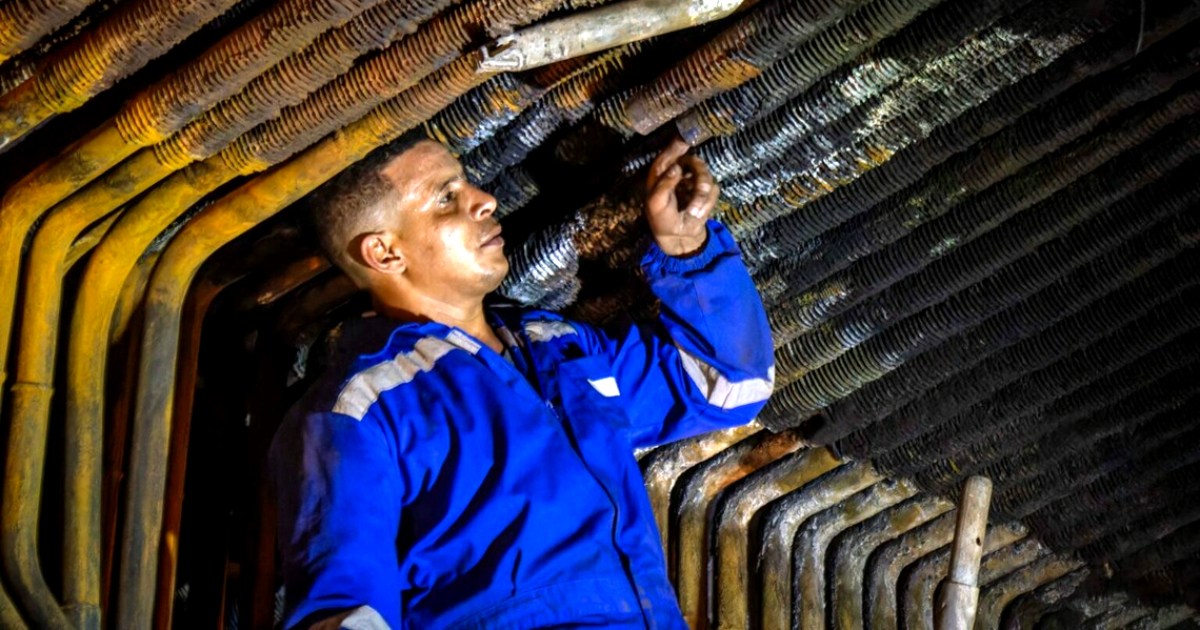
After the most recent breakdown, inspections revealed holes in the economizer, the high-temperature reheater, and the nurse area. Technical deputy director Elmer García Romero reported around 180 corrective tasks, noting that the economizer is the most deteriorated part. Solís mentioned that resources are available for the current intervention, with plans to manufacture a new economizer for future comprehensive maintenance.
The economizer utilizes combustion gas heat to preheat the water feeding the boiler. Holes in its tubes can cause leaks, forcing the unit to shut down. However, fixing these leaks doesn't necessarily address the overall degradation of the component.
Why the Delay in Economizer Replacement?
By July, materials were available, but a decision was made to wait. On July 30, Román Pérez Castañeda, director of the Guiteras plant, admitted in an interview with the newspaper Girón that materials had been on hand for over a month to replace the economizer's elements en masse.
Why wasn't it done? Halting the unit during summer would have worsened blackouts, a decision made collectively by the plant's management, the UNE, the Ministry of Energy and Mines, the Communist Party, and the Government.
Pérez Castañeda also revealed that a study involving the University of Matanzas and CUJAE had determined that the economizer was generally aged and had lost the capacity to function for extended periods.
He estimated that a limited intervention on this component would take about 20 days, while a complete overhaul would require approximately six months. Moreover, he acknowledged the lack of other components and specialized services.
The July statements do not show that comprehensive maintenance could have been executed then, but they indicate the decision to delay a significant replacement despite knowing the equipment's deterioration.
Challenges Facing Cuba's Energy Sector
The ongoing energy crisis in Cuba sheds light on the current predicament. On Friday, November 13, the UNE forecasted an availability of merely 900 megawatts (MW) against a peak demand of 2,800 MW, resulting in an estimated shortfall of 1,930 MW.
The Guiteras shutdown, along with the paralysis of the Ernesto Guevara power plant and the unavailability of Felton among other outages, exacerbated the situation.
The crisis reached a critical point when the National Load Dispatch ordered Las Tunas to be disconnected preventatively to protect NES stability. The province was later reconnected with just 15 MW, allocated for essential services and a very limited supply rotation.
Although the Guiteras outage does not solely explain this decision, the incident highlights the fragility of a network forced to drastically limit consumption to prevent further disruptions.
The official explanation has an immediate operational logic: removing Guiteras for six months would worsen an energy crisis that already subjects millions of Cubans to prolonged blackouts.
However, keeping it running through successive repairs does not guarantee its generation capacity. The 28 shutdowns this year demonstrate that the plant can be lost unexpectedly, while the start-stop cycles impose new thermal and mechanical stresses on already deteriorated components.
The paradox is clear: to avoid a prolonged maintenance shutdown, an installation whose breakdowns cause continuous generation interruptions is kept operational.
So, when will the NES be able to manage without Guiteras for 180 days? What additional generation capacity is needed, and what is the plan to achieve it?
Solar expansion may ease daytime deficits, but without sufficient storage, it cannot replace thermal generation at night. Merely producing a new economizer isn't enough; a comprehensive overhaul requires addressing other systems, having parts, specialists, and resources, and completing necessary tests before restarting.
For now, authorities hope that Guiteras can resume operations on Monday, November 16. However, it remains unknown when it will be possible to halt operations for the essential repairs it has needed for years.
Understanding Cuba's Energy Challenges
What is causing frequent shutdowns at the Guiteras plant?
Frequent shutdowns are primarily due to the deterioration of key components like the economizer, which suffers from aging and leaks, forcing the plant to halt operations.
Why hasn't the economizer been replaced yet?
Despite having materials available since July, the replacement was delayed to avoid worsening blackouts during the summer, as decided by the plant's management and government bodies.
What impact does the Guiteras plant have on Cuba's energy supply?
The Guiteras plant is crucial for Cuba's energy supply. Its frequent outages contribute to the country's energy crisis, leading to blackouts and energy shortages.
What is being done to address Cuba's energy crisis?
Authorities are focusing on partial repairs to keep plants operational and exploring solar energy expansion, though a comprehensive solution requires significant overhaul and investment in infrastructure.