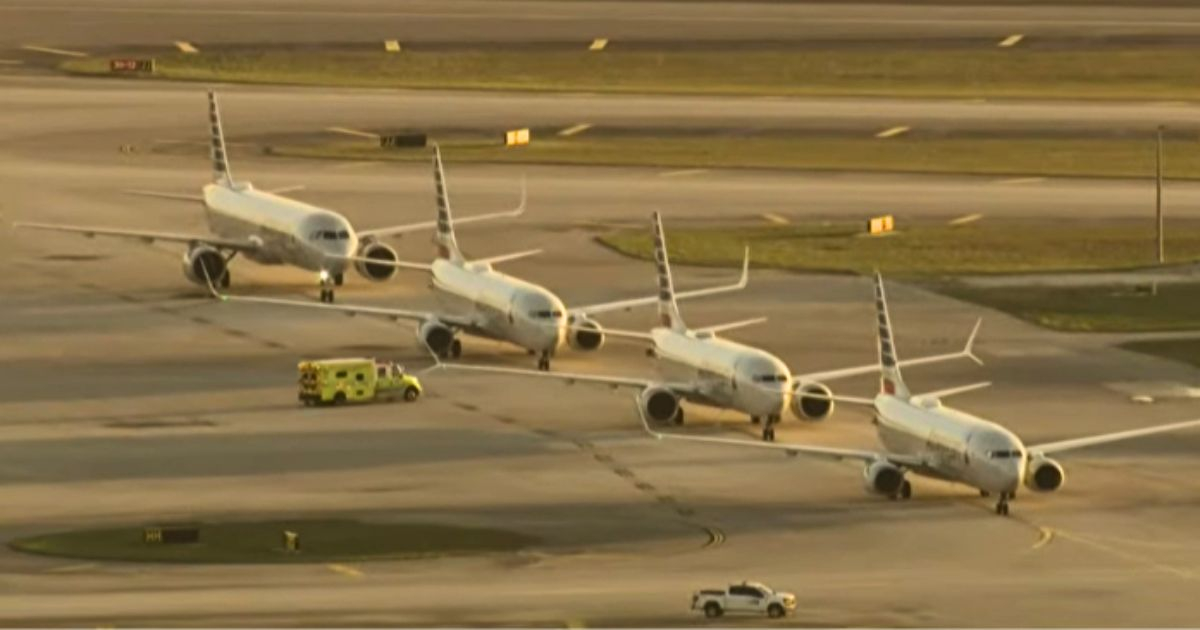
The Federal Aviation Administration (FAA) has lifted the nationwide grounding of flights in the United States after more than four and a half hours of disruption that left hundreds of thousands of passengers stranded and led to the cancellation of nearly 5,000 domestic flights across the country.
In a joint appearance at the White House press room, Transportation Secretary Sean Duffy and Homeland Security Secretary Markwayne Mullin addressed the incident, as reported by both El País and ABC News in their live coverage.
According to Duffy, instability in radar systems and communications at air traffic control centers nationwide was detected at 3:36 p.m. The root of the problem was an outdated technological system: "Our telecommunications are analog. Our switches and routers became overloaded processing data and ceased to function." Due to the "inconsistency" in the information from these systems, authorities opted to completely shut down the system.
Mullin ruled out a terrorist attack or cyberattack while leaving the investigation open: "It doesn't appear to be the case. It seems to be a mechanical issue. However, we are still investigating, so we won't rule it out." He reassured the public that "at no point was there any danger" and confirmed that President Donald Trump was briefed and that the government responded fully to the crisis.
Addressing comparisons with the September 11, 2001, attacks, Mullin emphasized: "This is not another 9/11—I cannot stress that enough. People are assuming that. This is a telecommunications disruption. This is very different." The Miami airport advised travelers to be patient and to confirm their flight status with airlines before heading to the terminals.
In South Florida, Miami International Airport reported 389 delays and 17 cancellations, while Fort Lauderdale-Hollywood saw 309 delays and 19 cancellations. Nationally, FlightAware logged approximately 7,000 delayed or canceled flights overall. At the FAA's request, Eurocontrol also suspended all flights destined for U.S. airports departing from its member states.
The incident highlighted the deterioration of the country's air infrastructure. Mullin warned that a complete system overhaul would cost around $50 billion and stated, "Patching does not work. We need a comprehensive system; we need someone to develop the system fully." A Government Accountability Office report published in September 2026 had already noted that 51 of the 138 FAA systems evaluated were unsustainable, with another 54 potentially so.
This marked only the third national ground stop in U.S. aviation history: the first occurred on September 11, 2001, and the second in January 2023, when the NOTAM system collapse resulted in nearly 9,000 delays in less than two hours.
For Cubans and Cuban-Americans, the U.S. air chaos compounded an ongoing crisis in Cuba, where ten of the island's airports have issued Jet A-1 fuel unavailability notices until December 1, 2026, leading to more than 1,700 accumulated flight cancellations throughout the year and at least 11 airlines suspending or reducing operations to the island.
Duffy acknowledged that a return to normalcy wouldn't be immediate but expressed optimism that the system would be operational in time for the Thanksgiving travel season: "We expect to see much better movement tomorrow."
(News in progress)
Understanding the U.S. Airspace Disruption
What caused the recent U.S. flight disruptions?
The disruptions were caused by instability in radar systems and communications due to an outdated technological system, leading to an overload of switches and routers.
Were the disruptions related to a terrorist attack?
Officials have ruled out a terrorist attack or cyberattack, stating that it appears to be a mechanical issue, although investigations are still ongoing.
How many flights were affected by the grounding?
Nearly 5,000 domestic flights were canceled, with approximately 7,000 flights delayed or canceled in total, according to FlightAware.