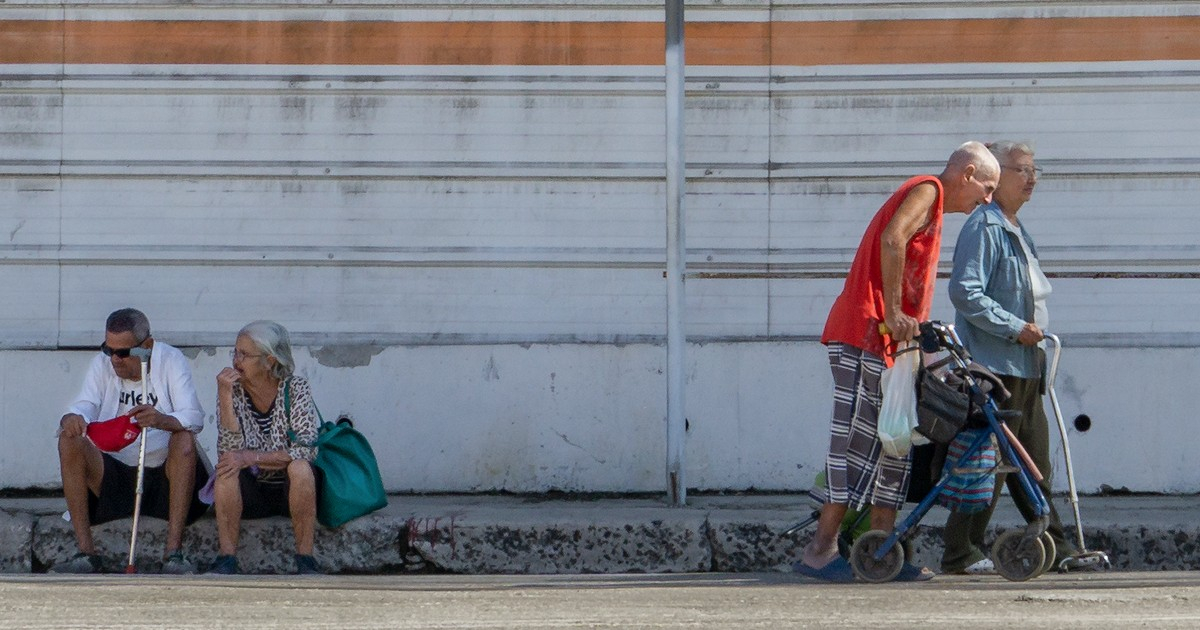
This past Friday, economist Pedro Monreal released a scathing critique of poverty and social welfare in Cuba, dismantling the regime's official statistics and advocating for a comprehensive restructuring of the system. His goal is to provide the most vulnerable with "a predictable income, enforceable rights, and dignity beyond relying on charity."
Monreal's report, titled "Cuba: Unclear Vulnerability, Inadequate Social Assistance, and Endless Misery," reveals a significant gap between three conflicting figures that lack official explanation. The regime acknowledges 883,436 individuals as vulnerable; the United Nations extends its 2026 Action Plan to two million; meanwhile, sociologist Dr. Mayra Espina estimates that 6.45 million Cubans—66% of the population—live in economic poverty.
In stark contrast, the state budget for social assistance in 2025 only supported 303,298 actual beneficiaries. Monreal, a respected economist with the Economic Commission for Latin America and the Caribbean (ECLAC), argues that this confusion is deliberate. "The government can declare 883,426 as vulnerable while only providing aid to 303,298 beneficiaries in 2025 without breaking any rules because the first number is a diagnostic, not a budgetary commitment. The latter is," he explains.
This distinction is crucial: being labeled "vulnerable" in Cuba means being listed for potential aid, with no guarantees. Being a "beneficiary" entails a recognized right with allocated funding. However, to qualify, three conditions must be met simultaneously: inability to work due to health or disability, insufficient income to cover basic needs, and lack of family support. Missing any of these criteria disqualifies one from assistance.
Social Protection Reliant on External Support
The analysis further illustrates that real social protection in Cuba comes not from the state but from family remittances and external humanitarian aid. The 2026 budget allocated 6,000 million pesos for social assistance, equivalent to only 6.6 million dollars at the informal exchange rate. Remittances, conservatively estimated at 1,000 million dollars, exceed this spending by over 140 times.
This protection is unevenly distributed: only 37% of Cuban households receive remittances, according to the Cuban Observatory of Human Rights, leaving 63% dependent on inadequate state aid.
Humanitarian assistance from the UN has benefited 1.7 million Cubans to date, which is 5.6 times more than the state's social assistance budget. The international community has pledged approximately 250 million dollars in in-kind humanitarian aid for 2026, compared to the Cuban state's 6.6 million.
Monreal draws a strong conclusion from this scenario: "Cuba's social protection no longer relies on its social assistance budget but on remittances and external humanitarian aid. When a state depends on donations to feed its vulnerable, the debate over labeling it a 'humanitarian crisis' becomes secondary: the problem exists, it's worsening, and the label doesn't solve it."
Call for Economic Transformation
The report's release follows Monreal's unusual political move in defending the rule of law as essential for any meaningful economic transformation in Cuba, as part of the "Cuba Transformation" project, developed with four other economists.
"Cuba doesn't need to choose between the market and social protection. It needs a state that ensures a baseline of protection as a right, funded by its own resources rather than donations, and an economy that generates the necessary income to maintain it," Monreal concludes.
Understanding Cuba's Economic Crisis
What does Pedro Monreal propose for Cuba's economic issues?
Pedro Monreal suggests a structural redesign of Cuba's social system to provide predictable income and enforceable rights to the vulnerable, moving away from reliance on charity.
Why does Monreal criticize the Cuban regime's statistics?
Monreal argues that the regime's statistics create confusion by differentiating between vulnerable individuals and actual beneficiaries, obscuring the true extent of support provided.
How does external aid factor into Cuba's social protection?
External aid, including family remittances and humanitarian assistance from the UN, plays a crucial role in supporting Cubans, as state assistance is insufficient and unevenly distributed.