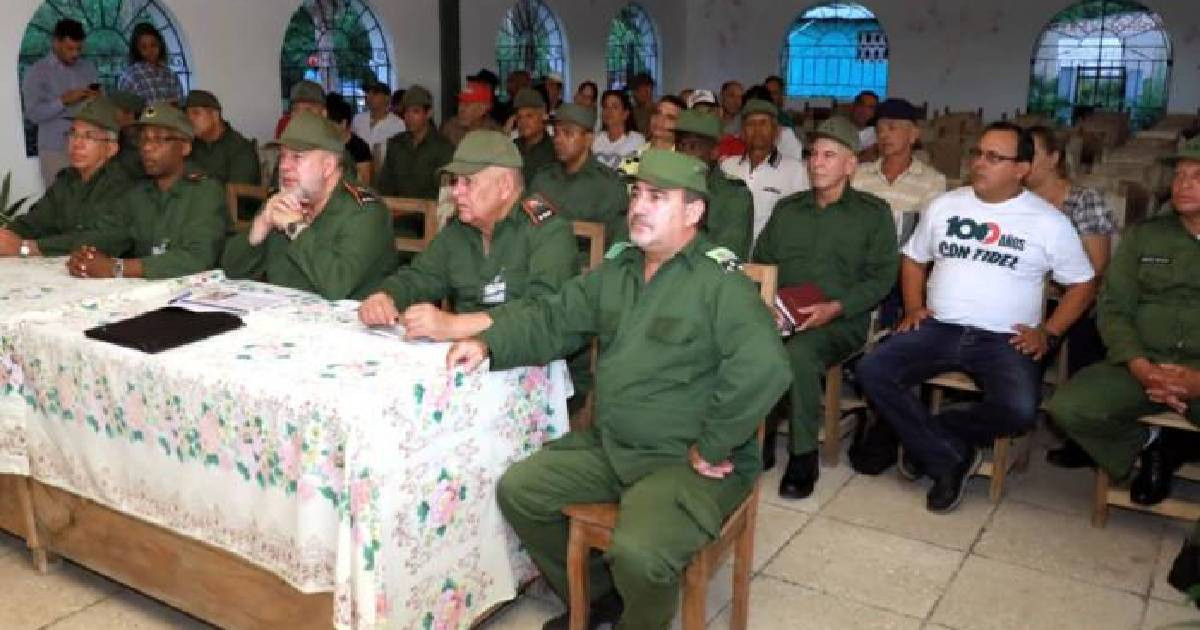
Cuban Prime Minister Manuel Marrero Cruz has called for an increase in local food production and emphasized the need to designate safe locations for relocating the elderly in case of emergencies, during an assessment of the economic, social, and defense capabilities of a region in Holguín.
The gathering took place in the Defense Zone of the San Rafael Popular Council, attended by First Colonel Luis de la Cruz Medina, head of the Holguín military region, along with key provincial and municipal authorities, as reported by the official newspaper Granma on Friday.
"The most reliable resources we will have to face any situation are those we can produce ourselves," Marrero stated. He also stressed the importance of accurately identifying locations to relocate elderly individuals and protecting vulnerable populations.
According to official reports, the area includes five population settlements and is equipped with water wells, two aqueducts, and cisterns to ensure water supply during exceptional circumstances. Additionally, solar panels are installed in homes, and charcoal production offers alternative energy sources.
The authorities highlighted measures such as road repairs, the opening of 24-hour advanced care clinics, a pharmacy, and school renovations. Marrero also urged progress in food production and the implementation of the 176 Economic and Social Transformations approved by the National Assembly of People's Power in June.
Marrero emphasized the necessity of safeguarding the most vulnerable members of the population, specifying the need to determine relocation sites for elderly people as part of the territory's emergency preparedness, according to the source.
This visit is part of the Prime Minister's tour of central and eastern Cuban territories to evaluate these strategies. Earlier in the week, he was in Camagüey, urging progress with objectivity and determination. He also led extraordinary sessions of the Provincial Councils in Guantánamo and Santiago de Cuba, where he demanded the elimination of bureaucratic obstacles.
The push for increased agricultural output is not new. In July, Marrero called for the cultivation of idle lands in Arroyo Naranjo, Havana, highlighting that "food is a key issue."
Nevertheless, Cuba currently imports between 70% and 80% of its consumed food, as domestic production of staples like rice dropped from 304,000 tons in 2018 to 111,000 in 2025.
In Holguín, provincial authorities acknowledged in September that 90,148 people, roughly one in ten residents, were in a vulnerable situation, reflecting the social challenges faced by the region despite official economic transformation programs.
In October, Marrero announced a monthly distribution of five pounds of rice, one pound of sugar, and one pound of grains for 883,000 vulnerable individuals as a temporary measure against food shortages.
Concluding his remarks in San Rafael, the Prime Minister urged working "with objectivity" and asserted that the reserves available in each territory would be what "saves lives" in the event of an emergency.
Key Concerns and Strategies in Holguín
What measures are being taken to ensure water supply in Holguín during emergencies?
The region is equipped with water wells, aqueducts, and cisterns to provide water in exceptional situations, ensuring a reliable supply during emergencies.
How is Cuba addressing its food import dependency?
Efforts are being made to boost local food production through initiatives like cultivating idle lands and implementing economic transformations to reduce reliance on imported food.
What challenges do vulnerable populations face in Holguín?
Approximately 90,148 people are in vulnerable situations, highlighting the social issues in the region despite efforts for economic transformation.