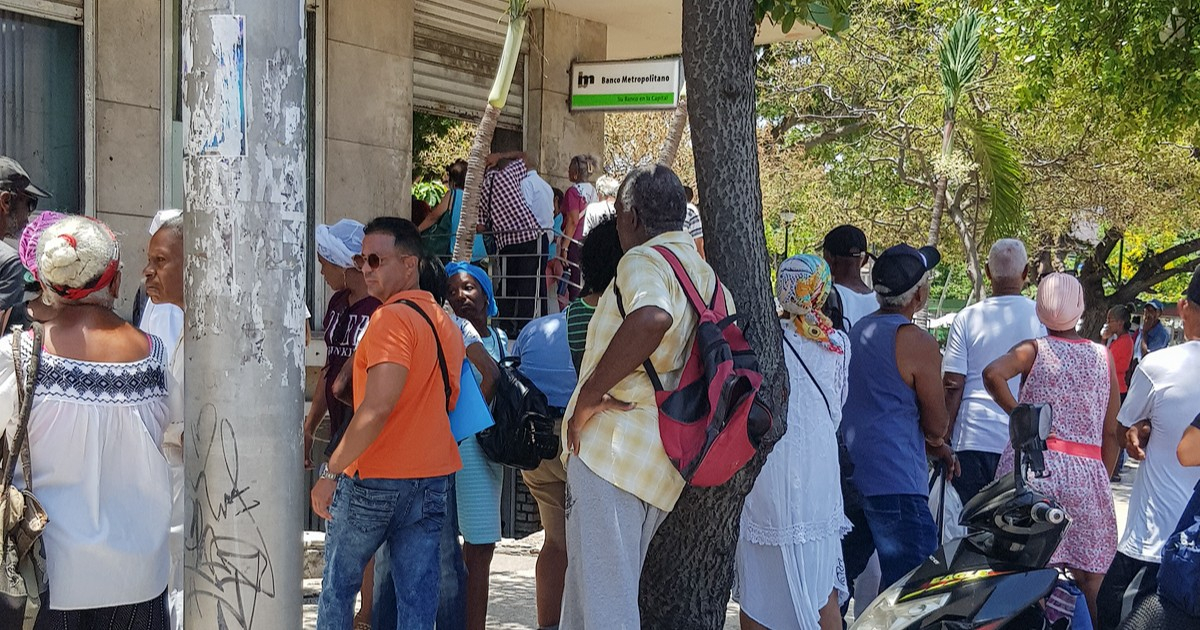
An educator from the University of Havana's Faculty of Communication shared her harrowing experience of trying to collect her salary at the bank, illustrating the monthly ordeal faced by millions of Cubans due to a failing banking system.
Iraida Calzadilla, a retired journalist from the official Granma newspaper and current university professor, took to Facebook to share a post titled "The Monthly Ordeal." In it, she recounted leaving her home at six in the morning, only to find herself still waiting in line five hours later, with a long queue ahead.
"Today, I have electricity and water at home, and I'm losing the chance to use these rare commodities because I have to be at the bank," Calzadilla lamented, highlighting the cruel irony of having to sacrifice two scarce resources—power and water—to fulfill a banking obligation.
The Endless Wait
Calzadilla described, "I left home at 6 a.m. and arrived in under 30 minutes, thanks to my proximity. It's now 11, and there's still a crowd ahead, suggesting I have a long way to go before reaching the teller." However, the wait was not her only grievance. She pointed out recurring issues at the bank counters: "Once again, there's the 'NO,' only half of what's due, limits on amounts, and even fake codes. And the arrogance of those with minor power is evident."
Critique of Banking Policies
The professor also criticized the official narrative regarding digitized payments: "The curse of the lie persists about the mandatory acceptance of transfers." She was candid about the inspectors tasked with enforcing compliance: "Everything is visible, everything verifiable, yet these supposedly reliable inspectors leave citizens completely defenseless." She concluded with a message to authorities: "Solution advocates: also make sure your solutions are being implemented."
Responses to her post indicated a shared plight. One commenter noted, "The bank situation is a disaster, and cash exchangers charge 30% on every corner." Another shared an experience of waiting two months to cash in with the "My Turn" system. Retirees and professors alike chimed in with their own tales of hardship and solidarity.
History of Public Complaints
This was not the first time Calzadilla publicly documented her struggles. In July, she spent eight grueling hours sitting on a curb outside the Ministry of Transport's bank, where retirees attempted to withdraw up to 5,000 Cuban pesos—less than nine dollars at the informal exchange rate—in a facility lacking proper infrastructure.
On that occasion, she described the experience as "eight divine, hot, overwhelming, and frustrating hours," concluding that "many voices have denounced these terror-filled days without any real solutions."
Roots of the Banking Crisis
Calzadilla's complaints carry weight as they come not from a dissident but from a veteran of official journalism. In July, she also publicly challenged the government with a question that resonated widely: "Who dares to demand more creative resistance from me when basic and not-so-basic needs are unmet?"
The banking crisis she describes has deep-seated causes. The mandatory digital payment policy, introduced in August 2023, expanded electronic transactions in a country where the banking infrastructure couldn't ensure cash access. By November 2026, over 60% of Havana's ATMs were out of service.
As of July, only 3.77% of transactions were digital, while the cash shortage fueled an informal market with conversion fees between 35% and 50% for turning transfers into physical money.
More than 1.7 million Cuban retirees rely on this broken system for their monthly pensions, and educators are similarly affected; in Camagüey, at least two months of back pay were reported for teachers last September.
Understanding Cuba's Banking Woes
Why is the banking system in Cuba struggling?
Cuba's banking system struggles due to a combination of inadequate infrastructure, mandatory digital payment policies, and cash shortages that have plagued the country since the introduction of electronic transactions.
What percentage of transactions in Cuba are digital?
As of July, only 3.77% of transactions in Cuba were conducted digitally, indicating the challenges in transitioning to electronic payment methods.
How are Cuban retirees affected by the banking crisis?
Cuban retirees, numbering over 1.7 million, depend on a fractured banking system to receive their pensions, often facing delays and difficulties in accessing their funds.