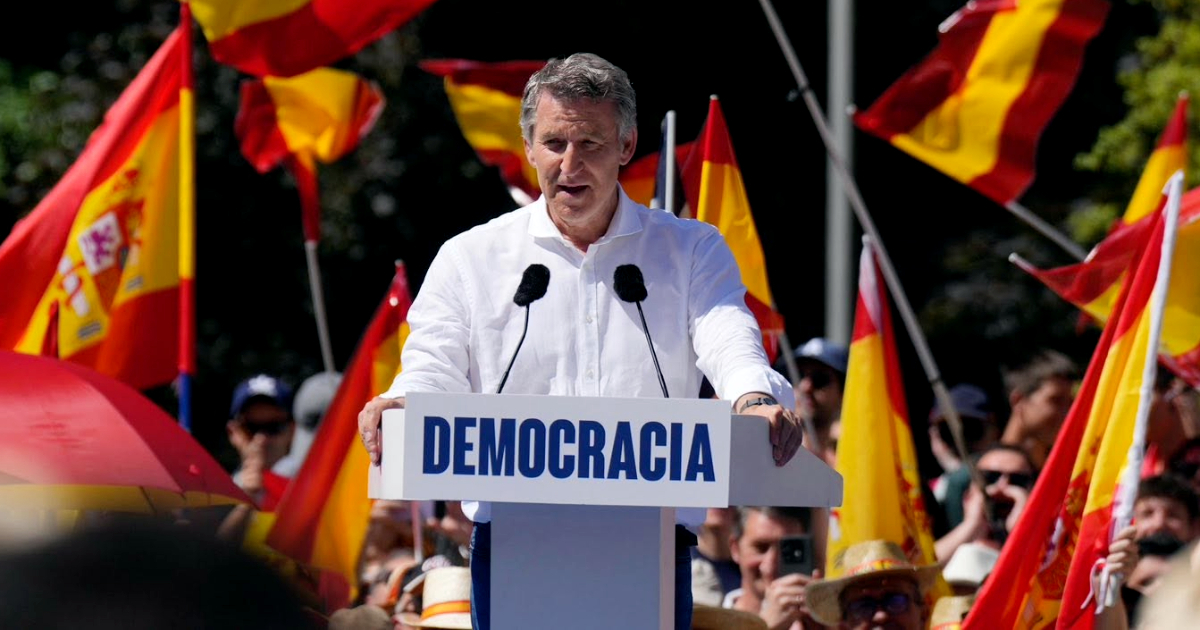
With the general elections just around the corner on November 29, the Popular Party (PP), led by Alberto Núñez Feijóo, has unveiled its electoral manifesto titled "National Reconstruction." This 82-page document outlines 249 proposals that would significantly alter the residency and citizenship conditions for over 287,000 Cubans registered in Spain.
According to an analysis by Infomigrante, the immigration section of the manifesto impacts four key areas that are crucial to the Cuban community: residency through arraigo, renewal of residency permits, citizenship, and the Grandchildren’s Law. These are electoral proposals, not current laws, and their implementation would depend on the PP forming a government and passing constitutional and European scrutiny.
Residency Through Arraigo: A Limited Option
Point 42 of the manifesto indicates a ban on "massive and indiscriminate regularizations by law," with arraigo being designated as an "exceptional" pathway. It is redefined as an "individual exceptional acknowledgment, not a generalized form of regularization."
Back in June 2026, the Ministry of Inclusion highlighted that family-based arraigo accounted for 45% of current authorizations, while social-labor-based arraigo made up 33%. However, specific data for Cubans is not provided.
The document does not specify which arraigo modalities would be maintained or eliminated, nor does it provide new timelines or clarify the fate of pending applications. It also does not explicitly state that previously granted authorizations would be revoked.
Point 98 adds that certain aid will prioritize those with a "real, long-lasting, and verifiable connection"—such as proof of registration, contributions, and residency duration—rather than relying "solely on nationality."
Residency Renewal and Points-Based Visas
According to Point 43, foreigners seeking to renew their temporary residency under the general regime would need to sign an integration commitment. This would include learning Spanish, understanding the Constitution and European Union values, and, where applicable, receiving employment training.
Compliance would need to be documented for permit renewal. This measure is not proposed for all foreign residents in Spain, but specifically targets those renewing temporary residency under the general regime.
The manifesto also suggests implementing points-based visas and annual quotas to regulate the entry of foreign workers. These would be adjusted based on unemployment rates, unfilled job positions, and the capacity of public services, offering two paths: a signed contract from abroad or a temporary visa to seek employment in Spain.
Stricter Citizenship Requirements
Points 140 to 143 introduce a new Nationality Law aimed at ensuring citizenship reflects an "effective connection with Spain" and is not "almost automatically granted over time." In July, Feijóo noted, "A passport must be earned."
Enhanced requirements would include legal and continuous residency, knowledge of Spanish and its institutions, good civic behavior, no criminal record, and fulfillment of tax obligations.
The manifesto does not specify new residency durations but maintains "preferential treatment for Hispanic countries." It also proposes regulating the loss of nationality for non-native Spaniards with firm convictions for serious crimes, while avoiding statelessness.
The Grandchildren’s Law: The Biggest Uncertainty
The most sensitive issue for Cubans is the potential repeal of the Democratic Memory Law, which the PP aims to replace with a Concord Law. The "Grandchildren’s Law" is the eighth additional provision of this legislation.
As of mid-2026, the Spanish Consulate in Havana had over 137,700 pending applications, with estimates suggesting between 300,000 and 350,000 Cubans have initiated procedures since October 2022.
Should the PP repeal the law, the fate of these applications would depend on transitional provisions of the new law: they would not be automatically canceled, but legal uncertainty is a real concern. The manifesto does not clarify what would happen to ongoing procedures. For those who have already been granted nationality, there is no proposal for revocation.
The Supreme Court rejected on November 9 to extend the provisional suspension of voting rights to adult children of those nationalized under the Grandchildren’s Law. However, on November 11, it admitted an appeal filed by Iustitia Europa against this decision, allowing until November 15 for arguments to be presented.
The controversy potentially affects a group of 189,678 individuals registered as Spaniards through Annex III, including descendants of beneficiaries of the 2007 legislation. Nonetheless, it is unknown how many are part of the overseas electoral census and could be affected by the voting suspension.
Polls currently favor the PP for the upcoming elections on November 29. A survey by 40dB., published on November 13 by EL PAÍS and Cadena SER, predicts that the PP and Vox together would secure 190 seats, 14 more than the 176 required for an absolute majority in the Congress of Deputies.
Impact on Cubans in Spain with PP's Proposed Changes
What is the main change proposed for residency through arraigo?
The PP proposes making arraigo an "exceptional" individual acknowledgment rather than a generalized regularization pathway, potentially limiting access.
How would citizenship requirements change under the PP's plan?
Citizenship would require demonstrating a "real connection" with Spain, reinforced by legal residency, language proficiency, civic behavior, and tax compliance.
What is the Grandchildren’s Law and its significance for Cubans?
The Grandchildren’s Law is part of the Democratic Memory Law, allowing descendants of Spaniards to claim Spanish nationality. Its repeal could create legal uncertainty for pending applications from Cubans.