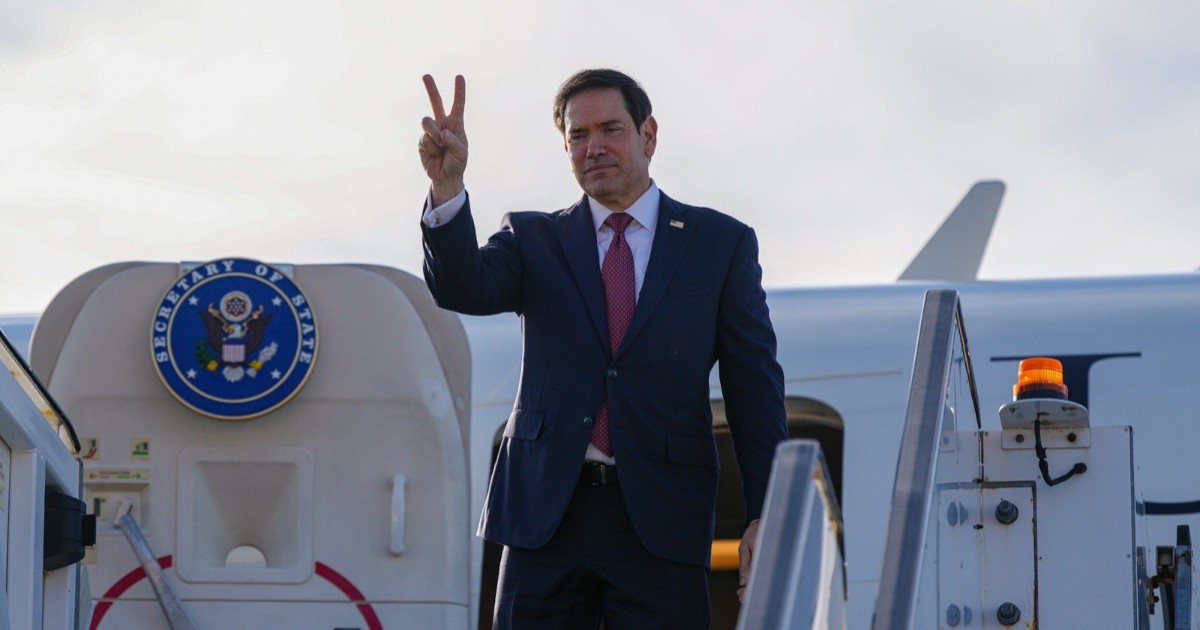
An investigation conducted by The Washington Post has brought to light that Secretary of State Marco Rubio utilized government aircraft, amounting to over $1.2 million, to attend University of Florida football games where his son plays.
The report, authored by journalists Noah White and Rick Maese, reveals that since taking office in January 2025, Rubio has made at least 23 trips to Gainesville, home of the university, and attended at least ten Florida Gators games over the past two seasons.
According to the State Department, 15 of these trips were deemed "exclusively personal," costing approximately $770,600. An additional seven trips combined personal and official duties, adding around $443,900. The primary aircraft used were Gulfstream C-37A and C-37B, billed at about $9,100 per hour, though a Boeing C-32A was used for three trips, at a rate of around $18,600 per hour.
Federal regulations prevent the Secretary of State from using commercial airlines due to security concerns, similar rules apply to the Secretary of Defense and the directors of the FBI and CIA. The law only requires reimbursement equivalent to a coach-class ticket, a minimal fraction of the actual cost. The Post estimated this reimbursement to be around $18,000 for strictly personal travel, merely 1.5% of the total expense. Neither Rubio nor the State Department disclosed the actual amount paid.
A government ethics expert consulted by the newspaper noted that while the trips "comply with federal rules," they "raise questions about the management of public funds." Former State Department officials told the Post that Rubio's personal travel significantly exceeds that of his predecessors.
The most notable incident happened on October 31, when Rubio utilized his attendance at the G20 foreign ministers' meeting in Atlanta to bring several counterparts to the Florida-Georgia game at the Mercedes-Benz Stadium, where Georgia triumphed 27-8. Guests included representatives from Argentina, Mexico, Australia, the United Kingdom, India, the European Union, and Poland.
Anthony Rubio, the Secretary of State's son, has been a running back for the Florida Gators since 2023, although his playing time has been limited; over four seasons, he has played in just four games.
Rubio, who graduated from the University of Florida in 1993 and has been an avid Gators fan long before his son joined the team, staunchly defended his travels: "I have attended and will continue to try to make it to as many events that are personally and family important to me as possible," he told the Post.
The official response was swift. Dylan Johnson, Under Secretary of State for Global Public Affairs, dismissed the report as "stupid" on social media platform X, arguing that "the Post's own article cites experts saying this is not news and there's nothing here."
The defense of the State Department was echoed by Rubio's allies. Former White House Press Secretary Karoline Leavitt wrote on X: "The Washington Post confirms that Secretary Rubio is a great father."
Rubio is considered a potential Republican contender for the presidency in 2028, adding a political dimension to the controversy regarding his use of public funds for personal travel.
Questions About Rubio's Travel Controversy
What is the main issue with Marco Rubio's travel expenses?
The main issue is that Secretary of State Marco Rubio used government aircraft for personal travel to attend his son's football games, costing over $1.2 million, which has raised questions about the management of public funds.
How does the federal regulation impact the reimbursement for Rubio's travels?
Federal regulation permits the Secretary of State to avoid commercial flights for security reasons, with reimbursement only required for the cost of a coach-class ticket, leading to minimal repayment compared to the actual travel expenses.
Why does Rubio's travel controversy have political implications?
The controversy carries political weight as Rubio is a potential Republican candidate for the 2028 presidential election, making the scrutiny over his use of public funds significant in the political arena.