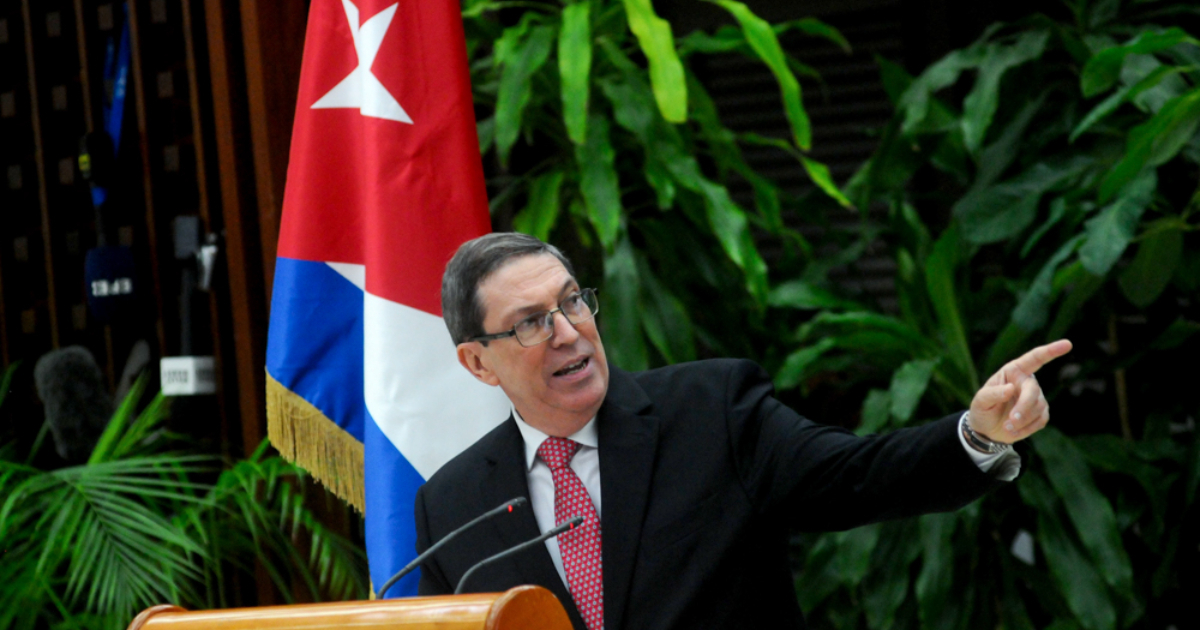
Cuban Foreign Minister Bruno Rodríguez Parrilla issued a response on Thursday via social media platform X to the joint statement released by the G7 foreign ministers following their meeting in Paris.
In his post, Rodríguez criticized the statement, asserting that it "ignores the harsh reality of the cruel impact of the blockade, economic warfare, and energy siege imposed by the United States government on Cuba, which constitutes a blatant, massive, and systematic violation of the human rights of the Cuban people and infringes upon the sovereignty of third-party states."
Rodríguez described U.S. policy as "genocidal" and accused the G7 of "echoing false narratives fabricated by Washington to justify the criminal blockade." He also reminded that the United Nations General Assembly recently condemned this policy.
The foreign minister's remarks came while he was on an official visit to China as a special envoy of the Cuban Communist Party and government, accompanied by Deputy Prime Minister Óscar Pérez-Oliva Fraga and Cuban Ambassador to Beijing, Alberto Blanco.
On Wednesday, Rodríguez held discussions with Chinese Foreign Minister Wang Yi, who assured that China would support Cuba "regardless of how circumstances evolve" in the face of sanctions and external interference.
G7's Stance on Cuba's Situation
The G7's statement, which prompted the Cuban regime's reaction, was issued on Wednesday after the foreign ministers' meeting held in Paris on November 9-10, under France's presidency of the group. The declaration was endorsed by the United States, Canada, France, Germany, Italy, Japan, the United Kingdom, and the European Union.
The document expressed concern over "the deep economic crisis and humanitarian needs faced by the Cuban people, including shortages of food, fuel, and medicines."
The foreign ministers urged Cuban authorities to "advance and implement significant and substantial political and economic reforms to promote prosperity, respect for human rights, and the fulfillment of the Cuban people's legitimate aspirations."
The statement also called for "concrete steps toward multiparty democratic governance, freedom of the press, and freedoms of expression and association," and demanded "the release of all individuals arbitrarily detained."
Notably, the declaration did not use the term "blockade" nor did it explicitly attribute the Cuban crisis to Washington's policies, instead encouraging a "constructive and inclusive dialogue to find a way out of the crisis."
FAQs on G7's Statements and Cuba's Response
What was Bruno Rodríguez's main criticism of the G7 statement?
Bruno Rodríguez criticized the G7 for overlooking the severe impact of the U.S. blockade and economic warfare on Cuba, which he claims is a violation of human rights.
How did the G7 address the situation in Cuba?
The G7 expressed concern about Cuba's economic crisis and humanitarian needs, urging the government to implement significant reforms and advocating for multiparty democratic governance and freedom of expression.
Did the G7 statement mention the U.S. blockade on Cuba?
No, the G7 statement did not use the term "blockade" nor did it directly link Cuba's crisis to U.S. policies, instead promoting dialogue to resolve the crisis.